
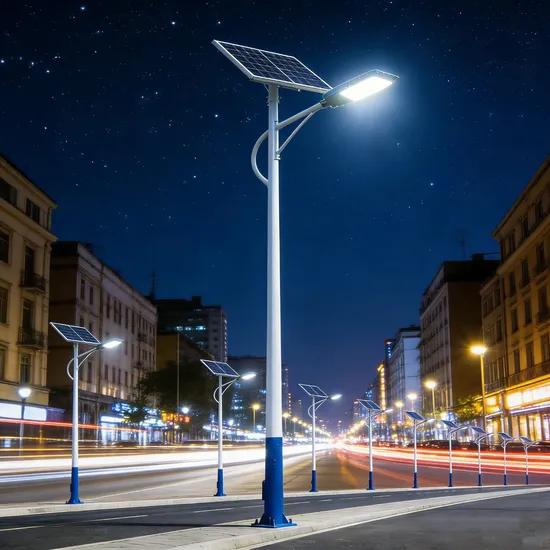
The commercial lighting market changes rapidly, and solar street lights no longer function as simple, standalone fixtures. In 2026, these systems operate as intelligent, cloud-connected assets that combine high-efficiency solar harvesting, advanced energy storage, and AI-driven power management.
Whether you manage municipal roads, expand a corporate business park, or upgrade an industrial facility, investing in the right technology directly impacts your long-term return on investment (ROI). Cheap, poorly engineered alternatives fail within months under harsh weather, whereas professional-grade systems deliver grid-free reliability for decades.
To help you navigate the procurement process, this comprehensive buyer’s guide outlines exactly what you must look for when choosing the best solar street lights for your project this year.
1. Battery Chemistry and Autonomy Rates
The battery serves as the heart of any off-grid lighting system. In 2026, smart buyers entirely avoid older lithium-ion or lead-acid chemistries due to their short lifespans and poor thermal management.
Instead, look strictly for Lithium Iron Phosphate ($LiFePO_4$) batteries. These advanced cells offer several critical advantages:
- Extended Lifespan: They provide over 2,000 to 3,000 charge cycles, which equates to roughly 5 to 8 years of dependable, maintenance-free service.
- Thermal Resilience: They handle extreme climate fluctuations—from freezing winter nights to blistering summer heatwaves—without degrading or posing safety risks.
- High Autonomy Days: Premium solar lighting range solutions feature a minimum of 3 to 5 days of battery autonomy. This means the system stores enough reserve power to run flawlessly through consecutive days of heavy rain, thick cloud cover, or storms.
2. Solar Panel Efficiency (Monocrystalline vs. N-Type TOPCon)
The solar panel dictates how fast and how well your system recharges during short winter days. Never settle for outdated polycrystalline panels, which offer poor conversion efficiency.
For maximum power generation in 2026, prioritize Monocrystalline or cutting-edge N-type TOPCon silicon cells. These panels deliver conversion efficiencies above 22% to 24%. High conversion efficiency means the panel generates substantial power even in low-light or overcast conditions.
Additionally, consider the physical design of the fixture. If your project demands fast, hassle-free installation with minimal labor, look for an All-in-One (Integrated) solar street light, which mounts the panel, battery, and light source onto a single chassis. For high-wind zones or heavy highway applications, choose a Split Solar Design, which lets you angle a larger, independent panel toward true north for maximum solar absorption.
3. Intelligent MPPT Controllers and AI Dimming
Older solar units operate on simple timers that quickly drain the battery on cloudy days. Modern solar street lighting systems use Maximum Power Point Tracking (MPPT) controllers combined with smart sensors to optimize power consumption.
When evaluating controllers, check for these capabilities:
- Adaptive Lighting Profiles: The controller uses real-time algorithms to monitor available battery reserve and adjust brightness levels dynamically. If the battery is low after three days of rain, the system dims slightly to preserve core functionality through the night rather than shutting down completely.
- PIR Motion Sensors: To save massive amounts of energy, the light drops to a 30% ambient glow when the street is empty. The moment the sensor detects a pedestrian or oncoming vehicle, it instantly ramps up to 100% brightness.
4. Optical Design, Lumens, and Chip-on-Board (COB) Tech
Do not judge a light solely by its wattage. In 2026, professional lighting designers evaluate fixtures based on lumen output and optical distribution.
High-performance fixtures utilize specialized asymmetric lenses that direct light downward and outward across the road surface. This specific distribution pattern prevents glare for drivers and eliminates dark patches between poles.
Look for manufacturers utilizing unique Chip-on-Board (COB) technology. COB LEDs bundle multiple chips tightly together to deliver a dense, highly efficient beam that maximizes contrast on the road. This makes it much easier for drivers to spot hazards, ensuring your public road and pathway lighting projects strictly comply with local safety standards.
5. Rugged Build Quality and Environmental Ratings
Australia features some of the harshest environmental conditions on earth. From salty coastal air to driving rain and flying debris, your fixtures must feature heavy-duty structural engineering to survive.
- Ingress Protection (IP) Rating: Look for a minimum rating of IP65, though IP66 or IP67 is highly preferred for coastal or heavy-rain environments. This ensures dust, moisture, and powerful water jets cannot penetrate the internal electronics.
- Housing Material: Avoid cheap ABS plastic housings, which crack and degrade rapidly under intense UV exposure. Demand marine-grade, die-cast aluminium bodies paired with anti-corrosion coatings to guarantee structural integrity.
- Impact Resistance: Ensure the fixture carries an IK08 or IK09 impact rating so it easily withstands hailstones, falling branches, or vandalism.
Why Local Support and Lighting Design Matter
Investing in commercial-grade solar infrastructure requires careful planning. If you guess the pole spacing or lumen requirements, you risk building an unsafe layout or overspending on unnecessary equipment.
By partnering with an established provider, you gain access to comprehensive engineering support. High-quality suppliers do not just ship boxes; they provide tailormade layout simulations to verify that your system delivers the exact foot-candles or lux levels required for your specific property. Ensure your chosen vendor offers robust warranties (minimum 3 to 5 years) backed by local, accessible technical support to protect your municipal or commercial and industrial lighting investment.
Summary
When buying solar street lights in 2026, look beyond the price tag and focus on technical specifications. Prioritize $LiFePO_4$ batteries, high-efficiency monocrystalline panels, intelligent MPPT controllers, and rugged aluminium housings.
If you are currently mapping out a commercial development, parking lot upgrade, or municipal roadway project, we can help you eliminate the guesswork. Contact the engineering team at Sonaray today to book an expert consultation and lighting design layout, and let us build a durable, energy-independent lighting plan tailored to your property’s exact needs.
Are you preparing to present this specific solar street light guide to a client or municipal board, or are you focused strictly on building out the blog’s SEO visibility?