
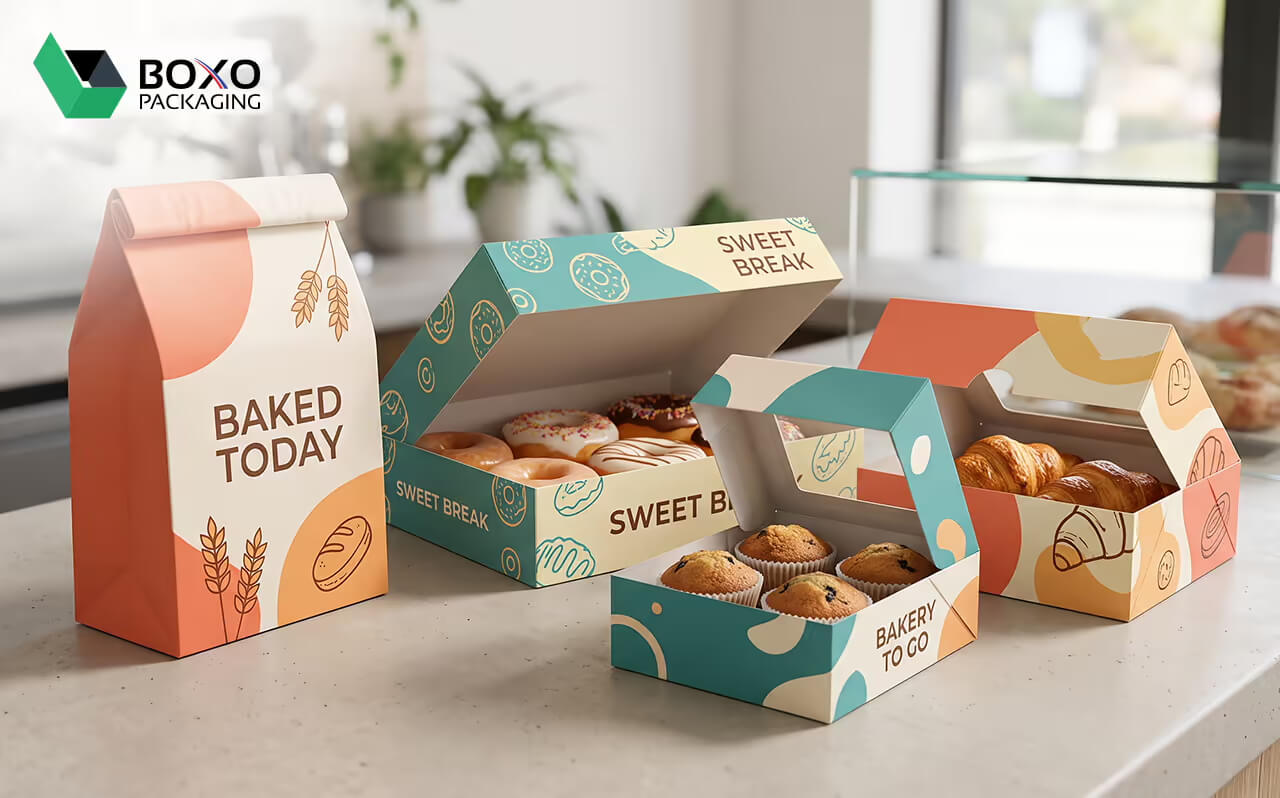
A box is often the last thing a customer sees before the first bite. Custom bakery boxes keep cakes, pastries and cookies intact while showing off your brand on the way home. This guide covers the main styles, materials and cost factors so you can brief a supplier clearly.
Which Box Styles Suit Which Bakes
The right style depends on what you sell and how far it travels. Four formats cover most requests:
- Window boxes: a die cut opening lets shoppers see the product, ideal for cookies, donuts and macarons.
- Cake boxes: a sturdy, often square carton with a reinforced base for tiered or iced cakes.
- Gable boxes: a carry handle design that suits cupcakes, slices and party favours.
- Pastry trays with lids: shallow and wide, which stops delicate items stacking on each other.
Pick the style around the most fragile item on your menu, then adapt it for the rest.
Materials and Board Weights
Most bakery boxes use folding carton board of around 300 to 400 GSM, either white SBS or kraft. White board gives sharper colour, while kraft gives a natural, handmade look.
Heavier items such as large cakes need a thicker base. E flute corrugated board adds rigidity and keeps the box flat when carried with one hand.
Food safety matters here. Ask your supplier for board suitable for direct food contact and confirm it meets UK food contact rules. Greaseproof liners or coated board help with buttery or cream filled items.
At Boxo Packaging, we usually ask for the weight of the heaviest product, the delivery method and whether items are served warm or cold before suggesting a board grade.
Windows, Liners and Inserts
A window sells the product, but plastic film must be separated before recycling. A paper window film or an open cut out is easier to dispose of, though it protects less.
Inserts keep cupcakes and macarons from sliding. Card inserts are easy to recycle, while foam is better avoided.
Cost Factors and Sustainability
Order quantity has the biggest effect on price, since setup and tooling are spread across more units. Size, board grade, print colours and finishing then add to the total, and a new cutting die is a one off charge.
For a lower footprint, look for FSC certified board and water based inks. Avoid claiming a box is “fully green”, as every material has some footprint. Grease coatings can also affect recyclability, so check with your supplier.
Ordering Tips Before You Commit
Request a physical sample and fill it with real products. Check that the base holds, the lid closes cleanly and nothing slides when the box is tilted.
Allow extra lead time, since production and freight can take several weeks. A reliable supplier will question your specification rather than simply accept it. That is how we work at Boxo Packaging, because fixing a problem early costs far less than a reprint.
Customised Packaging Wholesale: A Practical Guide for Growing Brands
Buying in bulk can lower your cost per unit, but it also raises the stakes if something goes wrong. Customised packaging wholesale works best when you know your specification before you order. This guide covers the main formats, materials and cost factors so you can brief a supplier clearly.
What Does Wholesale Packaging Mean?
Wholesale packaging means ordering printed or sized boxes in large quantities, usually directly from a manufacturer. The unit price falls as volume rises, because setup and tooling costs are spread across more pieces.
Minimum order quantities vary by box style and print method. Digital printing often allows smaller runs, while offset and flexographic printing suit larger ones.
Popular Formats for Bulk Orders
The right format depends on your product and sales channel. Four options cover most requests:
- Mailer boxes: self locking corrugated boxes for ecommerce orders.
- Folding cartons: lightweight, flat packed boxes for cosmetics, supplements and food.
- Rigid boxes: thick, premium boxes for gifts and luxury goods, though they take more storage space.
- Shipping cartons: plain corrugated boxes for heavier parcels.
Choose the format that suits your most common order, then adapt it for other products.
Materials and Board Weights
Folding cartons usually use board of 300 to 400 GSM. Corrugated boxes use E flute for rigidity or B flute for extra cushioning, with double wall board for heavy loads.
For food contact, ask your supplier for board suitable for direct use and confirm it meets UK food contact rules.
At Boxo Packaging, we usually ask for product weight, dimensions and shipping route before suggesting a board grade, because these details decide strength far more than appearance does.
Pricing and Storage Factors
Quantity has the biggest effect on price, followed by board grade, size, print colours and finishing. A new cutting die is a one off charge, so reordering an existing design costs less.
Bulk orders also need warehouse space. Flat packed boxes save room, but rigid boxes arrive assembled and take much more. Ask for quotes at two or three quantities to see where the price drops.
Sustainability Choices
Look for FSC certified board, water based inks and single material designs that recycle more easily. Avoid claiming a box is “fully green”, as every material has some footprint.
Heavy lamination and plastic windows can complicate recycling, so weigh the look against disposal.
Ordering Tips Before You Commit
Request a physical sample and test it with your real product before approving a large run. Check the dieline proof, drop test a packed box and allow extra lead time, since production and freight can take several weeks.
A reliable supplier will question your specification rather than simply accept it. That is how we work at Boxo Packaging, because fixing a problem early costs far less than a reprint.