
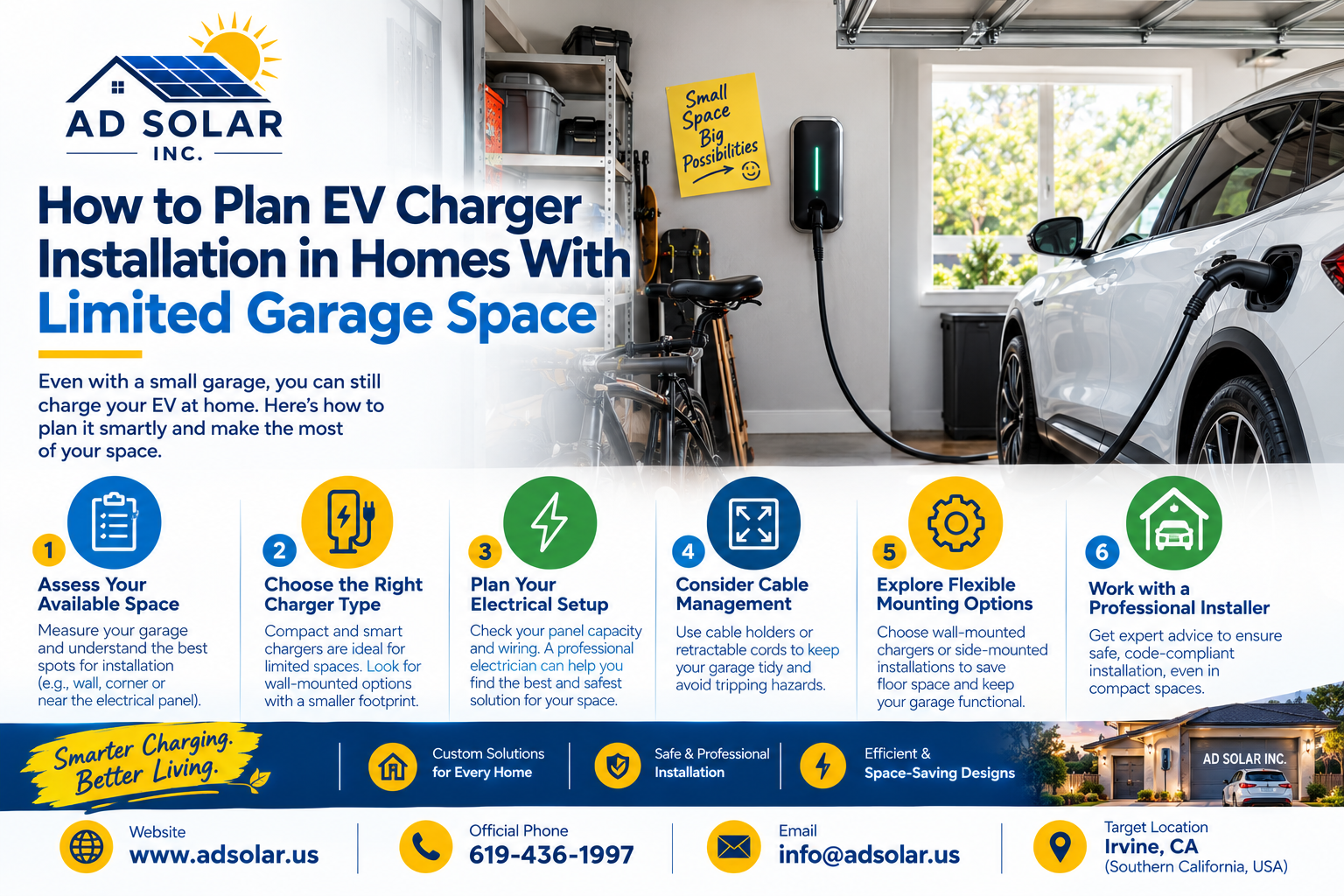
Limited garage space does not necessarily mean a homeowner has to give up on convenient home charging. With thoughtful planning, EV charger installation can be arranged to suit different parking layouts, vehicle sizes, and household electrical needs. The key is to consider how the garage is used before choosing the charging equipment or deciding where it should be installed.
In many homes, the garage serves more than one purpose. It may hold vehicles, bicycles, storage shelves, gardening equipment, and tools. Adding a charging station without considering these existing uses can make parking awkward or leave charging cables in inconvenient places.
A better approach is to review the available space, understand the vehicle’s charging requirements, and discuss suitable installation options with a qualified professional. This guide explains what homeowners should consider when planning EV charging in a compact garage or a property with limited parking space.
1. Review Your Garage Layout Before Choosing a Charger
The first step is to understand how much usable space is available. Measure the parking area and consider where the vehicle sits when parked normally. Look at the distance between the vehicle’s charging port, the walls, the garage door, and nearby storage.
The charging port’s location matters because different vehicles have ports in different positions. A charger installed in an inconvenient location may require the cable to stretch across a walking path or around the vehicle.
Before selecting a wall-mounted charging unit, consider:
- Where the vehicle’s charging port is located.
- Whether the vehicle can park in its usual position.
- How much space remains for people to walk safely.
- Whether doors, cabinets, or the garage door could interfere with the equipment.
- Where bicycles, bins, tools, and other stored items are kept.
A simple sketch of the garage can help you explain the layout to an installer. Include the vehicle’s approximate parking position and any fixed obstacles. This gives the professional a clearer starting point for assessing possible charger locations.
2. Choose a Location That Keeps Parking Practical
In a small garage, the best charger location is not necessarily the closest available wall. It should allow the vehicle to connect comfortably while keeping the cable away from areas where people walk or move objects.
A wall near the vehicle’s charging port may be practical, but the final position depends on the garage layout, cable reach, electrical routing, and manufacturer requirements.
Avoid choosing a location based only on appearance. A neat installation should also allow the charger to be used without repeatedly moving storage items or repositioning the vehicle.
Discuss these points during the site assessment:
- Can the cable reach the charging port without excessive tension?
- Can the vehicle be parked without hitting the charger?
- Is the unit protected from likely impacts?
- Can the cable be stored safely when not in use?
- Will the proposed position leave access to electrical equipment and other important areas?
A qualified installer can assess mounting surfaces, clearances, cable management, and electrical routing before recommending a final position.
3. Compare Wall-Mounted and Portable Charging Options
The appropriate charging setup depends on your vehicle, daily driving, electrical system, and available space.
A wall-mounted charging unit may be useful when a household wants a dedicated charging location. It can reduce the need to store a separate charging unit after every use, although the cable still needs to be managed carefully.
Some electric vehicles also come with portable charging equipment. Its suitability for regular home use depends on the equipment specifications and the available electrical supply. Homeowners should not assume that every household outlet is suitable for frequent vehicle charging.
When comparing options, consider the following:
Wall-mounted charging equipment: May offer a consistent location and convenient cable storage when properly planned.
Portable charging equipment: May offer flexibility, but homeowners need to follow the equipment’s instructions and confirm that the intended electrical outlet and circuit are suitable.
Charging speed: The charging rate depends on the charger, the vehicle’s onboard charging capability, and the electrical supply.
Do not select equipment solely because it is compact. Check its compatibility, installation requirements, cable length, and operating instructions before making a decision.
4. Plan Cable Management to Avoid Clutter
Cable management deserves particular attention when garage space is limited. A cable left across a walking route can create a tripping hazard, while a cable stretched tightly around a vehicle may be damaged over time.
Ask the installer how the charging cable will be stored when it is not in use. Depending on the equipment, an appropriate holder or cable-management accessory may help keep the area organized.
The cable should reach the vehicle without being pinched by a door, trapped under a tire, or pulled around sharp edges. Keep connectors away from locations where they may be struck by tools, storage boxes, or vehicle doors.
It is also important not to improvise an extension arrangement unless the equipment manufacturer and a qualified professional confirm that the specific setup is permitted and safe. Follow the charger’s instructions and use only compatible accessories.
A little planning can make daily charging easier while keeping the garage usable for its other purposes.
5. Check Electrical Capacity Before Installation
Space planning is only one part of the project. Before installing a charging unit, a qualified professional should assess the home’s electrical system and determine whether it can support the proposed equipment.
The review may include the electrical panel, existing household loads, circuit requirements, wiring route, and charger specifications. If the home already has several high-demand appliances, the installer may need to evaluate how the additional load fits into the overall electrical setup.
Some properties may be suitable for the proposed charger with limited additional work. Others may require electrical modifications. The answer depends on the existing installation and the equipment being considered.
Ask for a written estimate that explains:
- The proposed charging equipment.
- The electrical work required.
- Any panel or circuit modifications.
- Permit and inspection responsibilities, where applicable.
- Testing and handover arrangements.
- Any work that is excluded from the estimate.
Understanding these details before work begins can help homeowners compare proposals fairly and avoid choosing a charger that does not fit their electrical system.
6. Consider Outdoor or Driveway Charging When the Garage Is Too Small
Some homes have narrow garages, while others use the garage for storage and park vehicles in the driveway. In these situations, an outdoor installation may be worth discussing with a qualified installer.
However, moving the charger outside introduces additional considerations. The equipment must be suitable for its intended environment, and its installation must follow the manufacturer’s instructions and applicable requirements.
Think about where the vehicle usually parks, whether the cable can reach safely, and whether the charger would obstruct a walkway or driveway access. The location should also be assessed for exposure to weather, potential vehicle impact, and access by children or visitors.
Do not assume that a charger designed for indoor use is automatically appropriate outdoors. Confirm the equipment’s environmental rating and installation instructions before selecting an exterior location.
Homeowners should also consider how they will connect and disconnect the vehicle during everyday use. A technically possible location may still be inconvenient if it creates a regular obstacle around the entrance or parking area.
7. Think About Future Solar and Energy Needs
A charging setup should work for your current routine while leaving room to consider future energy plans. Some homeowners may later explore rooftop solar, battery storage, or other electrical upgrades.
If solar is already installed, the amount of solar electricity available for vehicle charging will depend on system production, household consumption, and the time the vehicle is connected. Solar panels do not automatically supply all the electricity an EV requires.
If you are researching solar installers in irvine ca, consider discussing your home’s electricity use and future charging needs as part of the wider energy plan. Ask providers to explain which services they offer and whether the proposed equipment can work with your existing system.
Homeowners considering both solar and EV charging should compare their options based on actual household requirements rather than assuming that a larger system or a home battery is necessary for every property.
You can also research solar installers Irvine CA and confirm directly whether the provider handles the specific installation work you need. The right scope of service will depend on whether your project involves charging equipment alone or a broader electrical and solar upgrade.
8. Understand Permits, Installation, and Final Testing
Before installation begins, confirm which permits and inspections apply to your property. Requirements can vary according to the work involved and the local authority having jurisdiction.
Ask who will prepare any required documentation, arrange inspections, and coordinate the work. These responsibilities should be clear before you approve the project.
After installation, the equipment should be checked according to the manufacturer’s instructions and applicable requirements. Ask the installer to explain how to operate the charger, identify any status indicators, and locate the user manual and warranty information.
Before using the charger regularly, make sure you understand how to connect the cable and store it safely. Do not use equipment with visible damage or attempt to repair electrical wiring yourself. If you notice unusual heat, a burning smell, or repeated faults, stop using the equipment if safe and contact a qualified professional.
Keep the estimate, installation records, equipment details, and any inspection documents together. These may be useful if you later need maintenance or want to modify the setup.
9. Compare Providers Based on the Full Installation Plan
When comparing installers, look beyond the initial price. A proposal should address the practical limitations of your garage, the equipment being supplied, the electrical work involved, and the way the installation will be completed.
Ask each provider to explain why the recommended charger location suits your parking arrangement. If two proposals recommend different locations, compare their reasoning, cable routes, clearances, and electrical requirements.
It can also help to ask whether the quote includes permits, inspections, testing, and cleanup, where applicable. Make sure any potential additional work is explained clearly.
AD Solar provides solar and electrical services in Southern California. Homeowners can review the company’s website and contact the team directly to confirm whether its available services match their EV charging project and property requirements.
A clear scope of work makes it easier to compare options and choose a setup that fits both your garage and your everyday routine.
Frequently Asked Questions
Can I install an EV charger in a small garage?
A small garage may still accommodate a charging unit, but the suitable location depends on the vehicle, parking layout, cable reach, mounting surface, and electrical requirements. Have the space assessed before selecting equipment.
Is a wall-mounted EV charger better for a compact garage?
A wall-mounted unit can provide a dedicated charging location and may help keep equipment organized. Whether it is the best choice depends on your garage layout, vehicle compatibility, electrical system, and charging needs.
Can I install an EV charger outside my garage?
Outdoor installation may be possible if the equipment is suitable for the environment and the installation meets applicable requirements. A qualified professional should assess the location, cable route, and electrical supply.
Does a home EV charger require an electrical panel upgrade?
Not every home needs an upgrade. A qualified professional should assess the existing panel, household loads, and proposed charger to determine whether modifications are necessary.
Can solar panels help power my electric vehicle?
Solar electricity can contribute to EV charging when generation and charging times align. The amount available depends on solar production, household electricity use, system configuration, and the vehicle’s charging schedule.
Do I need a permit for EV charger installation?
Permit and inspection requirements depend on the project and local authority. Confirm the applicable requirements with your installer and local building or electrical department before work begins.
Final Thoughts
Planning EV charging in a compact garage starts with the way you park, move around, and use the available space. Choosing a suitable charger location, managing the cable carefully, and checking electrical capacity can help you avoid an inconvenient setup.
Outdoor charging or future solar integration may also be worth exploring when they fit the property’s layout and energy needs. Each option should be assessed according to the equipment, installation requirements, and local rules.
For more information, visit AD Solar and confirm directly whether the company offers the services required for your project.