
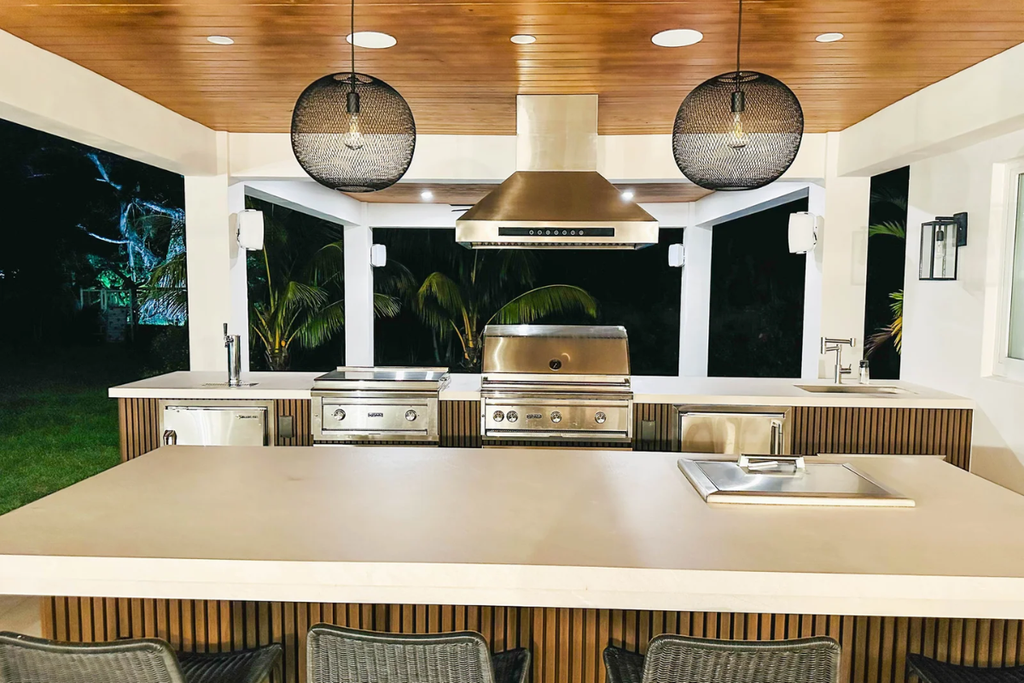
Modern kitchen islands serve as central spaces for cooking, food preparation, and social interaction. However, positioning a cooktop away from surrounding walls creates unique ventilation challenges. Without nearby walls to help contain rising cooking emissions, smoke, grease particles, and steam can spread into the surrounding kitchen.
Choosing between a traditional overhead ventilation system and a ceiling-integrated design requires careful consideration of airflow, mounting height, and kitchen layout. A 36 island range hood is one option for kitchens with centrally positioned cooking surfaces, while flush ceiling-mounted systems offer an alternative for homeowners who prefer unobstructed sightlines.
Understanding the differences between these ventilation configurations can help homeowners select equipment that balances cooking performance, installation requirements, and visual design.
What Is a 36-Inch Island Range Hood?
A 36 island range hood is a ceiling-supported ventilation appliance designed for installation above a kitchen island.
Unlike wall-mounted range hoods, island models are surrounded by open space and must capture cooking emissions without assistance from adjacent walls.
Traditional island hoods generally feature a canopy positioned above the cooktop, with a chimney or mounting structure extending toward the ceiling.
Their primary purpose is to capture airborne grease, cooking odors, moisture, and smoke before these emissions spread throughout the kitchen.
A 36-inch-wide model is commonly considered for cooking surfaces of similar or smaller dimensions. However, actual ventilation performance depends on the hood’s depth, capture area, airflow, and mounting position.
For high-intensity cooking, a wider canopy may provide better coverage than a hood that matches the cooktop width exactly.
How Does a Flush Ceiling Mount Range Hood Work?
A flush ceiling-mounted range hood is designed to sit within or close to the ceiling rather than extending downward as a traditional chimney-style hood.
These systems typically incorporate an intake panel, filters, and a ventilation fan. Depending on the design, the blower may be integrated into the unit or installed remotely.
During operation, the fan draws cooking emissions toward the ceiling-mounted intake.
Ducted configurations then transport the extracted air outdoors through a dedicated exhaust route.
The primary advantage of this arrangement is its discreet appearance. By eliminating a large suspended canopy, ceiling-integrated ventilation can preserve open views across the kitchen.
However, because the intake is generally farther from the cooking surface, effective pollutant capture can be more challenging.
The system must be specifically designed and installed to provide adequate ventilation at its intended mounting height.
Which Design Provides Better Cooking Smoke Capture?
Capture efficiency is one of the most important differences between traditional island hoods and flush ceiling-mounted systems.
A conventional 36 island range hood is usually positioned closer to the cooking surface, allowing its canopy to intercept rising cooking emissions before they disperse.
Flush ceiling-mounted hoods operate at a greater distance from the cooktop. As smoke and steam rise, they can spread outward, making it more difficult for the ventilation system to capture everything.
Several factors influence performance:
- Mounting height: Greater distances between the cooktop and intake can reduce capture effectiveness.
- Canopy coverage: A larger capture area can help contain emissions from multiple burners.
- Airflow capacity: Adequate airflow is necessary, but higher CFM alone does not guarantee effective capture.
- Cooking intensity: Frying, searing, and wok cooking generate emissions that may require more effective source ventilation.
- Air movement: Ceiling fans, open windows, and nearby ventilation outlets can disturb rising cooking plumes.
For kitchens where high-temperature cooking is frequent, a properly sized canopy positioned at the manufacturer’s recommended height may provide more reliable source capture.
How Much CFM Does a 36-Inch Island Hood Need?
CFM, or cubic feet per minute, measures the volume of air a ventilation system can move.
The appropriate airflow capacity depends on cooking habits, appliance specifications, duct resistance, and hood design.
A 36 island range hood may be available with different airflow capacities to accommodate moderate or intensive cooking requirements.
However, homeowners should not select ventilation equipment based solely on the highest advertised CFM rating.
Actual airflow can decrease when ductwork contains excessive bends, long horizontal runs, or undersized connections.
Higher-capacity exhaust systems may also require makeup air to replace the air removed from the building.
For example, the International Residential Code includes makeup-air provisions for certain domestic kitchen exhaust systems capable of exhausting more than 400 CFM, subject to the adopted code edition and local amendments.
Checking local requirements before installation is particularly important when selecting powerful ventilation equipment.
What Are the Installation Differences?
Traditional island hoods and flush ceiling-mounted systems have different structural requirements.
Traditional Island Hood Installation
A conventional island hood typically requires a secure ceiling support structure, electrical connections, and an appropriate duct route.
The installer must also verify the distance between the hood and cooking surface.
Ceiling height matters because the appliance must fit while maintaining the manufacturer’s required clearances.
Flush Ceiling Hood Installation
Flush-mounted ventilation systems may require a ceiling cavity or specially constructed enclosure to accommodate the equipment.
Depending on the model, additional space may be necessary for ductwork, blower components, and service access.
Structural framing and ceiling joists can also affect installation feasibility.
A flush-mounted design should never be assumed compatible with every ceiling simply because it has a low-profile appearance.
Which Range Hood Is Easier to Maintain?
Maintenance accessibility is another important consideration.
Traditional island hoods usually position grease filters and controls within relatively convenient reach.
Flush ceiling-mounted systems may require a step ladder or specialized access method for cleaning and filter removal.
Both designs require regular grease-filter maintenance to prevent excessive accumulation and airflow restrictions.
Homeowners should also inspect accessible ventilation components and follow the manufacturer’s recommendations for cleaning intervals.
Before choosing either design, consider whether filters can be removed safely and whether the ventilation system provides sufficient access for routine servicing.
Which Ventilation Design Is Better for an Open Kitchen?
Open-concept kitchens benefit from ventilation systems that manage cooking emissions before they spread into nearby living spaces.
A suspended 36 island range hood creates a visible architectural feature above the island and can provide effective capture when appropriately sized and positioned.
Flush ceiling-mounted systems maintain a more open visual appearance, making them attractive for minimalist interiors or kitchens where uninterrupted sightlines are important.
However, appearance should be evaluated alongside ventilation effectiveness.
For frequent high-temperature cooking, the proximity and capture area of a traditional island hood may offer practical advantages.
For lighter cooking and kitchens designed around concealed appliances, a properly engineered ceiling-integrated system may be suitable.
The final decision should reflect actual cooking requirements rather than aesthetics alone.
Conclusion
Traditional island hoods and flush ceiling-mounted ventilation systems offer different approaches to managing cooking emissions. While conventional designs position the capture area closer to the cooktop, ceiling-integrated systems prioritize a discreet appearance and unobstructed kitchen views. Homeowners researching ceiling-integrated ventilation may encounter descriptions such as our flush ceiling mount island range hood. Before selecting this configuration, it is important to verify the actual product dimensions, recommended installation height, ventilation capacity, and available ceiling space. Ultimately, a 36 island range hood can provide an effective solution for centrally located cooking surfaces when properly sized and installed. Comparing capture efficiency, maintenance accessibility, ductwork requirements, and kitchen design priorities will help homeowners choose a ventilation system suited to their everyday cooking needs.