
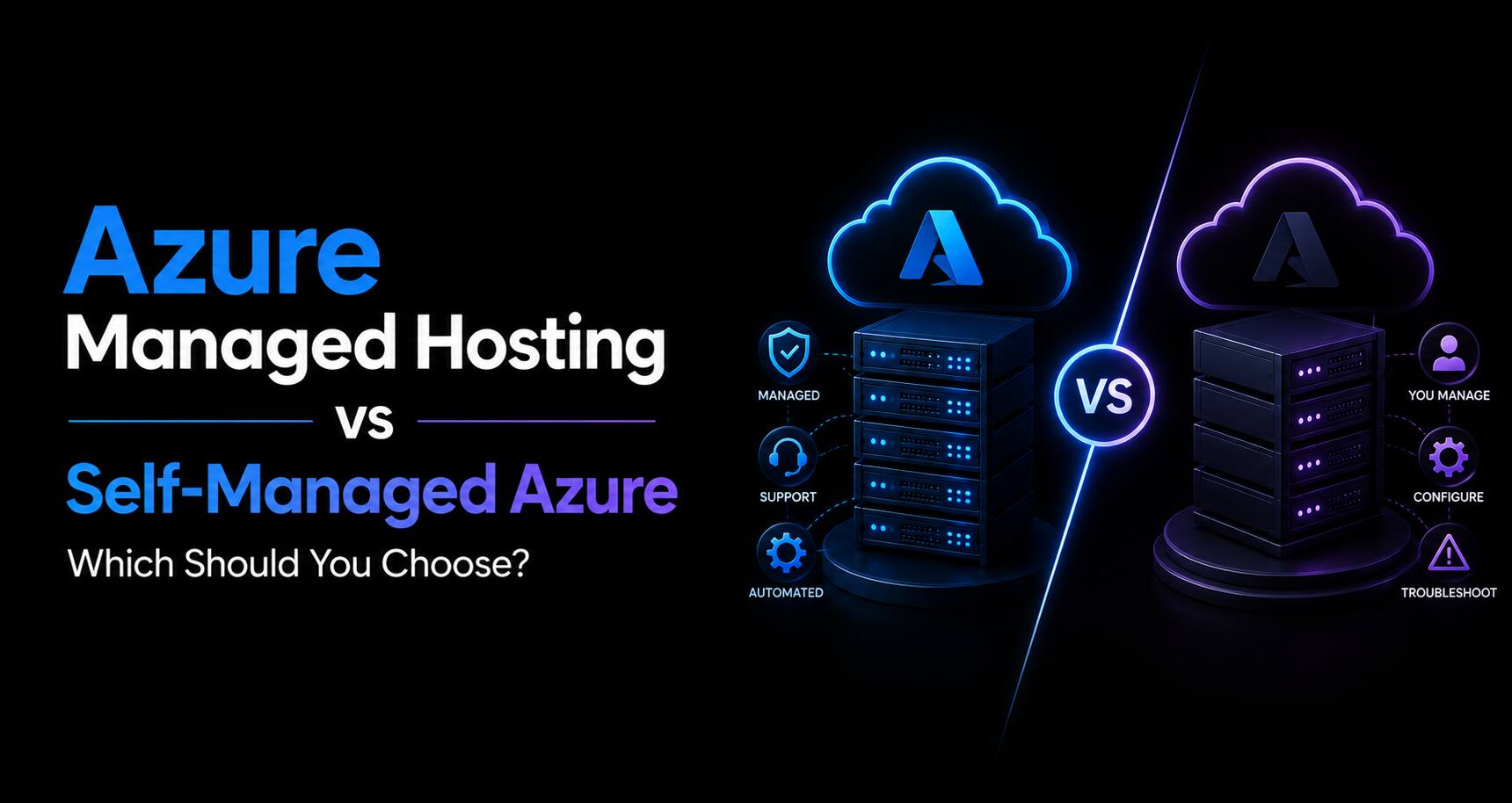
Businesses migrating to the cloud often face a critical decision: opt for Azure Managed Hosting or take the self-managed route on Azure. Both approaches have distinct advantages, but choosing the wrong one can result in spiraling costs, security gaps, or operational bottlenecks. This guide breaks down the key differences so you can make a confident, informed decision.
What is Azure Managed Hosting?
Azure Managed hosting is a service model where a third-party provider – or Microsoft itself – handles the deployment, configuration, monitoring, security, and ongoing maintenance of your Azure infrastructure. Businesses get all the power of Azure without the burden of day-to-day management.
Think of it as renting a fully staffed IT department focused exclusively on keeping your Azure environment healthy, secure, and optimized.
Key Features of Azure Managed Hosting:
- 24/7 infrastructure monitoring and support
- Automated backups and disaster recovery
- Security patch management and compliance
- Proactive performance optimization
- Dedicated expert support teams
What is Self-Managed Azure?
Self-managed Azure means your internal IT team takes full ownership of deploying, configuring, securing, and maintaining your Azure resources. You have complete control — but also complete responsibility.
Key Features of Self-Managed Azure:
- Full control over all configurations and settings
- Flexibility to customize infrastructure architecture
- Requires in-house Azure expertise
- Direct access to every Azure service and tool
- Costs depend heavily on internal resource allocation
Azure Managed Hosting vs Self-Managed Azure: Head-to-Head Comparison
| Factor | Azure Managed Hosting | Self-Managed Azure |
| Management Overhead | Low — handled by provider | High — fully in-house |
| Cost Structure | Predictable monthly cost | Variable; depends on team size and expertise |
| Technical Expertise Required | Minimal | Extensive Azure knowledge needed |
| Security & Compliance | Managed and monitored by experts | Your team’s responsibility |
| Scalability | Fast, provider-assisted | Flexible but manual |
| Support | 24/7 dedicated support | Internal team or Microsoft support plans |
| Time to Deploy | Faster — provider handles setup | Slower — full in-house configuration |
| Customization | Moderate | Maximum |
When to Choose Azure Managed Hosting
Azure Managed Hosting is the right fit when:
- Your Team Lacks Deep Azure Expertise – Not every business has certified Azure architects on staff. A managed hosting provider fills that skills gap instantly, so you’re not paying to train or hire expensive specialists.
- You Want Predictable Costs – Managed hosting packages typically come with fixed monthly pricing, making budgeting much easier than tracking variable infrastructure spend.
- Compliance and Security Are Non-Negotiable – Industries like healthcare, finance, and legal require strict adherence to standards like HIPAA, SOC 2, and GDPR. Managed hosting providers proactively handle compliance updates and security monitoring.
- You Need 24/7 Uptime Assurance – Round-the-clock monitoring, incident response, and support mean your applications stay online even when your internal team is offline.
- You Want to Focus on Business, Not IT – Managed hosting offloads the heavy lifting so your team can focus on revenue-generating activities rather than server maintenance.
When to Choose Self-Managed Azure
Self-managed Azure makes sense when:
- You Have a Strong In-House Azure Team – Organizations with certified Azure engineers and dedicated DevOps teams can leverage full control to build highly custom environments.
- You Need Maximum Customization – Some enterprise workloads require unique configurations, custom networking setups, or specialized integrations that managed services may not fully support.
- Cost Optimization Is the Priority at Scale – At very large scale, a skilled internal team can optimize Azure spend more aggressively than a managed service package allows.
- You Operate in a Highly Specialized Industry – Niche workloads with proprietary technology stacks may need hands-on control that only an internal team can provide.
Cost Comparison: What Should You Expect?
Cost is one of the biggest deciding factors. Here’s a realistic breakdown:
1. Azure Managed Hosting Costs
- Bundled service fees (management + support + monitoring)
- Predictable monthly billing
- No hidden staffing or training costs
- Typically lower total cost of ownership for SMBs
2. Self-Managed Azure Costs
- Azure consumption fees (pay-as-you-go or reserved instances)
- Azure-certified staff salaries (often $100K–$180K+ per engineer)
- Microsoft support plan costs
- Training and certification expenses
- Risk of over-provisioning without expert guidance
For small to mid-sized businesses, Azure Managed Hosting almost always delivers better ROI when factoring in the true total cost of maintaining in-house expertise.
Security: Managed vs Self-Managed
Security in the cloud is a shared responsibility — but who handles it matters enormously.
- Azure Managed Hosting Security: Managed providers maintain dedicated security operations teams that handle threat detection, vulnerability assessments, patch management, and compliance audits. Most reputable providers offer SLA-backed security guarantees.
- Self-Managed Azure Security: Your internal team is responsible for configuring Azure Security Center, setting up Defender for Cloud, managing identity and access policies, and responding to security incidents — all in real time.
Unless your organization has a mature security operations center (SOC), managed hosting provides a stronger and more consistent security posture.
Scalability: Growing Without the Headache
- Azure Managed Hosting lets you scale resources with a simple support request. Providers provision additional compute, storage, or networking quickly — often within hours.
- Self-Managed Azure offers more granular scaling control but requires your team to plan, provision, test, and monitor every scaling event manually.
For businesses with unpredictable workloads or rapid growth, managed hosting scales faster and with less risk.
Which Option is Right for Your Business?
Here’s a quick decision guide:
- Startup or SMB with limited IT staff? → Azure Managed Hosting
- Enterprise with a large, certified Azure team? → Self-Managed Azure
- Regulated industry requiring compliance? → Azure Managed Hosting
- Need maximum customization and control? → Self-Managed Azure
- Want predictable costs and 24/7 support? → Azure Managed Hosting
- Have budget to build a dedicated cloud ops team? → Self-Managed Azure
Conclusion
Choosing between Azure Managed Hosting and self-managed Azure ultimately comes down to your team’s capabilities, budget, compliance needs, and long-term goals. For the majority of small to mid-sized businesses, Azure Managed Hosting offers a faster, more secure, and more cost-effective path to the cloud.
If you’re looking for a trusted partner to manage your Azure environment end-to-end, Apps4Rent is a leading Microsoft-certified managed hosting provider with decades of experience helping businesses maximize the value of Azure. From initial migration to ongoing optimization and 24/7 support, Apps4Rent takes the complexity out of cloud management — so you can focus on growing your business.
Ready to Get Started with Azure Managed Hosting?
Don’t let infrastructure management slow your business down.
Partner with Apps4Rent for expert Azure Managed Hosting services — including 24/7 support, security management, compliance assistance, and seamless scalability.
Frequently Asked Questions
1. What is Azure Managed Hosting?
Azure Managed Hosting is a service where a third-party provider manages your Azure infrastructure – including deployment, security, monitoring, backups, and support — so your team doesn’t have to.
2. Is Azure Managed Hosting more expensive than self-managed?
Not necessarily. When you factor in staffing, training, and support costs, Azure Managed Hosting often has a lower total cost of ownership — especially for SMBs without a large internal IT team.
3. Can I switch from self-managed Azure to managed hosting later?
Yes. Most managed hosting providers can migrate your existing Azure environment to their managed platform with minimal disruption to your operations.
4. Does Azure Managed Hosting support compliance requirements like HIPAA or GDPR?
Yes. Reputable Azure Managed Hosting providers offer compliance-ready environments with built-in controls, regular audits, and documentation to meet industry standards.
5. How do I know which Azure Managed Hosting provider to trust?
Look for providers with Microsoft Gold or Solutions Partner status, proven SLAs, 24/7 support, and experience in your industry. Customer reviews and case studies are strong indicators of reliability.