
The other Sunday I was reading through some old poems of mine and I found one I’d half-forgotten about. It was called Ironed Sheets, and it was a bit of a doom-laden thing about a woman trapped in a relationship with a man who liked grey duvets and Sunday roast and never wanted to go anywhere spontaneous. She left. He barely noticed.
Reading it back, what struck me wasn’t the woman. It was Stephen. The man who barely noticed.
Because Stephen isn’t a villain. Stephen isn’t cruel. Stephen is just somebody who never quite learned to listen, and when his wife finally walked out the door, he genuinely couldn’t understand why. He read her note three times. He aligned its edge with the line of a tile. He made another cup of tea and stared into the dark garden, waiting for the world to rearrange itself into something that made sense.
I’ve been Stephen. I think most of us have, at some point. And I think that’s what empathy actually is, not the feeling, but the willingness to admit you might have been the Stephen in the story, and to try not to be him next time.
The lady with the bell
Years ago, my grandma came to live with us. She’d lost her husband in 1969 and then she’d fallen and broken her leg (the two events, I’m always careful to point out, were entirely unrelated). She moved in for a recovery and never left.
By the time I was a teenager, she was in her nineties, sitting in her winged chair by an unlit fireplace, with a pink and grey crocheted blanket over her stockinged legs. She hadn’t smelled anything since 1952, when a vat exploded at the vinegar factory where she worked. So when one of our dogs, Lucy, dug up the body of our dead rabbit Bess from the back garden and stashed her down the side of the settee to rot, Grandma was understandably not the first to notice.
“Can you not smell that, Grandma?” I asked her.
Of course she couldn’t. Hadn’t done for forty years. And yet I kept saying it, as if the next time I asked, she might somehow be able to.
That’s a small thing, and a daft one. But I’ve thought about it a lot since. How often I’ve expected somebody to be able to do something they simply couldn’t. How often I’ve asked the question without really thinking about who I was asking.
Empathy isn’t always about emotional pain. Sometimes it’s just remembering that not everybody is built the same as you are.
The man who wouldn’t dance
There’s a moment in Ironed Sheets where Elara, the wife, asks Stephen to dance with her at a wedding. She watches the other couples, bodies pressed close, hair stuck to necks, laughter spilling out, and she wants, desperately, to feel some of that with the man she’s married.
He says no. Then he relents, and dances stiffly, and excuses himself after one song.
Stephen isn’t being cruel. He genuinely doesn’t know what she’s asking for. He hears the request, dance with me, and he answers the request. He doesn’t hear what’s underneath it.
That’s the thing about real listening. The words are almost never the whole sentence.
When Ms Khan in my picture book says “just tea today, no crumpet,” what she’s actually saying is something about her mother in hospital. When the butcher tells Maude business is doing nicely, what he’s actually saying is that today has been a hard day. When Maude’s daughter Eliza says she’s fine, she’s not fine at all.
Maude hears all of it, because she has a magical ear trumpet. The rest of us have to do the work the slow way.
The night shift, and the people who do it
My wife was a nurse for a long time. I wrote a poem a while back called Night Shift at the General, about what it’s like to watch the woman you love come in from a night on the ward.
Feet steaming in a cloud of disinfectant. Fingers worn to the knuckle. Legs aching through tan tights. Hair tied up tighter than a tourniquet. Eyeliner dissolved by the million tears discreetly cried into a hastily microwaved leftover dinner. Nostrils still full of incontinence. A symphony of buzzers and bells still ringing in her mashed-up brain.
And the last line, the one that I worried for a while about including, was: when you walked in, I couldn’t have loved you more.
That’s what empathy is, I think. Not the grand statement. Just noticing. Noticing the steaming feet and the tan tights and the tired eyes and not trying to fix any of it. Just seeing. Just being there.
My wife didn’t need me to make it all better. She needed me to put the kettle on and not ask any stupid questions.
What Maude knew that I didn’t
When I was writing Maude’s Magical Ear Trumpet, I had no idea I was writing a book about empathy. I thought I was writing a book about a strange old lady with a horn-shaped device.
But here’s what Maude figured out, and what it took me decades to start figuring out: most of the people in our lives are telling us how they feel all the time. They’re just not using the words we expect.
The butcher’s loud cheerfulness. The daughter’s brisk “I’m fine.” The friend’s slightly-too-quick change of subject. These are the sentences underneath the sentences. And once you start hearing them, you can’t really stop.
It’s exhausting, sometimes. I’ll be honest. There’s a reason most of us choose not to listen that closely most of the time.
But it’s also, I think, the only thing that really matters. Everything else, the careers, the achievements, the trying to be noticed, none of that lasts. The people who put their trumpet up and actually heard us. Those are the ones we remember.
About Maude’s Magical Ear Trumpet
If you’ve come this far with me, I’m grateful. And if you’ve ever wished you had a magical ear trumpet of your own, for the daughter, or the butcher, or the friend at the café, then I’d like to introduce you to Maude.
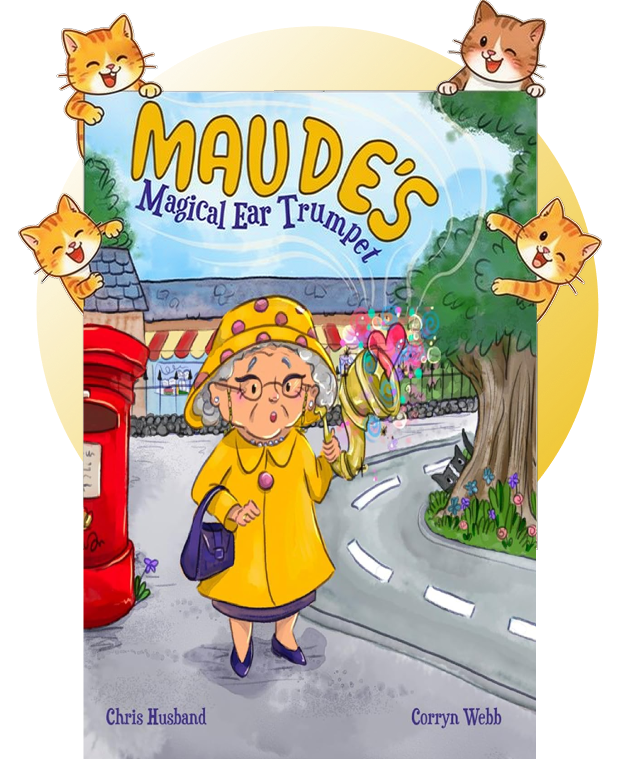
Maude’s Magical Ear Trumpet is my picture book about an older lady in a bright yellow coat and a pink and yellow spotted hat, who is given a strange old trumpet by her doctor. When she puts it to her ear, it tells her how people really feel. The butcher who says he’s fine but isn’t. The daughter who says nothing’s wrong but everything is. The friend in the café carrying something quietly. And in the end, of course, the trumpet turns out not to be magic at all — Maude was the magic the whole time.
It’s a story for children aged roughly 4 to 8, but I think you’ll find it’s also a story for the grown-up reading it aloud.
👉 Buy Maude’s Magical Ear Trumpet on Amazon
If you do read it, drop me a line and tell me what you thought. I read every message. That’s the Maude in me, I suppose.