
Introduction: The Technology Reshaping Blockchain Scalability
Blockchain technology has transformed digital finance, decentralized applications, and online ownership. However, as blockchain adoption continues to accelerate in 2026, one challenge remains central to the industry’s evolution: scalability.
Networks like Ethereum have become the foundation for thousands of decentralized applications, DeFi protocols, NFT ecosystems, gaming platforms, and enterprise blockchain solutions. Yet, increasing user activity often leads to network congestion, slower transaction processing, and higher gas fees. These limitations have pushed developers and businesses to seek advanced scaling technologies capable of handling mass adoption without compromising security or decentralization.
This is where Zero-Knowledge Rollups, commonly known as ZK Rollups, have emerged as one of the most revolutionary innovations in blockchain infrastructure. Today, organizations investing in ZK rollup development services are building faster, more secure, and highly scalable blockchain ecosystems capable of supporting millions of users simultaneously.
As blockchain enters a new era of mainstream adoption, understanding ZK Rollups is no longer optional for businesses, developers, investors, and enterprises. This comprehensive guide explains everything you need to know about ZK Rollups in 2026, including how they work, their advantages, use cases, challenges, and future potential.
Understanding ZK Rollups
A ZK Rollup is a Layer 2 scaling solution designed to increase blockchain throughput while maintaining the security guarantees of the underlying Layer 1 network.
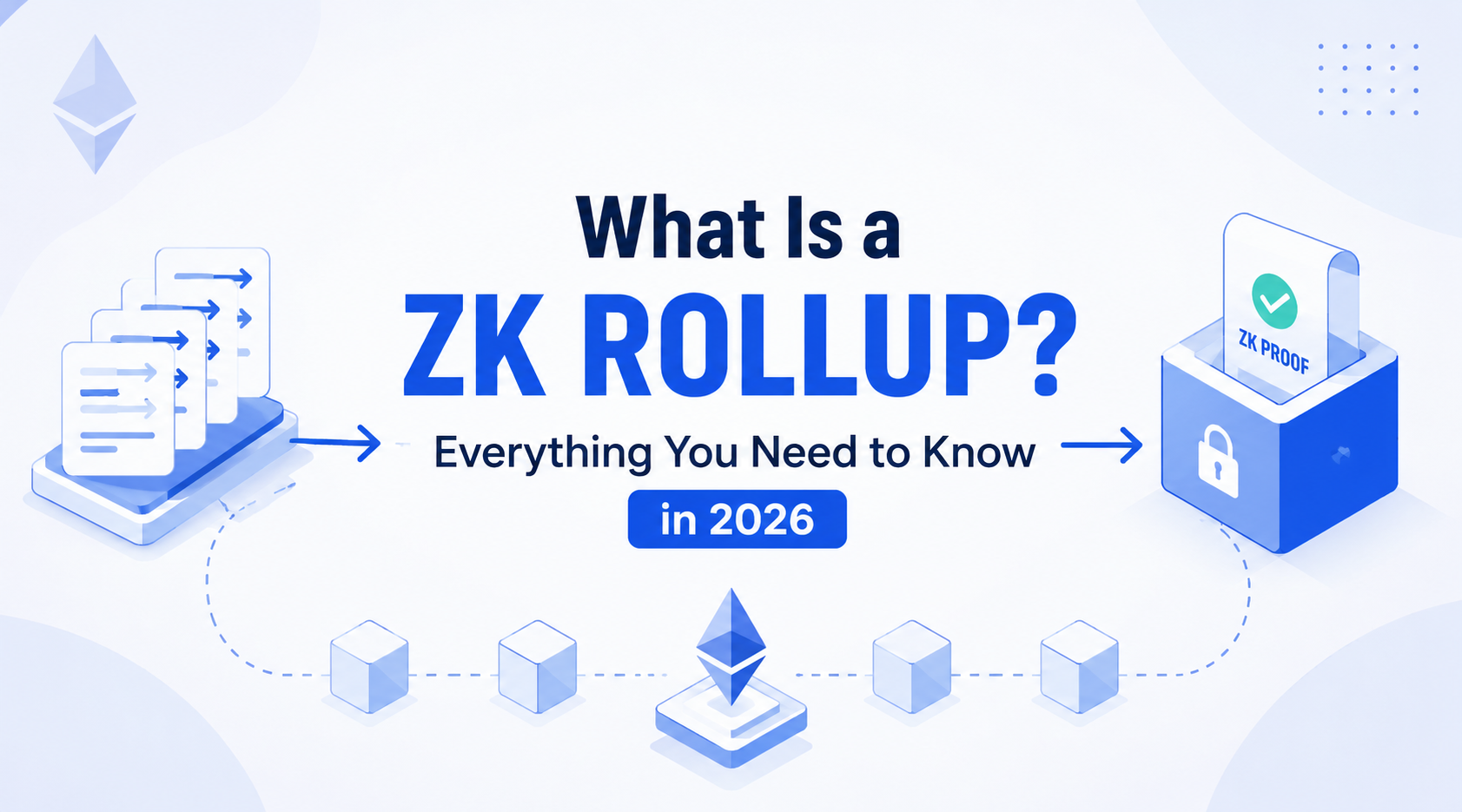
The term “rollup” refers to the process of bundling hundreds or thousands of transactions into a single batch. Instead of processing every transaction individually on the main blockchain, these transactions are executed off-chain and then compressed into a single proof that is submitted to the Layer 1 network.
The “ZK” in ZK Rollup stands for Zero-Knowledge, a cryptographic technique that allows one party to prove that a statement is true without revealing the underlying data.
In simple terms, ZK Rollups process transactions off-chain and provide cryptographic proofs that all transactions are valid. This proof is then verified on the main chain, significantly reducing computational load while maintaining security.
The result is a blockchain ecosystem capable of handling thousands of transactions per second while dramatically lowering transaction costs.
Why Blockchain Networks Need ZK Rollups
Traditional blockchain networks face a difficult balancing act known as the Blockchain Trilemma. This concept suggests that blockchains struggle to simultaneously achieve scalability, security, and decentralization.
As user activity grows, blockchains often sacrifice one of these three elements. Increasing block sizes may improve scalability but can negatively impact decentralization. Reducing security measures can improve speed but expose the network to risks.
Ethereum, despite being one of the most secure and decentralized blockchains, has historically struggled with scalability during periods of high demand. Transaction fees can rise substantially, making applications less accessible to everyday users.
ZK Rollups address this challenge by moving transaction execution off-chain while retaining Layer 1 security. This approach allows networks to process significantly more transactions without increasing congestion.
Consequently, ZK Rollups have become one of the most promising solutions for supporting the next generation of decentralized finance, gaming, social platforms, and enterprise blockchain applications.
How ZK Rollups Work
To understand the impact of ZK Rollups, it is important to examine the underlying workflow.
When users initiate transactions on a ZK Rollup network, those transactions are collected by specialized operators known as sequencers. Instead of immediately submitting every transaction to the main blockchain, the sequencer executes and validates them off-chain.
After processing a large batch of transactions, the system generates a cryptographic proof known as a validity proof. This proof mathematically demonstrates that all transactions in the batch are valid.
The proof, along with minimal transaction data, is then submitted to the Layer 1 blockchain. Validators on the main chain only need to verify the proof rather than re-execute every transaction.
This dramatically reduces computational requirements while preserving trustlessness and security.
Because the proof guarantees correctness, users do not need to trust the operator. Even if the operator behaves maliciously, the network will not accept invalid transactions.
This innovative architecture enables blockchain systems to achieve higher scalability without compromising decentralization.
The Role of Zero-Knowledge Proofs
Zero-Knowledge Proofs are the cryptographic backbone of ZK Rollups.
These proofs allow one party to verify information without revealing the underlying details. In blockchain environments, they enable the validity of transactions to be proven without exposing every computational step.
Modern ZK Rollups primarily rely on technologies such as zk-SNARKs and zk-STARKs.
zk-SNARKs offer compact proofs and fast verification times, making them suitable for many blockchain applications. zk-STARKs provide enhanced transparency and resistance against future quantum computing threats.
Both technologies contribute to improved scalability while maintaining strong security guarantees.
As cryptographic research advances, proof generation is becoming faster, cheaper, and more efficient, further accelerating the adoption of ZK Rollups across the blockchain industry.
ZK Rollups vs Optimistic Rollups
When discussing Layer 2 scaling solutions, comparisons between ZK Rollups and Optimistic Rollups are inevitable.
Optimistic Rollups assume transactions are valid by default and rely on fraud proofs to detect malicious activity. Users can challenge suspicious transactions during a predefined dispute period.
ZK Rollups, on the other hand, provide mathematical proof of transaction validity before final settlement.
This difference creates several advantages.
Transaction finality is significantly faster because no challenge period is required. Security verification occurs immediately through cryptographic proofs. Capital efficiency improves because users can withdraw assets without waiting for dispute windows to expire.
While Optimistic Rollups played an important role in Ethereum scaling, ZK Rollups are increasingly viewed as the long-term solution due to their superior efficiency and security model.
Key Benefits of ZK Rollups
One of the primary reasons behind the growing popularity of ZK Rollups is their extensive range of benefits.
Scalability stands out as the most obvious advantage. By processing transactions off-chain and submitting compressed proofs, ZK Rollups can achieve significantly higher transaction throughput than traditional Layer 1 networks.
Lower transaction fees represent another major benefit. Because many transactions share the cost of a single proof submission, users experience dramatically reduced fees.
Security remains exceptionally strong since transaction validity is ultimately verified on the Layer 1 blockchain. Users benefit from the security guarantees of the underlying network without sacrificing performance.
Faster transaction confirmation improves user experience and enables real-time blockchain applications. This is particularly important for gaming, payments, and high-frequency financial applications.
Improved developer flexibility allows teams to build sophisticated decentralized applications without worrying about Layer 1 congestion.
Together, these advantages position ZK Rollups as a foundational technology for the future of Web3.
Real-World Applications of ZK Rollups
The practical applications of ZK Rollups continue to expand across numerous industries.
In decentralized finance, ZK Rollups support high-volume trading platforms, lending protocols, derivatives markets, and decentralized exchanges. Users can execute transactions at lower costs while maintaining security.
Blockchain gaming platforms benefit from faster transactions and improved scalability. Players can interact with in-game assets and economies without experiencing network delays.
NFT marketplaces leverage ZK Rollups to reduce minting costs and improve user accessibility.
Enterprise organizations utilize ZK Rollups to process large volumes of transactions while maintaining compliance and security requirements.
Cross-border payment solutions increasingly rely on ZK Rollup technology to facilitate faster and more affordable transfers.
Supply chain systems, digital identity platforms, healthcare applications, and tokenized asset ecosystems are also exploring ZK-powered infrastructure to enhance operational efficiency.
The Rise of Layer 2 Ecosystems
The blockchain industry in 2026 is witnessing a rapid expansion of Layer 2 ecosystems.
As businesses seek scalable blockchain infrastructure, demand for layer 2 app development services has increased substantially. Organizations recognize that Layer 2 solutions provide the performance necessary for mainstream adoption while preserving the trustless nature of blockchain technology.
Developers are increasingly building decentralized applications directly on Layer 2 networks rather than relying solely on Layer 1 infrastructure. This shift enables applications to offer user experiences comparable to traditional web platforms while maintaining decentralization benefits.
The result is a growing ecosystem of wallets, decentralized exchanges, gaming platforms, social applications, payment solutions, and enterprise systems operating on advanced Layer 2 architectures powered by ZK technology.
Challenges Facing ZK Rollups
Despite their impressive advantages, ZK Rollups are not without challenges.
Generating cryptographic proofs can require substantial computational resources. Although technological advancements continue to reduce costs, proof generation remains a complex process.
Development complexity presents another obstacle. Building ZK-compatible applications often requires specialized expertise in cryptography, blockchain architecture, and smart contract engineering.
Interoperability across multiple blockchain ecosystems continues to evolve. While progress is being made, seamless communication between various Layer 2 and Layer 1 networks remains an active area of research.
User education also remains important. Many users are still unfamiliar with ZK technology and its benefits, creating opportunities for greater awareness and adoption initiatives.
Fortunately, ongoing innovation is rapidly addressing these challenges, making ZK Rollups more accessible to developers and businesses alike.
Why Enterprises Are Investing in ZK Rollup Technology
Enterprise adoption of blockchain technology has accelerated significantly over the past few years. However, many organizations require infrastructure capable of supporting large-scale operations without sacrificing security or compliance.
ZK Rollups provide a compelling solution.
By combining scalability, privacy, and security, ZK Rollups enable enterprises to deploy blockchain applications that can efficiently handle millions of transactions.
Financial institutions use ZK-powered systems to improve settlement processes and reduce operational costs. Supply chain companies leverage ZK infrastructure to enhance transparency and traceability. Healthcare providers explore privacy-preserving applications that protect sensitive information while maintaining data integrity.
These capabilities make ZK Rollups particularly attractive for organizations seeking practical blockchain implementations at scale.
The Future of ZK Rollups in 2026 and Beyond
Industry experts widely consider ZK Rollups to be one of the most transformative blockchain technologies of the decade.
As proof systems become more efficient and developer tools mature, ZK Rollups are expected to support increasingly sophisticated applications. Innovations in account abstraction, interoperability, privacy-preserving computation, and decentralized identity are likely to integrate closely with ZK infrastructure.
Many analysts predict that future blockchain ecosystems will rely heavily on ZK-powered networks, with Layer 1 chains serving primarily as settlement and security layers.
The convergence of artificial intelligence, decentralized finance, tokenized real-world assets, and blockchain gaming is expected to create even greater demand for scalable infrastructure.
Organizations investing in custom blockchain development strategies today are positioning themselves to capitalize on this rapidly evolving technological landscape.
Conclusion
ZK Rollups have emerged as one of the most important breakthroughs in blockchain scalability. By leveraging advanced cryptographic proofs, they enable networks to process massive transaction volumes while preserving the security and decentralization of Layer 1 blockchains.
Their ability to reduce costs, improve performance, accelerate transaction finality, and support enterprise-scale applications has made them a cornerstone of the Web3 ecosystem in 2026.
From decentralized finance and gaming to enterprise applications and digital identity systems, ZK Rollups are reshaping how blockchain technology is deployed and experienced worldwide.
As blockchain adoption continues to grow, ZK Rollups will play an increasingly critical role in creating scalable, efficient, and secure digital ecosystems. Businesses, developers, and investors who understand this technology today will be better prepared to capitalize on the opportunities emerging in the next generation of decentralized innovation.