
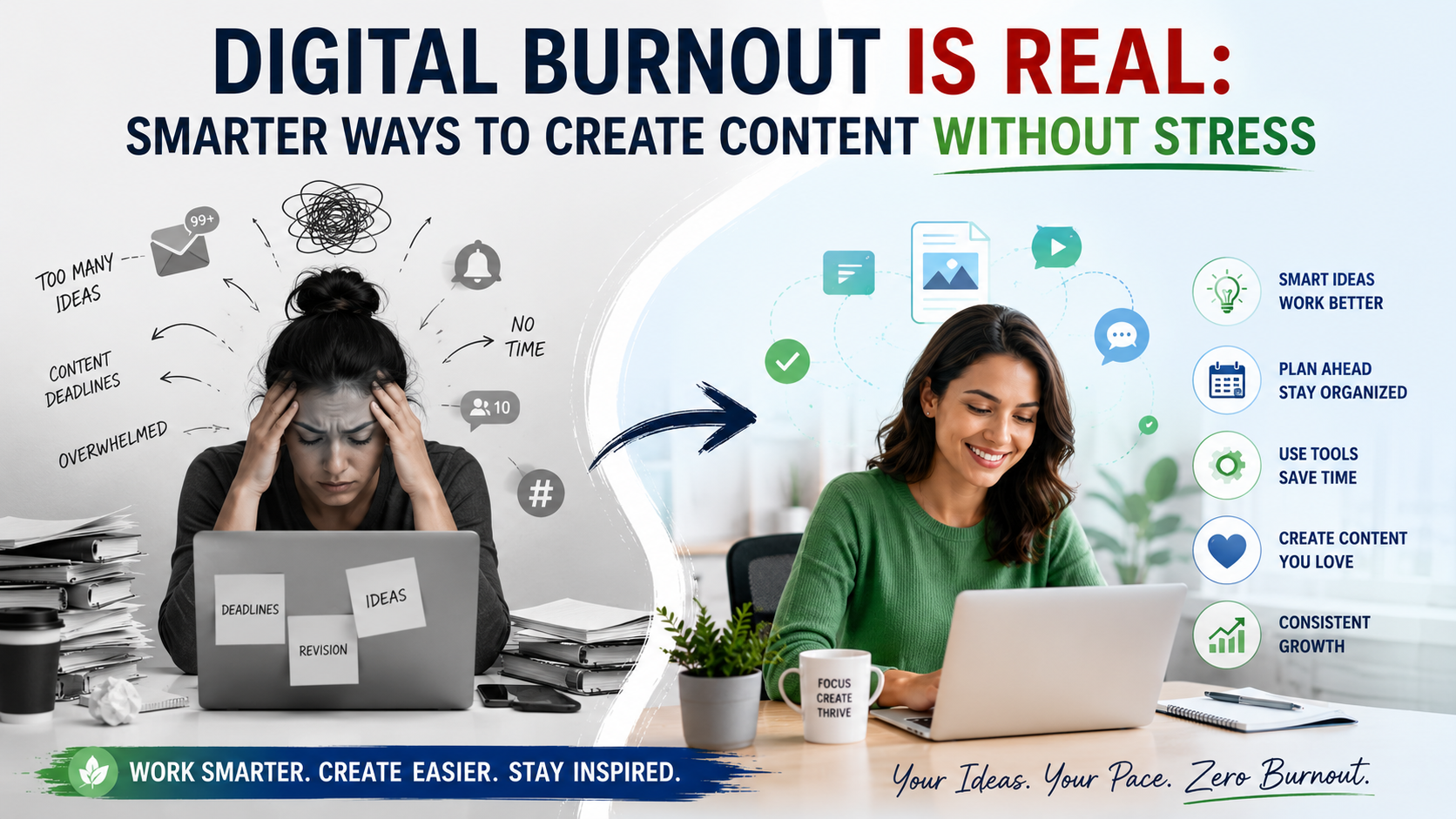
Creating content has never been easier. With smartphones, editing software, AI tools, and social media platforms, almost anyone can publish videos, blogs, podcasts, or graphics within minutes. But while content creation has become more accessible, staying consistent has become increasingly difficult.
Many creators, marketers, freelancers, and business owners feel pressured to post every day, respond to comments, follow trends, analyse performance, and constantly come up with fresh ideas. Over time, this pressure leads to something that many people experience but rarely talk about—digital burnout.
Unlike physical exhaustion, digital burnout develops gradually. At first, you simply feel less motivated. Then you start delaying projects, losing creativity, and struggling to enjoy work that once excited you. If ignored, it can affect both your productivity and your mental well-being.
The good news is that digital burnout isn’t a sign that you’re not working hard enough. More often, it’s a sign that your workflow needs improvement. By simplifying your content creation process and using technology wisely, you can stay productive without feeling overwhelmed.
What Is Digital Burnout?
Digital burnout is a state of mental and emotional exhaustion caused by spending too much time connected to digital devices and online platforms.
For content creators, it often comes from juggling multiple responsibilities every day, such as:
- Planning content
- Writing scripts
- Recording videos
- Editing
- Designing graphics
- Publishing posts
- Replying to messages
- Tracking analytics
- Keeping up with social media trends
None of these tasks seem overwhelming individually. However, when combined day after day without enough breaks, they create continuous mental pressure.
Common Signs of Digital Burnout
Burnout doesn’t happen overnight. It usually develops slowly.
Some early warning signs include:
- Feeling tired even after taking breaks
- Losing motivation to create content
- Spending hours working but making little progress
- Feeling guilty when taking time off
- Constantly checking notifications
- Running out of creative ideas
- Feeling anxious about posting consistently
Many creators mistake these symptoms for laziness, but they’re often signs that their mind needs recovery rather than more pressure.
Why Creators Experience Burnout More Often
Content creation is different from many traditional jobs because creativity cannot always be forced.
You might spend hours trying to write a blog, record a video, or design a post without feeling satisfied with the result.
On top of that, social media rewards consistency.
Creators often feel they must publish regularly to stay visible, even when they’re mentally exhausted.
This creates a cycle where they work harder but enjoy the process less.
Productivity Doesn’t Mean Working All Day
One of the biggest misconceptions about success is that productive people work constantly.
In reality, high-performing creators understand the importance of balance.
They don’t spend every waking hour creating content.
Instead, they focus on:
- Prioritising important work
- Automating repetitive tasks
- Planning ahead
- Taking meaningful breaks
- Protecting their creative energy
Working longer isn’t always the answer.
Working smarter usually is.
Build a Sustainable Content Workflow
The easiest way to reduce stress is by creating a workflow that you can realistically maintain.
Instead of creating one post every single day from scratch, try batching similar tasks together.
For example:
Monday:
- Research topics.
Tuesday:
- Write scripts or blogs.
Wednesday:
- Record videos.
Thursday:
- Edit and design.
Friday:
- Schedule content and review analytics.
This approach reduces mental switching and allows you to stay focused on one type of work at a time.
Stop Trying to Do Everything Yourself
Many creators believe they must personally handle every stage of content creation.
While this may work in the beginning, it becomes exhausting as your workload grows.
This is where AI-powered tools can help.
AI isn’t meant to replace creativity.
It’s designed to remove repetitive tasks so you can spend more time creating valuable ideas.
For example, an AI ad generator can quickly create multiple advertising concepts, draft marketing copy, and suggest creative variations for different platforms. Instead of starting every campaign with a blank page, creators can use AI-generated drafts as a starting point and then refine them with their own expertise and brand voice.
The same principle applies to captions, headlines, video scripts, and social media creatives. AI helps reduce the time spent on repetitive work, leaving more room for strategic thinking and creative storytelling.
Choose Quality Over Quantity
One of the fastest paths to burnout is believing you must post everywhere, every day.
Ask yourself:
- Does every platform matter for my audience?
- Am I creating valuable content or simply trying to stay active?
- Would fewer, higher-quality posts perform better?
In many cases, publishing three thoughtful posts each week delivers better long-term results than posting every day without a clear strategy.
Consistency is important, but sustainability matters even more.
AI Should Reduce Stress, Not Add to It
As AI tools become more popular, creators sometimes make another mistake—they try every new platform they discover.
Using too many tools creates unnecessary complexity.
Instead, choose only a few that genuinely improve your workflow.
For example:
- One writing assistant
- One design platform
- One video editor
- One scheduling tool
A simple toolkit is much easier to manage than ten different applications that perform similar tasks.
Helpful AI Platforms for Content Creators
If you’re looking to simplify your workflow, several trusted AI platforms can support different stages of content creation.
Some popular options include:
- ChatGPT for brainstorming, outlining, and writing.
- Canva AI for graphics and presentations.
- Adobe Express AI for marketing creatives.
- InVideo AI for turning ideas into videos.
- Predis.ai for social media content planning.
- CapCut AI for editing short-form videos.
- VEED for subtitles and online video editing.
- Descript for podcasts and video production.
The best approach isn’t to use every tool. Experiment with a few, identify which ones solve your biggest challenges, and build your workflow around those.
Don’t Forget to Disconnect
Technology helps creators reach millions of people.
However, creativity also needs moments away from screens.
Simple habits can make a big difference:
- Take short walks between work sessions.
- Avoid checking notifications during focused work.
- Keep one or two hours each day completely screen-free.
- Spend time reading books instead of endlessly scrolling.
- Schedule regular days off from content creation.
These breaks aren’t wasted time—they help your brain recover and often lead to better ideas.
Success Is a Marathon, Not a Sprint
Many successful creators didn’t grow because they worked non-stop.
They succeeded because they built systems they could maintain for years.
Burnout usually happens when expectations become unrealistic.
Instead of chasing every trend, focus on building a workflow that supports both your goals and your well-being.
Remember, your creativity is one of your greatest assets. Protecting it should always be part of your strategy.
Final Thoughts
Digital burnout is becoming increasingly common in today’s always-connected world, especially for creators who feel pressure to stay active across multiple platforms. But burnout isn’t a sign of failure—it’s often a sign that your current workflow needs adjustment.
By planning content in advance, simplifying your daily routine, taking regular breaks, and using AI responsibly, you can reduce stress without sacrificing consistency. Tools such as an AI ad generator can remove repetitive marketing tasks, giving you more time to focus on creativity, storytelling, and building meaningful connections with your audience.
The goal isn’t to create more content at any cost. The goal is to create better content while protecting your energy, maintaining your passion, and building a sustainable creative career that you can enjoy for years to come.