
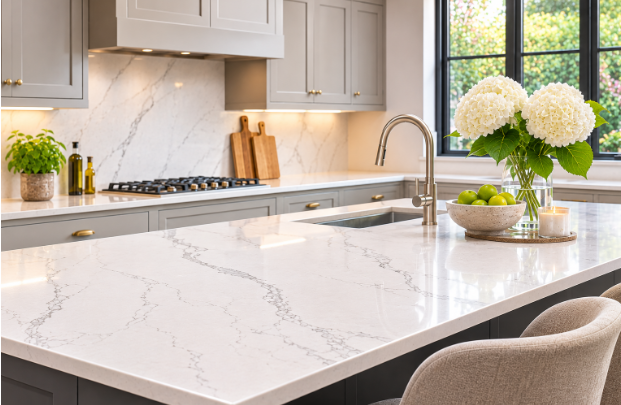
Kitchen worktops need to handle regular food preparation, frequent cleaning, and the occasional impact from cookware or utensils. At the same time, they occupy a large visible area, so their colour and finish can influence the character of the entire room. Choosing a surface involves balancing appearance, durability, maintenance, and installation requirements. Countertops for kitchens quartz are a popular consideration because engineered quartz surfaces combine natural mineral content with binding materials to create a consistent, non-porous worktop. Understanding their properties and limitations helps homeowners decide whether this material suits their kitchen.
What Are Quartz Kitchen Worktops?
Engineered countertops for kitchens quartz are manufactured using natural quartz particles combined with resins, pigments, and other materials. The mixture is formed into slabs and finished to create a durable surface with controlled patterns and colours. Since the material is engineered, manufacturers can produce designs that resemble natural stone or offer more uniform visual effects.
Natural quartz is a hard mineral, but the performance of a finished slab depends on its complete formulation and manufacturing process. Buyers should therefore review the specifications and care guidance for the particular product rather than assuming that every quartz surface has identical properties.
Quartz is available in a wide range of tones, including white, grey, beige, and darker shades. Some designs have subtle veining, while others include more pronounced patterns or decorative effects. This variety makes it possible to coordinate a worktop with different cabinet colours and interior styles.
Everyday Advantages of Quartz
Non-Porous Surface
One of the main practical features of engineered quartz is its non-porous surface. Unlike some natural stones, many quartz worktops do not require routine sealing. Their low absorption can make everyday spills easier to manage, although liquids should still be cleaned promptly.
Coffee, cooking oil, sauces, and other household substances can leave marks if allowed to remain on the surface, particularly if they contain strong pigments or chemicals. Following the manufacturer’s cleaning instructions helps protect the finish.
Resistance to Daily Wear
Quartz is known for its hardness and resistance to many forms of everyday wear. This makes it suitable for busy kitchens where the worktop is used for food preparation, storage, and other routine activities. However, scratch resistance does not mean the surface is scratch-proof. Cutting directly on the worktop can damage the finish or leave marks, so chopping boards remain necessary.
The same caution applies to heavy cookware. Although engineered quartz can withstand normal kitchen use, sharp impacts against edges or corners may cause chips. Careful handling helps preserve the surface over time.
Consistent Appearance
Natural stone can contain considerable variation between slabs. Engineered quartz generally offers more controlled colour and pattern consistency, which can be helpful when a kitchen requires multiple connected sections. Homeowners can compare samples to understand how a particular design will look under the lighting in their room.
Choosing a Colour and Pattern
The worktop should complement the cabinets, flooring, splashback, and other finishes. Light-coloured surfaces can make a compact kitchen feel brighter, while darker tones may create contrast against pale cabinetry. Veined designs can introduce movement, whereas plain finishes offer a simpler visual effect.
When comparing countertops for kitchens quartz, it is useful to view samples in the actual room. Artificial lighting, daylight, and nearby colours can change how a surface appears. A small sample may also show less pattern variation than a full slab, so asking to view a larger sample or slab can provide a better impression.
Edge profiles and thickness also influence the final appearance. A simple straight edge suits many contemporary kitchens, while more decorative profiles may complement traditional interiors. These choices should be considered alongside cabinet dimensions and installation details.
Understanding Heat and Chemical Limitations
Quartz worktops can tolerate normal kitchen conditions, but they should not be treated as heat-proof. Hot pans and baking trays should be placed on trivets or heat-resistant mats. Sudden temperature changes and prolonged exposure to high heat can damage the resin components or cause discolouration.
Strong chemicals may also affect the surface. Products containing harsh solvents, concentrated alkaline substances, or abrasive ingredients should not be used unless the manufacturer confirms they are suitable. Mild cleaning products are generally a safer choice for routine maintenance.
Cleaning and Routine Maintenance
Daily cleaning is usually straightforward. A soft cloth, warm water, and mild soap can remove many common spills and food residues. The surface should then be wiped clean to prevent streaks or residue. Dried substances may require gentle removal using a non-abrasive method approved by the manufacturer.
Avoid scouring pads and aggressive cleaning agents because they can dull or damage the finish. Worktops should also be kept clear of standing liquids, particularly around joints, sinks, and edges. Although quartz is low maintenance, routine attention helps preserve its appearance.
Measuring and Installing the Worktop
Accurate measurement is essential because kitchen worktops must fit around walls, cabinets, sinks, hobs, and other fixtures. Professional templating helps account for corners, cut-outs, and uneven surfaces. The installer should also check that the cabinets provide adequate support and that joints are positioned appropriately.
The weight of a quartz slab means handling and installation require suitable equipment and experience. Buyers should confirm the installation process, lead times, warranty conditions, and any preparation needed before the fitting date.
Comparing Suppliers and Product Options
A supplier should be able to explain slab specifications, available finishes, maintenance requirements, and installation arrangements. It is also useful to ask how samples compare with the full slab and whether the quoted price includes templating, fabrication, delivery, and fitting.
Different manufacturers offer different collections and technical specifications. Comparing more than one option can help homeowners understand differences in appearance, performance, and cost before making a final decision.
Conclusion
Quartz can provide a practical and visually consistent surface for kitchens when its characteristics match the household’s needs. Its low-porosity finish, broad design selection, and manageable routine cleaning make it worth considering, while heat precautions and careful installation remain important. Reviewing samples, technical details, warranties, and maintenance instructions helps prevent unrealistic expectations. Speaking with experienced local quartz suppliers can also clarify available materials, measurement requirements, fabrication options, and the installation process before a worktop is selected.