
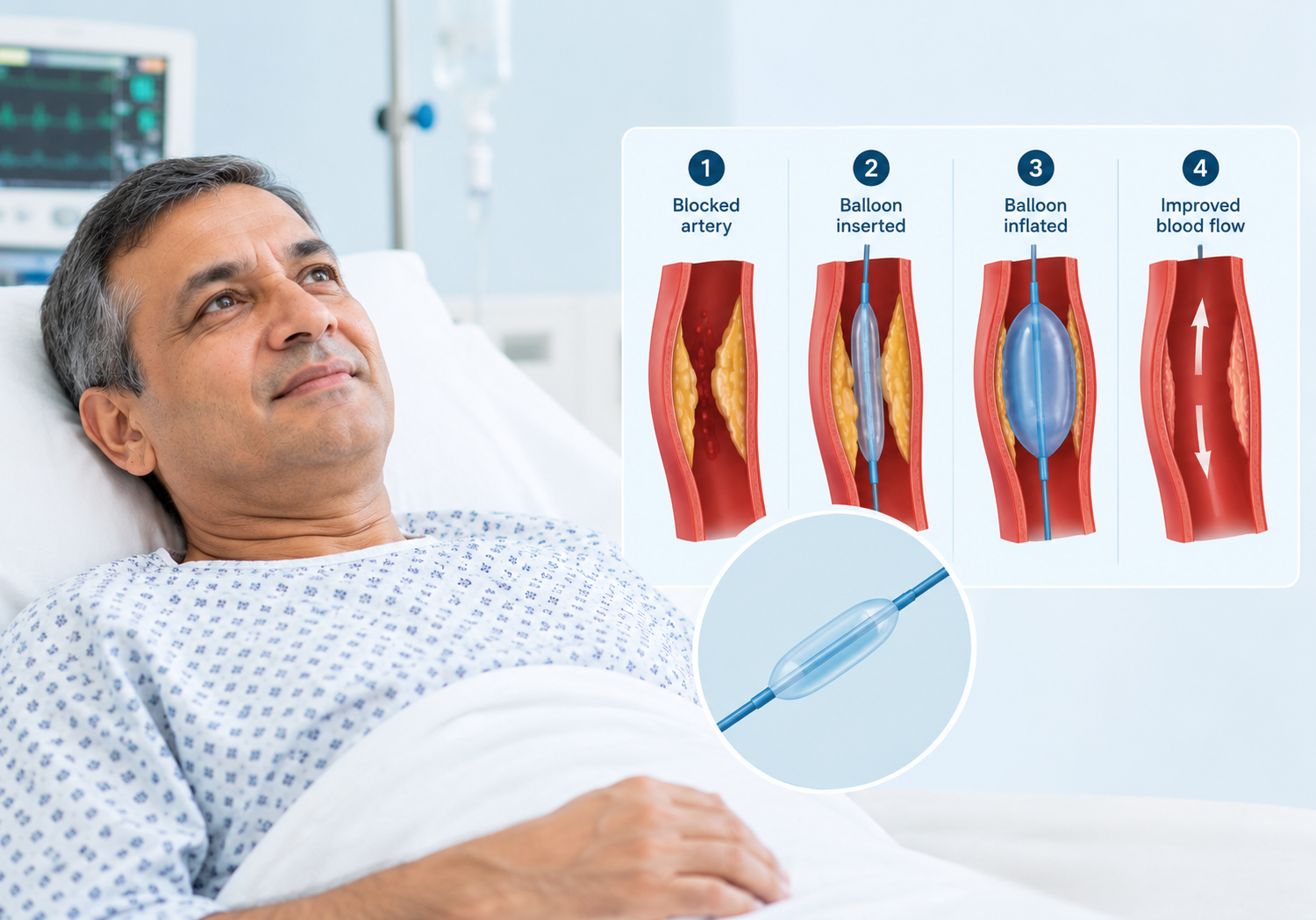
The biggest misconception about angioplasty is that it always ends up with a stent implant inside the artery. However, that notion is far from the truth. It is not always the case with angioplasty, as depending on many factors, including the patient’s heart health, their age, the condition of the narrowed or blocked artery after it has been opened, and their overall health, angioplasty can sometimes be performed without leaving a permanent implant inside the artery.
How Angioplasty Has Transformed Over The Years
In the early days of angioplasty, plain angioplasty was revolutionary. The procedure was much simpler than it is today. During the procedure, a cardiologist would guide a thin catheter, carrying a tiny balloon at its tip, toward the blocked/narrowed part of the artery. The balloon was then inflated to open the artery and remove fatty deposits called plaque, restoring normal blood flow. Back then, no medicine was delivered, and no device or metal implant was left behind.
While the approach worked perfectly fine in restoring blood flow for a specific period of time, it failed to deliver lasting results. Doctors soon realised that after the treatment, after a while, some arteries tend to narrow again, a process called restenosis. This challenge became the reason for stenting. But now, in today’s day and age, with newer advancements in cardiological treatment modalities, especially the Drug-Coated Balloon (DCB) angioplasty, it has been made possible to perform angioplasty without a stent.
What Is Drug-Coated Balloon (DCB) & How It Works
A DCB looks the same as the plain balloon used in angioplasty to open up the artery; the only difference is the medication that’s coated on it. Once the DCB is inflated, the medication is released at the narrowed/ blocked spot in the artery. The medication is designed to help reduce the growth of scar tissue that may cause restenosis. Once the medication is released, the balloon is then removed, leaving no permanent implant inside the artery.
Advantages Of DCB Therapy:
No permanent implants
After the procedure, only the medicine stays inside the artery and nothing else. The DCB also preserves the natural vessel’s structure and flexibility.
Natural Vessel Healing
After DCB therapy, the artery heals naturally over time, potentially reducing complications that are linked with permanent implants.
Precision Drug Delivery
The drug is released exactly where it needs to be, also reducing the chance of restenosis.
Reduced Need for Long-term Medication
Since there is no metal implant left inside the artery, the DCB allows for a shorter duration of Dual AntiPlatelet Therapy (DAPT), which is especially beneficial for patients who are at high bleeding risk.
DCB Is Not A Replacement For Stents
A drug-coated balloon is not designed to replace a stent. Instead, think of the two as different tools designed for different clinical scenarios to achieve the same result, that is to restore regular blood flow and to minimise the chance of restenosis.
When Is A Stent Necessary In Angioplasty
Some cases require more than traditional angioplasty. The cardiologist may feel that post-angioplasty there is a chance of restenosis. In such cases, a stent may be needed to ensure normal blood flow. In addition to that, for complex or heavily calcified arterial blockages, stenting may be a preferred option.
Angioplasty With Or Without Stent: Things To Remember
Angioplasty does not necessarily mean a permanent stent. Traditional angioplasty and also the newer DCB can allow some patients to be treated without the stent. However, avoiding a stent completely is not always a preferred option. In some cases, stents are actually better. The priority is to restore and maintain regular blood flow safely and achieve lasting results. The preferred approach depends entirely on the cardiologist’s discretion, the artery’s condition, the size of the artery, and the patient’s cardiovascular and overall health. It is always better to know more about what factors make stenting necessary during the angioplasty procedure.
Having said that, DCB or stenting is only one part of the recovery. It depends as much on managing cholesterol, controlling hypertension, diabetes, and quitting smoking. A successful angioplasty procedure opens a narrowed/blocked artery, but long-term, disciplined heart health is ensured with proper, timely medication, regular heart health check-ups, and lasting lifestyle modifications.