
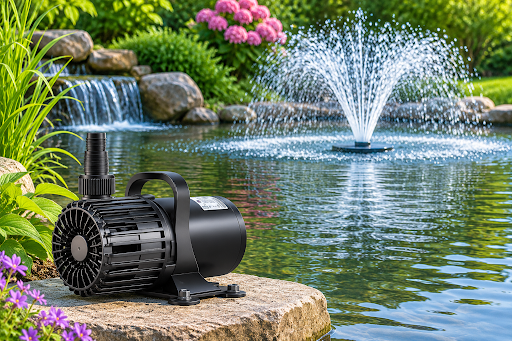
An attractive pond fountain starts with a practical understanding of how water travels through its equipment. When planning around a 1600 GPH pond pump, the distance between the intake and nozzle matters just as much as the size of the pond. Tubing, fittings, spray heads, and changing water levels affect the final display. Mapping these details before installation can prevent disappointing spray patterns and avoidable adjustments.
Draw the Water Route Before Choosing a Nozzle
A 1600 GPH pond pump has a nominal flow rating of 1,600 gallons per hour under defined conditions, not a promise that this volume reaches every elevated outlet. Begin with a simple sketch showing the planned pump position, hose route, nozzle, and water surface. Mark vertical lift, tubing length, bends, and any valves or connectors. Those features collectively influence resistance to flow.
When available, use the manufacturer’s performance curve to estimate output at the relevant total dynamic head. A pump can move considerable water with little resistance and substantially less through a narrow nozzle several feet above its outlet. If a particular spray pattern requires a minimum flow or pressure, confirm compatibility instead of selecting by appearance alone.
Consider the Pond’s Changing Water Level
A 1600 GPH pond pump must remain positioned within the immersion limits stated by its manufacturer. A pond can lose water through evaporation, windblown spray, and seasonal changes. If the intake becomes exposed, equipment may overheat or run without adequate cooling or lubrication. Conversely, positioning it directly in deep sediment can increase blockages.
Plan for a secure support or mounting location that does not obstruct the intake. In floating-fountain systems, verify how the pump attaches to the float and whether the assembly can move without pulling on cables. The referenced model is described for small to medium floating fountains, supports different fountain attachments, and includes a 20-foot electrical cord. These are useful starting specifications, but actual mounting and nozzle compatibility still need checking.
Balance the Spray Against Its Surroundings
A 1600 GPH pond pump may create different visual effects depending on which compatible fountain head is installed. A narrow jet directs water upward, while a wider pattern distributes droplets over a larger area. The latter can be appealing but may lose more water beyond the pond edge during windy conditions. Consider nearby paths, seating, and shoreline planting when deciding how much height or spread is practical.
Observe the display from normal viewing positions rather than only from beside the equipment. An impressive spray seen up close might block a view across the pond or wet a neighboring walkway. Test changes one at a time and document the resulting pattern. This makes it easier to return to a suitable configuration if a later adjustment performs poorly.
Verify Power and Commissioning Procedures
Before running a 1600 GPH pond pump, confirm that the outdoor electrical supply, circuit protection, and cord placement satisfy the manufacturer’s instructions and local electrical requirements. Ground-fault protection is especially important around water. Never make improvised submerged splices or assume an indoor extension lead is suitable for permanent pond use.
After installation, inspect the assembly from a safe position for stable flow, unusual vibration, and leaks at accessible connections. Disconnect power before putting hands in the water or changing a nozzle. Check that any intake screening does not reduce flow below the pump’s operating requirements. A gradual commissioning process can reveal routing problems before they become recurring maintenance tasks.
Record Performance Across the Seasons
A 1600 GPH pond pump benefits from a simple maintenance record. Note when the intake was inspected, which nozzle is fitted, and whether the spray looks weaker after storms or leaf fall. Changes may reflect debris, water level, hose restrictions, or wear rather than an immediate need for a replacement motor.
Follow the manual for cleaning and cold-weather storage. If fish or aquatic plants are present, avoid disturbing sensitive areas while removing accumulated debris. Remember that circulation does not by itself guarantee adequate water quality or oxygen throughout a pond; overall design and ecological conditions matter too.
Conclusion
A water pump filter bag may reduce debris entering a compatible intake, provided its fit and flow restriction meet the pump manufacturer’s instructions. Planning the water route, spray placement, power supply, and seasonal inspection schedule gives a fountain a better chance of running consistently. Good results follow from matching the equipment to the entire setting rather than one printed capacity figure. A measured installation is easier to operate and maintain.