
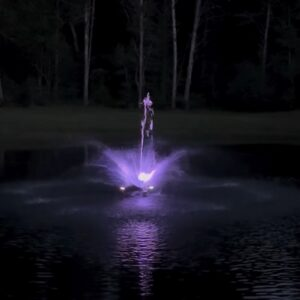
A pond fountain can change considerably after sunset when its water movement is properly illuminated. Lighting does more than make a water feature visible at night; it can define spray patterns, emphasize moving water, and improve the overall appearance of a landscape. The type of fixture, light color, placement, power requirements, and compatibility with the fountain all influence the final result.
Understanding these factors helps property owners select lighting that works with their water feature instead of simply adding brightness around it. Outdoor fountain lighting is particularly useful for fountain installations because strategically positioned fixtures can direct light into the spray and create a more defined nighttime display.
Why Fountain Lighting Matters After Dark
Water naturally reflects and refracts light, making fountains particularly suitable for nighttime illumination. Without dedicated lighting, much of the fountain’s movement may become difficult to see once natural light disappears.
Properly positioned fixtures can highlight the height and shape of water streams while creating reflections across the pond surface. White lighting can provide a clear view of water movement, while color-changing options can create a more decorative appearance.
Lighting can also help visually define a fountain’s location after dark. This may be useful around landscaped ponds, recreational properties, parks, and other spaces where people spend time during the evening.
LED Lights Are Common for Pond Fountains
LED technology is widely used for water-feature lighting because LEDs can provide illumination with relatively low power consumption. Outdoor fountain lighting systems may also use low-voltage electrical systems, depending on their design and installation requirements.
For example, some fountain lights use three 12-volt LED fixtures with a combined 6-watt power consumption. These fixtures can be mounted directly around a floating fountain assembly to illuminate the spray from below. LEDs are also available in different lighting configurations. Static white illumination can emphasize water clarity and spray definition, while multi-color systems can produce changing visual effects.
White vs. Color-Changing Fountain Lights
The appropriate lighting color depends largely on the intended appearance of the water feature.
White Lighting
White LEDs provide straightforward illumination and can make water movement easier to distinguish at night. They are suitable for landscapes where the goal is to maintain a clean, natural appearance without introducing changing colors.
Because white light provides consistent illumination, it can also make different fountain spray patterns easier to observe.
Color-Changing Lighting
Color-changing LEDs offer a more decorative approach. Different colors can be used to alter the appearance of the fountain for events, seasonal displays, or landscape design preferences.
These systems are particularly noticeable when the light beams intersect with moving water. Instead of simply illuminating the pond surface, correctly positioned fixtures can make individual streams and droplets more visible.
Placement Affects the Appearance of the Fountain
The position of a light can be just as important as its brightness. A fixture aimed incorrectly may create glare, illuminate only part of the spray, or produce uneven areas of brightness.
Lights installed around the fountain assembly can direct illumination upward through the water. This approach helps reveal the movement of the spray rather than simply lighting the surrounding pond.
The fountain’s spray height and width should also be considered. A larger fountain may require broader or strategically positioned illumination to cover the complete water display. Smaller fountains may need more focused lighting to avoid excessive glare or unnecessary light spill.
Consider Electrical Requirements Carefully
Water and electricity require careful planning. Outdoor fountain lighting should be designed specifically for wet or outdoor environments, and the electrical installation should follow applicable safety requirements.
Low-voltage lighting is commonly used in fountain applications. Some floating fountain lighting systems, for example, use 12-volt LED fixtures while the fountain itself operates from a separate higher-voltage supply.
Before installation, users should verify voltage requirements, transformer compatibility, cable length, connector protection, and the location of the power source. Electrical components should be appropriately protected from moisture, and installations should follow local electrical codes and manufacturer instructions.
Match Lighting to Fountain Size and Spray Pattern
A lighting system should complement the fountain rather than overwhelm it. The fountain’s pump capacity, spray height, number of nozzles, and overall dimensions can affect how light interacts with the water.
Some floating fountain systems offer multiple interchangeable spray nozzles, producing different shapes and dimensions. A lighting arrangement that works well for one spray pattern may appear different when the nozzle is changed.
This is why lighting selection should take the complete fountain configuration into account. The objective is to illuminate the water movement evenly while maintaining a balanced appearance across the pond.
Maintenance Helps Preserve Light Performance
Outdoor fountain lights remain exposed to moisture, changing temperatures, minerals, algae, and other environmental conditions. Over time, buildup on a fixture can reduce the amount of light reaching the water.
Routine maintenance can include checking fixtures, cleaning surfaces according to manufacturer instructions, examining cables and connections, and removing debris around the fountain. Any damaged electrical component should be addressed before the lighting system is returned to operation.
Proper maintenance is especially important for installations that operate frequently or remain outdoors throughout changing seasons.
Conclusion
Effective pond illumination requires more than choosing the brightest available fixture. The fountain’s size, spray pattern, lighting color, installation position, electrical requirements, and environmental conditions all influence how the finished display looks and operates.
For anyone planning to illuminate a floating pond fountain, selecting compatible LED fixtures and positioning them to work with the water movement can create a clearer and more balanced nighttime display. Careful installation and regular maintenance can further support consistent performance while helping the lighting remain an integrated part of the overall water-feature design.