
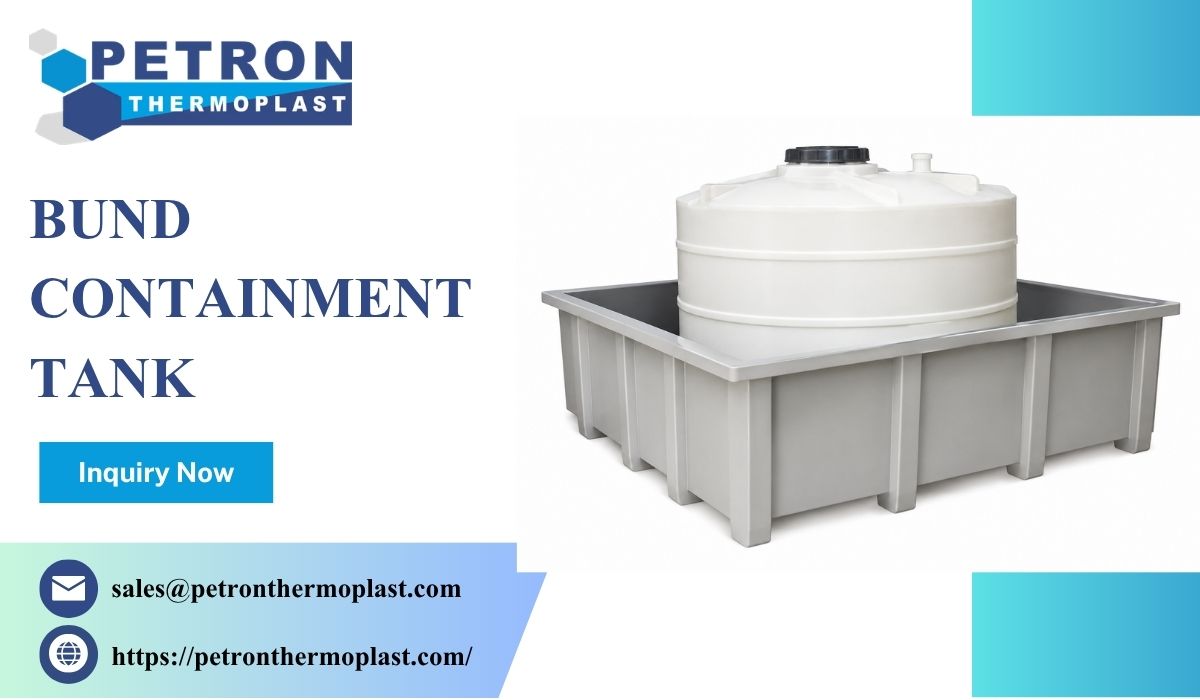
Chemical storage and handling require more than a primary storage tank. Industrial facilities also need a reliable secondary containment system to help manage accidental leaks, spills, and overflow. A Bund Containment Tank provides an additional layer of protection around a chemical storage or process tank.
With a custom size and capacity, a bund containment tank can be designed according to the dimensions of the primary tank, available installation space, chemical requirements, and site conditions. This makes it suitable for different industrial applications where standard containment systems may not provide the required fit.
Petron Thermoplast provides custom-fabricated thermoplastic containment solutions for chemical storage and industrial applications, with options based on tank dimensions, capacity, material, fittings, and project requirements.
What Is a Bund Containment Tank?
A Bund Containment Tank is a secondary containment structure designed to collect liquid that may escape from a primary storage tank, process tank, chemical container, or connected piping system. The primary tank stores the chemical or process liquid. The bund acts as a protective containment area around or beneath the primary tank.
Its main purpose is to help:
- Control accidental chemical spills
- Reduce the spread of leaked liquids
- Protect surrounding floors and equipment
- Support safer chemical handling
- Simplify spill management
- Reduce the risk of contamination around storage areas
Why Is Secondary Containment Important?
Even a properly designed storage tank can experience leakage because of damaged fittings, piping failures, accidental impact, overfilling, connection problems, or other unforeseen events.
Without secondary containment, a chemical spill can spread across the plant floor and potentially reach drains, equipment, soil, or other sensitive areas. A properly designed bund provides an additional barrier between the stored liquid and the surrounding environment.
For industrial chemical storage areas, secondary containment can therefore be an important part of the overall safety and spill-management strategy.
Custom Size and Capacity
Every industrial facility has different storage requirements. A standard bund may not fit a particular tank or installation area.
A custom Bund Containment Tank can be designed according to:
- Primary tank length
- Primary tank width
- Primary tank height
- Required containment capacity
- Available floor space
- Tank support arrangement
- Chemical type
- Number of tanks
- Piping connections
- Drain requirements
- Installation conditions
Materials Used for Bund Containment Tanks
Material selection is an important consideration when handling chemicals. Thermoplastic materials can offer good corrosion resistance for many chemical applications.
Common materials may include:
| Material | Typical Characteristics |
| PP | Good chemical resistance and fabrication flexibility |
| PPH | Suitable for demanding chemical applications |
| HDPE | Good chemical and impact resistance |
| PVC | Suitable for many compatible chemical services |
| CPVC | Useful where higher temperature capability is required |
| PVDF | Excellent resistance for demanding chemical environments |
How Does a Bund Containment System Work?
A typical arrangement consists of a primary storage tank positioned within or above a secondary containment area.
Under normal operating conditions, the primary tank holds the chemical. The bund remains available to collect liquid if a leak or spill occurs.
If the primary tank develops a leak, the released liquid is directed into the containment area rather than spreading across the surrounding plant floor.
Depending on the design, the containment system can include:
- Drain arrangements
- Sump areas
- Inspection access
- Removable covers
- Level indication
- Tank supports
- Custom nozzles
- Pump-out arrangements
Applications of Bund Containment Tanks
Bund containment systems are used in several industries where liquids need controlled storage and handling.
- Chemical Storage
Chemical plants may use secondary containment around tanks storing acids, alkalis, solvents, and other compatible chemicals.
- Acid Storage
Acid storage areas can benefit from secondary containment to help manage accidental leakage and prevent uncontrolled spread.
- Water Treatment
Chemical dosing and treatment facilities often store chemicals in dedicated tanks. A bund can provide additional protection around these storage systems.
- Electroplating and Metal Finishing
Plating plants may handle several aggressive chemicals. Bunded containment can be incorporated into chemical storage and process areas.
- Pickling Operations
Pickling processes involve corrosive chemical solutions. Secondary containment can help protect the surrounding work area in case of leakage.
- Manufacturing Plants
Industrial manufacturing facilities may use chemicals, oils, cleaning agents, and process fluids that require controlled containment.
- Chemical Distribution and Storage Facilities
Bulk storage facilities can use containment systems around chemical tanks to support safer storage operations.
Key Features of a Custom Bund Containment Tank
A properly designed bund can include several application-specific features.
Custom Dimensions
The length, width, and height can be designed according to the primary tank and available installation space.
Chemical-Resistant Construction
The selected thermoplastic material can be chosen based on the chemical being contained.
Reinforced Construction
Large containment systems may require additional reinforcement to maintain structural stability.
Easy Inspection
The design can provide access for inspection and cleaning.
Drain or Sump Arrangement
A controlled drainage or sump system can help manage collected liquid, subject to the site’s operating and safety procedures.
Tank Support Integration
The bund can be designed around the support arrangement of the primary storage tank.
Custom Connections
Pipe, drain, overflow, and other connections can be incorporated where required.
Benefits of a Custom Bund Containment Tank
Choosing a custom solution can provide several practical advantages.
- Better use of available installation space
- Application-specific containment capacity
- Improved compatibility with the primary tank
- Reduced risk of uncontrolled liquid spread
- Chemical-resistant material options
- Easier integration with existing systems
- Flexible drain and piping arrangements
- Suitable for different tank configurations
- Simplified inspection and maintenance
Bund Containment Tank Capacity
Containment capacity is one of the most important design considerations.
The required capacity should not be selected simply by looking at the physical dimensions of the primary tank. Engineers may need to consider:
- Primary tank volume
- Number of tanks inside the bund
- Freeboard requirements
- Potential rainfall for outdoor installations
- Displacement from tank supports and equipment
- Applicable local regulations
- Chemical properties
- Emergency response procedures
Technical Factors to Consider Before Ordering
Before requesting a quotation, buyers should provide complete project information.
| Requirement | Details |
| Primary Tank Size | Length, width, height |
| Tank Capacity | Total and working volume |
| Chemical | Chemical name and concentration |
| Temperature | Normal and maximum operating temperature |
| Bund Dimensions | Required length, width, and height |
| Installation | Indoor or outdoor |
| Tank Quantity | Number of tanks to be contained |
| Drainage | Drain or sump requirements |
| Connections | Required piping and fittings |
| Material | Preferred thermoplastic or application requirements |
Providing these details helps the manufacturer understand the application and develop an appropriate design.
Custom Bund vs. Standard Bund
Standard containment systems can work well for common tank sizes. However, custom fabrication provides greater flexibility when the installation has special requirements.
| Feature | Custom Bund Containment Tank | Standard Bund |
| Dimensions | Application-specific | Predetermined |
| Capacity | Customizable | Fixed |
| Tank compatibility | Designed around project requirements | Limited to standard sizes |
| Connections | Custom options | Standard options |
| Space utilization | Optimized | May require additional space |
| Project flexibility | High | Moderate |
Why Choose Petron Thermoplast?
Petron Thermoplast provides fabricated thermoplastic solutions for chemical storage, process applications, and secondary containment requirements.
The company can support requirements involving:
- Custom bund dimensions
- Different containment capacities
- Thermoplastic material selection
- Reinforced construction
- Drain and sump arrangements
- Custom tank supports
- Piping connections
- Industrial chemical applications
- Bulk project requirements
Conclusion
A Bund Containment Tank with Custom Size and Capacity can provide an important secondary containment layer for industrial chemical storage and process applications. It helps control accidental leaks and spills while protecting surrounding equipment and work areas.
Custom fabrication allows the containment system to be designed according to the primary tank, available floor space, chemical compatibility, required capacity, and installation conditions.
For chemical plants, water treatment facilities, plating units, pickling operations, and other industrial environments, proper secondary containment can contribute to safer and more organized liquid handling.
Petron Thermoplast offers custom-fabricated bund containment solutions for industrial requirements, with options based on tank size, capacity, material, and application.Looking for a Bund Containment Tank with custom size and capacity? Contact Petron Thermoplast with your primary tank dimensions, chemical details, and containment requirements for a customized solution.