
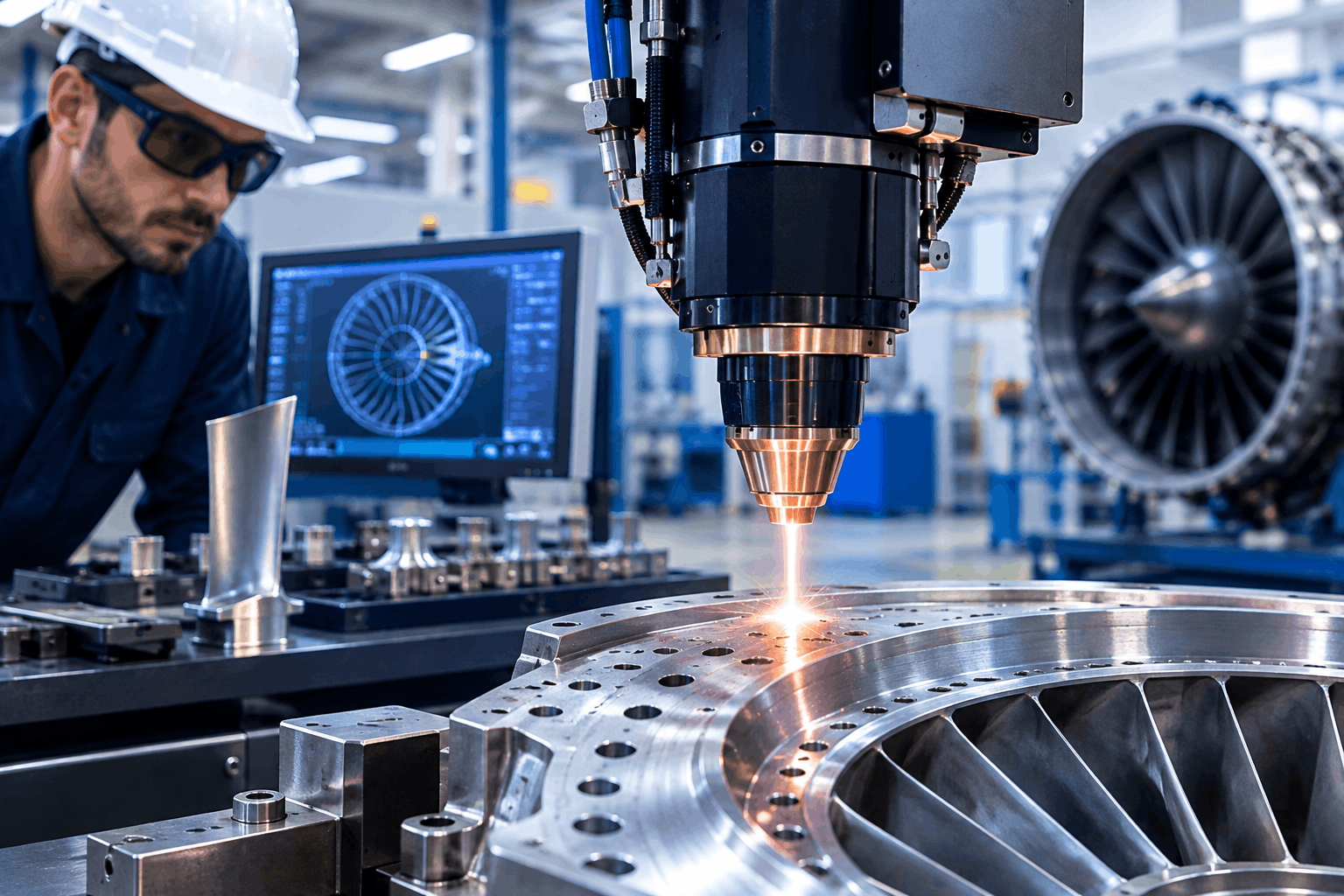
Ever wondered how a jet engine survives temperatures hot enough to melt the metal it’s made from? The secret isn’t some exotic material nobody’s heard of. It’s actually thousands of tiny, precisely placed holes that let cooling air pass through turbine blades like sweat through skin. And the tool responsible for creating those holes, often smaller than a human hair, is the laser drill.
If you work anywhere near aerospace manufacturing, you’ve probably heard laser drilling mentioned in the same breath as “impossible tolerances” and “mission-critical parts.” That’s not marketing fluff. When a single misplaced hole can throw off airflow across an entire turbine blade, precision stops being a nice-to-have and becomes the whole point.
Let’s break down what laser drilling actually is, why the aerospace industry can’t seem to function without it, and where this technology is headed next.
What Exactly Is Laser Drilling?
1. The Basic Science Behind the Beam
At its core, laser drilling uses a concentrated beam of light to vaporize or melt material at a precise point, creating a hole without a drill bit ever touching the surface. Think of it like using a magnifying glass to burn a hole in a leaf, except instead of sunlight, you’ve got a laser capable of hitting temperatures over 10,000 degrees Celsius in a spot smaller than a pinhead.
The beam is pulsed rather than continuous in most aerospace applications. Each pulse removes a tiny layer of material, and repeated pulses gradually bore through the part. This pulsing gives engineers granular control over depth, diameter, and how much heat spreads into surrounding material.
2. How It Differs From Mechanical Drilling
A mechanical drill bit physically grinds and shears material away, which sounds simple until you’re trying to drill a hole 0.3mm wide through a curved, heat-resistant alloy without cracking it. Laser drilling skips the physical contact entirely. No tool wear, no cutting forces bending thin walls, and no risk of a snapped drill bit ruining a part that cost thousands of dollars to forge in the first place.
That’s a huge deal in aerospace, where a single turbine blade can be more expensive than the car you drive.
Why Aerospace Manufacturing Leans So Heavily on Laser Drilling
1. Turbine Blade Cooling Holes
Jet engines run hotter than the melting point of the metals used to build them. The only reason those blades survive is a network of micro-holes, sometimes numbering in the hundreds per blade, that channel cooler air across the surface. Laser drilling is really the only practical way to create that many holes at that scale with the angle precision required, since many of these holes are drilled at steep compound angles rather than straight down.
2. Working With Nickel Superalloys and Titanium
Aerospace components are frequently made from nickel-based superalloys and titanium, materials chosen specifically because they resist heat, corrosion, and fatigue. Unfortunately, those same properties make them brutal to machine conventionally. Lasers don’t care how hard or heat-resistant a material is; they just vaporize it, which makes laser drilling a natural fit for these notoriously stubborn alloys.
3. Speed Without Sacrificing Accuracy
A modern laser drilling system can punch out a hole in milliseconds. Multiply that across a production run of thousands of blades, and you start to see why manufacturers rely on lasers instead of slower mechanical methods. Speed matters, but it only matters if accuracy doesn’t take a hit, and that balance is exactly what laser systems are built to deliver.
The Laser Drilling Process, Step by Step
1. Material Prep and Fixturing
Before any beam fires, the component gets cleaned and locked into a fixture that holds it dead still. Even a fraction of a millimeter of movement can throw off hole placement on a part where tolerances are measured in microns.
2. Pulse Selection and Beam Focusing
Engineers dial in pulse duration, energy, and focal length based on the material thickness and desired hole geometry. This step is where the real expertise lives. Get the pulse settings wrong, and you risk excess melting, warping, or holes that taper instead of running straight through.
3. Drilling and Post-Process Inspection
Once drilling is complete, parts go through inspection, often using X-ray or borescope imaging, to confirm hole diameter, depth, and angle all meet spec. In aerospace, “close enough” isn’t a phrase anyone wants to hear during a quality check.
Common Challenges Engineers Run Into
1. Recast Layer and Micro-Cracking
When the laser melts material, some of it resolidifies around the hole edge, forming what’s called a recast layer. If not managed properly, this layer can crack under thermal stress later. Manufacturers combat this with secondary processes like chemical etching or controlled pulse profiles that minimize recast buildup in the first place.
2. Hole Taper on Thick Sections
Drilling straight through thicker material can cause the hole to narrow slightly from entry to exit, like a cone instead of a cylinder. Engineers counter this with trepanning techniques or by adjusting beam angle mid-drill to keep the hole walls parallel.
3. Heat-Affected Zones
Even a laser leaves a thermal footprint. The area immediately surrounding the hole can experience microstructural changes that weaken the material if left unchecked. Careful cooling and pulse timing keep this heat-affected zone as thin as possible.
Laser Drilling vs. Deep Laser Engraving in Aerospace Work
1. When Drilling Makes More Sense
Drilling is the go-to when you need a hole that passes through or into material for a functional purpose, cooling channels, fuel injector nozzles, or fastener clearance holes. It’s about creating an opening, not a mark.
2. When Engraving Takes Over
Deep laser engraving, on the other hand, is about marking rather than piercing, think serial numbers, traceability codes, or part identifiers etched into a surface without compromising structural integrity. Many aerospace suppliers rely on the same laser platforms for both jobs, switching settings depending on whether they need a hole or a mark. If you’re sourcing equipment capable of handling both roles, it’s worth looking into a reliable laser engraver for metal that can transition between drilling and marking tasks without a full retool, and comparing specs across the best laser engravers currently on the market before committing to a system.
The Future of Laser Drilling in Aerospace
1. Ultrafast Femtosecond Lasers
Femtosecond lasers fire pulses so short that they vaporize material almost instantly, with barely any time for heat to spread into surrounding areas. This drastically reduces recast layers and heat-affected zones, which is a big reason aerospace manufacturers are increasingly interested in adopting them for next-generation components.
2. Smarter, Self-Correcting Systems
Newer laser drilling rigs are being paired with real-time sensors and AI-assisted monitoring that adjust pulse energy on the fly if the system detects inconsistencies mid-drill. Instead of catching an error after the fact during inspection, the machine corrects itself before the part is even finished.
Conclusion
Laser drilling isn’t flashy in the way a jet taking off is flashy, but it’s one of those unsung processes that makes modern aviation possible in the first place. From the microscopic cooling holes in a turbine blade to the fuel injector nozzles keeping combustion efficient, this technology sits quietly behind some of the most demanding engineering standards on the planet. As materials get tougher and tolerances get tighter, laser drilling isn’t going anywhere. If anything, it’s only going to get more precise, faster, and smarter.
FAQs
1.Is laser drilling more accurate than mechanical drilling? Yes, especially for small, angled, or hard-to-reach holes in tough alloys.
2.What materials work best with laser drilling? Nickel superalloys, titanium, and other heat-resistant metals common in aerospace parts.
3.Does laser drilling weaken the material around the hole? It can, through heat-affected zones, but proper pulse control minimizes this significantly.
4.How small can laser-drilled holes be? Holes smaller than a human hair are achievable with precision laser systems.
5.Is laser drilling used outside aerospace? Yes, though aerospace remains one of its most demanding and common applications.