
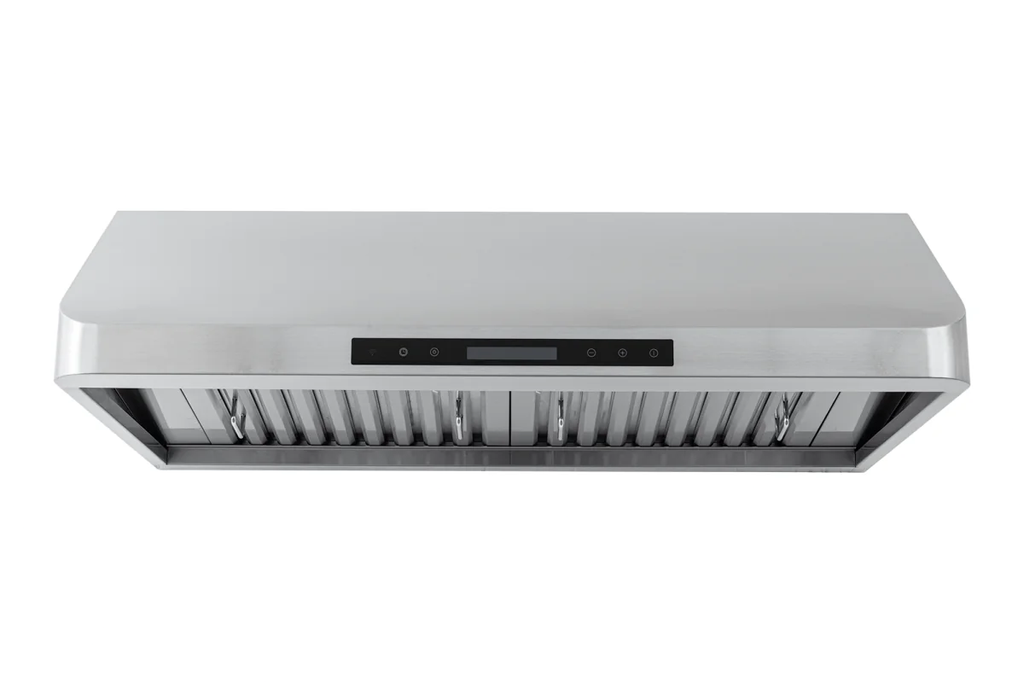
Kitchen ventilation helps control smoke, grease, steam, heat, and cooking odors produced during meal preparation. The right hood needs to fit the cooking surface while working effectively within the kitchen’s layout. An under-cabinet stove hood vent is designed to fit beneath existing cabinetry, making it a practical option for kitchens where preserving overhead space is important. Proline’s under-cabinet collection includes models with different widths, airflow capacities, and ducted or convertible configurations.
What Is an Under-Cabinet Range Hood?
An under-cabinet stove hood vent is installed directly beneath a cabinet above the cooktop or range. Its compact installation allows the existing cabinetry to remain part of the kitchen design while providing ventilation.
These hoods can be ducted, meaning cooking air is exhausted outside through a ventilation system, or convertible to ductless operation on compatible models. Ductless configurations use filtration before returning air to the kitchen. Proline’s collection includes both ducted models and convertible options.
Why Does Hood Size Matter?
The hood should provide adequate coverage for the cooking surface. Common widths include 30, 36, 42, 48, 54, and 60 inches, depending on the model. Proline’s under-cabinet stove hood vent collection includes several models designed for standard-sized kitchen layouts.
Before purchasing, the width of the range or cooktop, cabinet opening, available depth, and installation clearance should be measured carefully. The manufacturer’s installation specifications should always take priority because dimensions and clearance requirements vary between models.
How Much CFM Is Needed?
Airflow is measured in cubic feet per minute, or CFM, and indicates how much air the hood can move. The appropriate capacity depends on the cooking surface, cooking habits, fuel type, and the amount of smoke and heat produced.
Proline’s under-cabinet range hood collection includes models ranging from approximately 600 CFM to 2000 CFM, providing options for different cooking requirements.
A higher CFM rating does not automatically mean better performance for every kitchen. Excessive airflow can increase noise and may introduce additional ventilation considerations. The hood should therefore be selected according to the cooking application and manufacturer’s recommendations.
Ducted or Ductless: Which Is Better?
Ducted ventilation removes cooking air from the kitchen and exhausts it outside. It can be particularly useful for frequent frying, grilling, or high-heat cooking because airborne grease and odors are directed outdoors.
Ductless ventilation is useful when installing external ductwork is impractical. Compatible systems use charcoal filters to help capture odors and other airborne particles before filtered air returns to the room. Proline recommends periodic charcoal filter replacement depending on usage.
How Does a Wall-Mount Hood Compare?
A 30-inch wall-mount range hood is installed against the wall rather than underneath cabinetry. This configuration can provide a different visual appearance and may offer larger hood designs for kitchens with open wall space.
Under-cabinet hoods are generally better suited to layouts where cabinets surround the cooking area. Wall-mounted models may be preferable when there is no cabinet directly above the range or when a more prominent hood design is desired. The choice depends largely on kitchen layout, available space, ventilation requirements, and design preferences.
What Other Features Should Be Considered?
Important features can include fan-speed settings, lighting, filter type, controls, noise levels, and construction materials. Stainless steel is commonly used because it is durable and relatively easy to maintain.
For example, the Proline PLSW 115 offers 600 CFM, four fan speeds, dishwasher-safe baffle filters, LED lighting, and a convertible ductless configuration.
Conclusion
Selecting an under-cabinet hood requires consideration of hood width, airflow, ventilation method, cabinet dimensions, filtration, and maintenance. Under-cabinet models can preserve valuable kitchen space, while a wall mount range hood 30 inch may be more appropriate for open wall installations without overhead cabinetry. Comparing these factors with the kitchen’s layout and cooking habits can help identify a ventilation system that provides suitable performance and practical everyday use.