
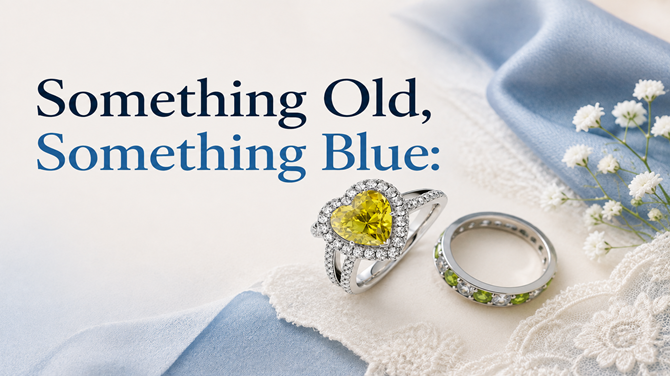
Most people who repeat “something old, something new, something borrowed, something blue” on a wedding day have no idea they’re reciting something that predates their great-great-grandparents and that the “blue” part of it wasn’t originally about a sapphire or tanzanite wedding band, or a dress, a garter, or a ribbon at all. It was about warding off a curse.
A Rhyme Older Than Most People Realise
The rhyme is usually filed away as generic wedding folklore, the kind of thing nobody questions because it’s simply always been there. But it has a genuine, documented history, and it’s more specific than most brides ever hear.
The First Time It Was Written Down
The earliest known written record of the first two lines appears in an 1871 short story called Marriage Superstitions and the Miseries of a Bride Elect. Five years later, in 1876, a newspaper report describing a wedding in Lancashire mentioned a bride wearing something old, something new, something borrowed, and something blue, which is part of why the tradition is often traced back to that region of England. That said, the actual origin is genuinely uncertain; similar customs like exchange of rings like ruby, diamond or any gemstone ring like blue topaz engagement ring were already circulating through English folklore more broadly, and there’s evidence the tradition may also have existed in Northern France around the same period.
What the Rhyme Was Actually Protecting Against
Now, an intriguing fact is that this wasn’t originally a light-hearted style tradition. An 1898 compilation of English folklore explained the rhyme in far more ominous terms than the version told at modern weddings. Something old and something blue were both described as devices meant to confuse or ward off the Evil Eye, which was a belief, common across many cultures, that envy or ill intent could be directed at a person through a look, causing real harm. For a bride specifically, that harm was believed to take the form of infertility. The “new” item represented optimism for the marriage ahead, and the often-forgotten final line (a silver sixpence tucked into the bride’s shoe) was a charm for prosperity, sometimes described as a ward against rejected suitors wishing the marriage ill.
Why Blue Specifically Became the Colour of Choice
Blue wasn’t randomly assigned to the rhyme. Long before “something blue” became a wedding-day checklist item, the colour itself carried a long-standing association with purity and fidelity in English tradition, which is precisely why it made sense as the colour meant to protect a new marriage rather than any other shade.
The Garter Detail Nobody Mentions Anymore
In the earliest documented versions of the tradition, “something blue” specifically took the form of a garter, which was an item already tied to older wedding customs, including the now largely abandoned ritual of a bride’s garter being removed as part of the ceremony. Over time, as that particular custom faded, “something blue” loosened into whatever a bride chose it to be: a ribbon, ribbon-lined shoes, a sash, or, increasingly, jewellery.
A Colour That Kept Reappearing at Royal Weddings
The tradition has proven remarkably durable precisely because it’s flexible. When Catherine, then Duchess of Cambridge, married in 2011, a small blue bow was sewn into the inside of her dress, which is a documented, intentional nod to a superstition that by then was already well over a century old.
A Modern Way to Carry the Same Idea Forward
Everything above is documented history. What follows is not. It’s a way of looking at three entirely unique jewellery traditions through the lens of that history, rather than a claim that any of them are historically connected to the English rhyme itself.

A Blue Topaz Engagement Ring, Seen Through an Old Superstition
Although there’s no historical record of Victorian brides specifically choosing blue topaz for this tradition, the rhyme predates the kind of gemstone-specific styling associated with it by a significant margin. But it’s a genuinely intriguing modern parallel: a blue topaz engagement ring puts exactly the colour the old rhyme called for directly into the ring itself, rather than hiding it in a ribbon or a borrowed garter. What was once a private, almost superstitious detail has become something worn openly and permanently. That’s not history repeating itself; it’s simply a lovely piece of symmetry between an old idea and a modern choice.
A Tanzanite Wedding Band as a Different Kind of “Blue”
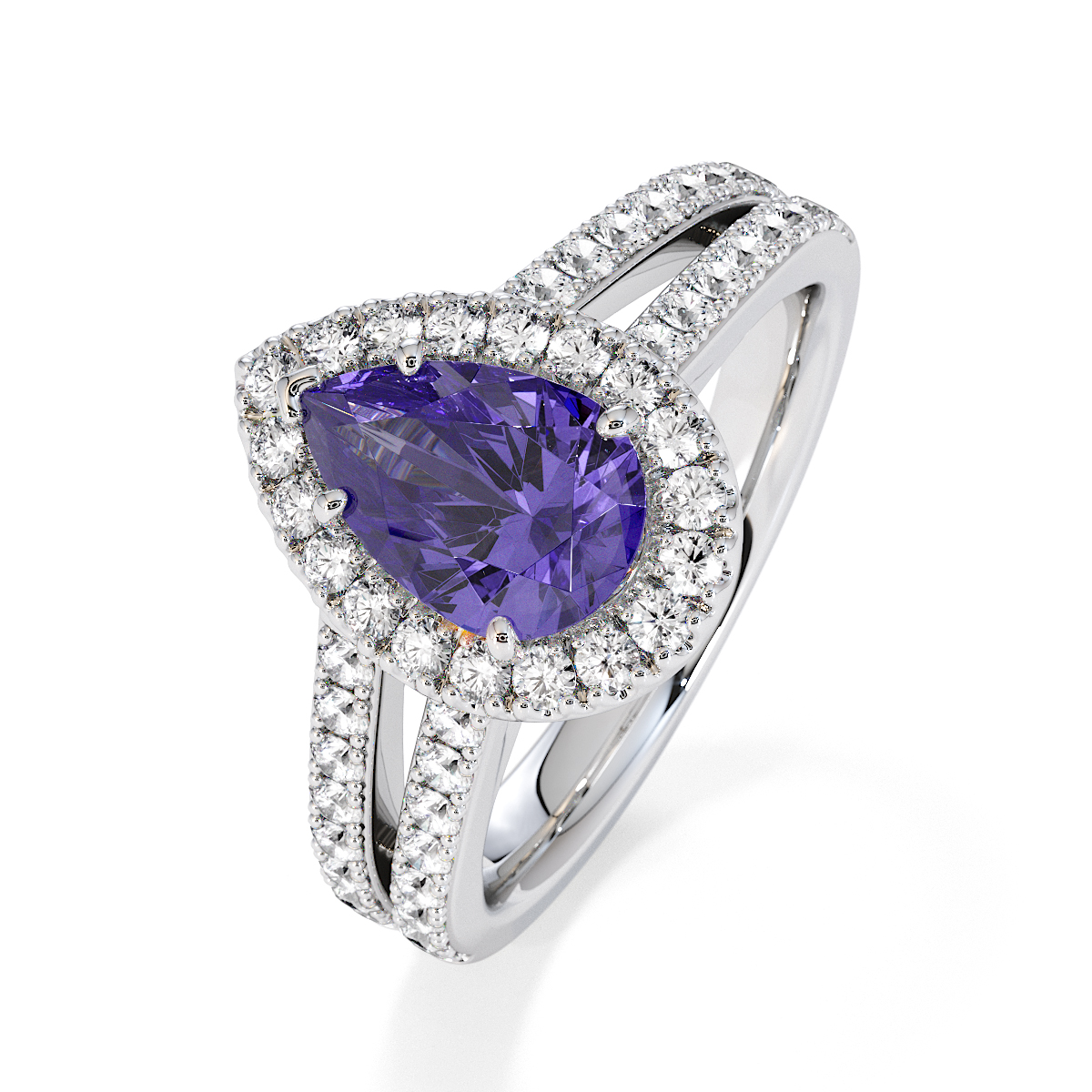
As a gemstone, Tanzanite is wonderful option in the shades of blue. It is worth noting how differently a tanzanite wedding band would fulfil the same symbolic role that the rhyme originally intended. Tanzanite doesn’t hold one fixed blue, but it shifts between blue, violet, and a faint burgundy depending on the light and angle, a genuine optical property called “pleochroism”. Where the Victorian tradition called for a single blue object worn once, on one day, a tanzanite wedding band is worn constantly and looks slightly different every time the light catches it, which is an intriguing, entirely modern reinterpretation of “something blue” rather than a historical one.
The Diamond Mangalsutra: A Completely Separate Tradition
Although the mangalsutra has no historical relationship to this English rhyme and originates from an entirely different cultural tradition, it is worn in Hindu marriage customs and was made from black and gold beads long before diamonds were incorporated into modern designs. The intriguing point isn’t a shared origin but a shared instinct. Two completely unconnected cultures, centuries and continents apart, independently arrived at the same basic idea: that marriage deserves a visible, permanently worn symbol, not just a private vow. A diamond mangalsutra and an English “something blue” charm both do that job, just through entirely separate histories.
Old Superstition, New Symbolism
The documented history here is genuinely worth knowing for its significance. A 19th-century English superstition about fertility and the Evil Eye has quietly survived into modern weddings, primarily as a pleasant tradition rather than the anxious protective ritual it once was. Whether that history has anything to do with the ring or necklace someone chooses today is really a matter of personal meaning rather than documented fact. But that’s arguably the more intriguing takeaway: traditions like this rarely survive by staying frozen. They survive by being reinterpreted, generation after generation, into whatever form still feels meaningful, like a hidden ribbon in 1876, a bow sewn into a royal wedding dress in 2011, or simply a stone chosen today because its colour still quietly means something.
Summing Up
To sum up, various histories are associated with different centuries and cultures. Although the cultures and the traditions might be different, the intent remains the same, which is to ward off the evil eye and wish for a happy future for the couple stepping into the new phase of their lives.