
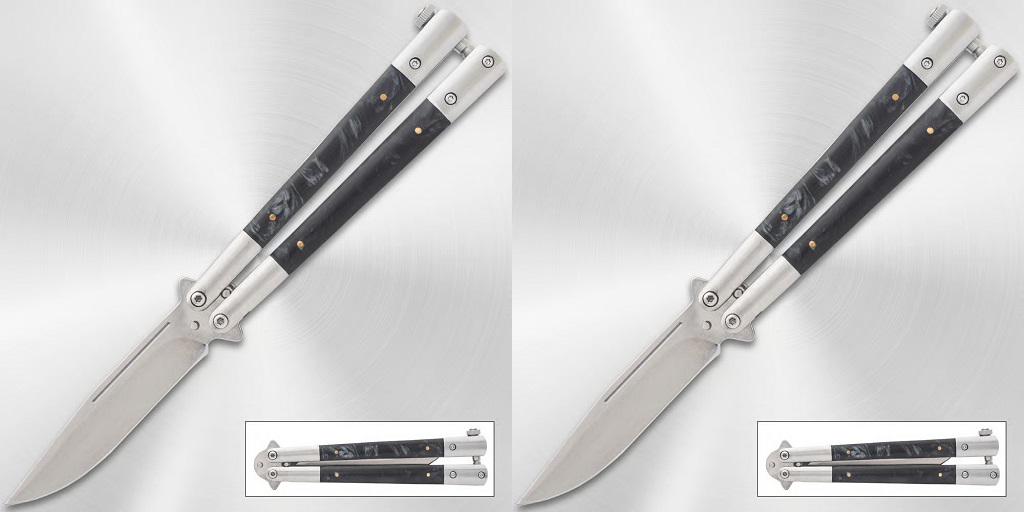
The vast majority of folding knives on the greater market are OTS knives of some form or other, whether they are automatic, assisted openers, or just manual knives with thumb studs or flipper tabs.
Either way, they’re not your only option, and you may have at some point considered an OTF knife as an alternative. If this is the case for you, here are a few things to think about.
An OTF Knife
An OTF knife is effectively any knife with a blade that deploys out of the front of the handle or frame, rather than rotating around a pivot built into it and coming out the side. OTF literally stands for “out the front”, giving an OTF knife its name.
There are some advantages of OTF knives that some users prefer:
- In some instances, they are easier to deploy than OTS knives.
- They have a lot of cool factor.
- Many OTF knives are autos that can be deployed and retracted with one hand.
- They’re quick and easy to learn to use for the most part, even if they are not as intuitive as some OTS folders.
- Some are gravity knives and have no deployment mechanisms that can break.
- Many OTF knives have very strong lock types.
With all of this being said, it doesn’t necessarily mean that an OTF knife is for you. Let’s take a closer look at OTS knives.
OTS Knives
If an OTF knife is any knife that has a blade that deploys out the front of the knife in linear fashion, then an OTS knife, or “out the side” knife, is any knife with a blade that folds along a pivot point such that it swings out the side of the knife, hence the name.
Traditional pocket knife patterns like stockman and barlow knives that have multiple blades are, strictly speaking, OTS knives, as are modern folders that open out the side. Like an OTF knife, an OTS knife can be an auto, but many are simply assisted openers and some require the blade to be opened manually.
Here are some advantages of OTS knives:
- The form factor is familiar and the learning curve is therefore usually shorter.
- OTS knives are often simpler than OTF knives.
- Most folding knives are OTS knives, offering you greater flexibility with respect to what you choose.
- Many OTS knives lack specific deployment mechanisms, making them easier to maintain.
- There are fewer regulations associated with OTS knives than there are with gravity knives and OTF autos.
Auto, Assisted Opening, or Manual?
Now that we’ve established what the draws of OTS and OTF knives are, you should consider the question of whether or not you want an auto, an assisted opener, or a manual knife.
Automatic knives open with the push of a button, and if you have a double action auto, it will close with the push of a button as well. These are easy and quick to deploy, but there are some legal considerations surrounding them.
Assisted openers require you to open the blade partly before a spring does the rest of the work. They can also be opened with one hand but require a little more skill, and there are fewer legal concerns associated with them.
Manual knives either have nail nicks and require two hands to open them, or else they will have thumb studs, holes, or flipper tabs that make it possible to open them with one hand. They’re also more widely available than either autos or assisted openers.
Where to Get a New OTS or OTF Knife?
Whether you’re here for an OTS or OTF knife, and whether or not you want an auto or a conventional folder with no fancy deployment mechanism, get what you’re looking for online at True Swords. Their online catalog has a wide range of options for you to choose from.
For more information about Wakizashi Katana and Wooden Handle Katana Please visit: True Swords.