
Japan’s flexible packaging market is undergoing a profound transformation, shifting rapidly toward circular economy principles, digital inkjet printing technologies, and strict regulatory compliance. As consumer preferences pivot toward convenience-oriented food consumption, ready-to-eat meals, and sustainable retail goods, brand owners and packaging converters are rethinking traditional material selection. Driven by ambitious national recycling targets and proactive industry collaborations, the sector is experiencing robust commercial expansion across major metropolitan hubs like Tokyo, Osaka, and Aichi.
Japan Flexible Packaging Market Size and Forecast 2026-2034
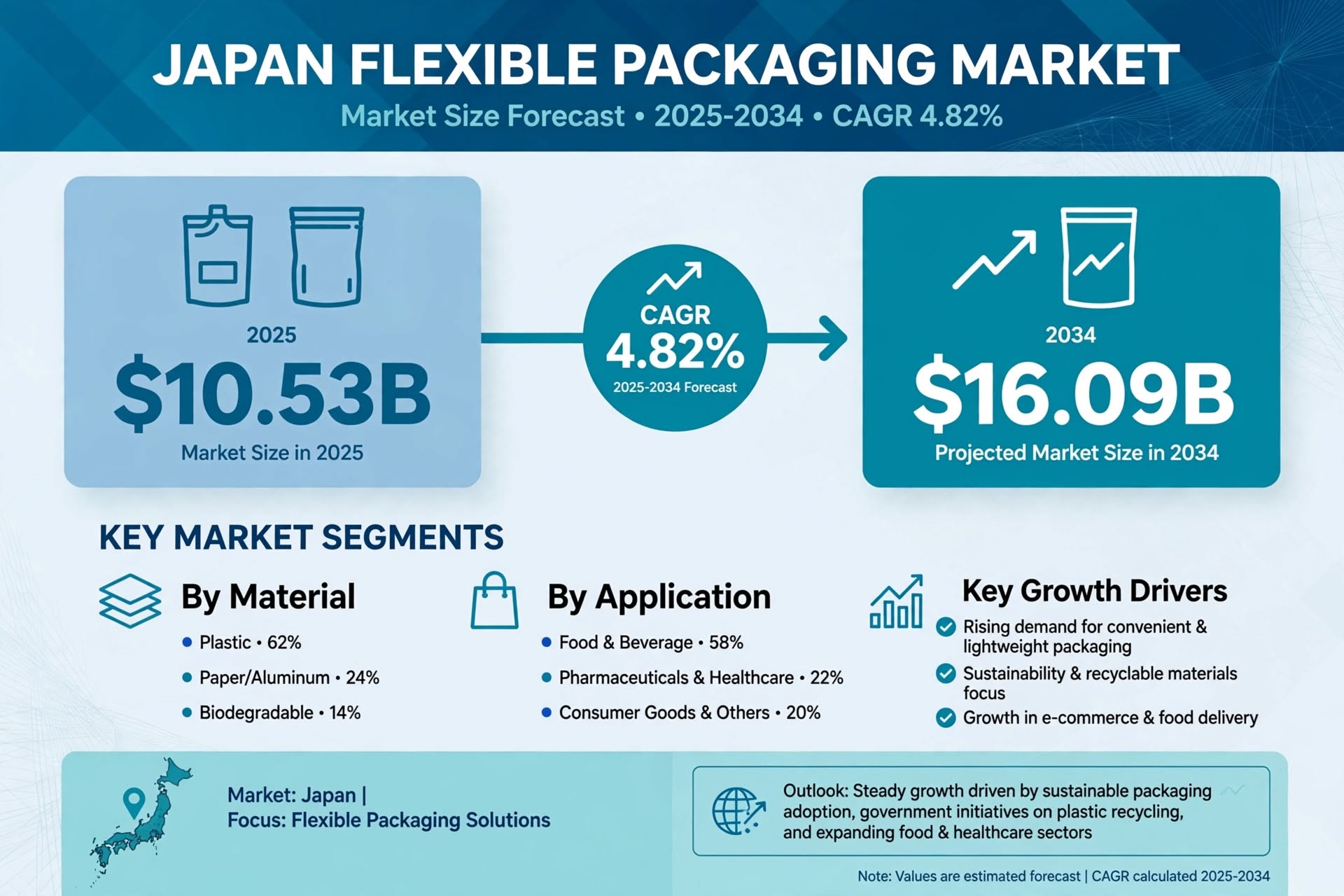
The Japan flexible packaging market is expected to reach US$ 16.09 billion by 2034 from US$ 10.53 billion in 2025, expanding at a compound annual growth rate (CAGR) of 4.82% from 2026 to 2034. This steady economic trajectory is propelled by accelerating demand for lightweight materials, stringent food safety mandates, and continuous innovations in recyclable mono-material and advanced packaging solutions.
Japan Flexible Packaging Industry Overview
Industrial efforts to enhance sustainability rely heavily on producing materials embedded with certified recycled content. This core strategy aligns directly with national and global aims to minimize plastic waste by encouraging circular economy models. For instance, in October 2024, TOPPAN Holdings Inc., RM Tohcello Co., Ltd., and Mitsui Chemicals, Inc. successfully developed a mass-production-ready recycled BOPP film derived from post-consumer and industrial film waste that was collected, de-inked, and reprocessed into high-purity pellets. This milestone supports Japan’s regulatory targets for recyclable plastics, aiming to expand horizontal recycling loops for flexible packaging films.
Concurrently, the manufacturing ecosystem is embracing advanced digital inkjet printing technologies to facilitate cost-effective small-batch production runs. In March 2024, Fujifilm Corporation introduced the Jet Press FP790, its pioneering water-based digital inkjet press engineered specifically for flexible packaging applications. Designed to maximize adaptability for food and household product manufacturers, it accommodates short-run orders without sacrificing high-speed productivity.
Industry leaders such as Rengo Co. Ltd. and Dai Nippon Printing Co. are pioneering high-barrier flexible solutions that extend product shelf life for cosmetics, pharmaceuticals, and perishable foods. Furthermore, the implementation of a positive list for food-contact additives by Japan’s Ministry of Health, Labor, and Welfare in June 2025 required converters to invest significantly in material reformulation per SKU, reinforcing product safety and regulatory alignment across domestic supply chains.
Download Free Sample Report:https://www.renub.com/request-sample-page.php?gturl=japan-flexible-packaging-market-p.php
Growth Drivers for the Japan Flexible Packaging Market
Rising Demand from Food and Beverage Industry The food and beverage sector remains the primary anchor of market expansion. Japanese consumers increasingly favor ready-to-eat meals, packaged snacks, and single-serve formats that accommodate busy, fast-paced lifestyles. Flexible pouches and wraps deliver exceptional barrier protection against oxygen, moisture, and ultraviolet light, safeguarding product freshness while reducing overall package weight and shipping costs.
Strong Focus on Sustainability and Recycling Initiatives Environmental stewardship and strict waste reduction laws are reshaping material choices. Manufacturers are accelerating investments in mono-material structures and biodegradable films designed to eliminate multi-layer sorting hurdles. Government-backed recycling incentives and corporate carbon-neutrality pledges ensure that eco-friendly packaging remains a dominant competitive differentiator.
Technological Advancements in Packaging Solutions Digital printing, automated converting lines, and smart packaging features like QR code traceability are transforming operational efficiency. These innovations empower brands to execute targeted promotional campaigns, reduce material waste, and satisfy consumer demands for transparent supply chain data.
Challenges in the Japan Flexible Packaging Market
Environmental Concerns and Plastic Waste Regulations Intensifying government oversight concerning plastic pollution places continuous pressure on packaging converters. Redesigning conventional structures to meet strict ecological standards while preserving shelf life and mechanical durability introduces complex engineering hurdles and higher initial compliance expenditures.
Recycling Complexity of Multi-Layer Films Traditional flexible packaging frequently utilizes multiple laminated polymer layers to achieve superior barrier integrity. However, separating these heterogeneous layers during municipal recycling remains technically challenging, constraining circularity and driving industry-wide shifts toward mono-polymer alternatives.
Regional Market Dynamics Across Japan
Tokyo Flexible Packaging Market Tokyo anchors the largest regional market due to dense urban populations, high retail turnover, and concentrated corporate headquarters. Fast-paced consumer demographics drive immense demand for portable convenience foods and high-barrier aesthetic packaging solutions.
Osaka Flexible Packaging Market Supported by a deeply established commercial and food-processing industrial base, Osaka plays a pivotal role in western Japan’s packaging distribution network. Regional manufacturers focus heavily on automated efficiency, recyclable substrates, and sustainable logistics.
Aichi Flexible Packaging Market Aichi benefits from a diverse manufacturing ecosystem spanning automotive components, electronics, and processed foods. Industrial and consumer product packaging demands here emphasize durability, protective barrier performance, and eco-conscious material integration.
Kanagawa Flexible Packaging Market Benefiting from close geographic proximity to Tokyo, Kanagawa features robust distribution networks and high consumer purchasing power. Urban retail markets demand visually appealing, sustainable, and easily portable packaging options across personal care and pharmaceutical segments.
Market Segmentations
- Application: Food & Beverage, Personal Care, Pharmaceutical, Household Care, Industrial, Others
- Packaging Type: Stand-up Pouch, Films, Bag-in-Box, Others
- Material: Paperboard, Plastic, Aluminum Foil, PET Film, Others
- Key Cities: Tokyo, Kansai, Aichi, Kanagawa, Saitama, Hyogo, Chiba, Hokkaido, Fukuoka, Shizuoka
Leading Competitive Players Profiled
Comprehensive strategic analysis across major industry participants evaluates company overviews, key executive profiles, recent corporate developments, SWOT analysis, and revenue performance across five distinct operational viewpoints:
- Amcor plc
- Berry Global Group, Inc
- Sealed Air
- DS Smith Plc
- Huhtamaki PPL Limited
- Graphic Packaging Holding
Frequently Asked Questions
What is the projected market size of the Japan flexible packaging industry by 2034? The market is projected to reach US$ 16.09 billion by 2034, growing at a compound annual growth rate (CAGR) of 4.82% from an estimated US$ 10.53 billion in 2025.
What factors are driving growth in the Japanese flexible packaging sector? Growth is primarily driven by rising consumer demand for convenience food formats, corporate and regulatory focus on sustainability and recycling, and technological breakthroughs in digital printing and mono-material science.
How are Japanese companies addressing plastic waste regulations? Manufacturers are actively developing mono-material structures, incorporating post-consumer recycled content into film production, and collaborating on advanced chemical and mechanical recycling initiatives.
What role does Tokyo play in the flexible packaging market? Tokyo represents the largest regional market in Japan, fueled by a dense population, extensive retail infrastructure, and high consumer preference for ready-to-eat and single-serve packaged goods.
Why are multi-layer flexible packaging materials difficult to recycle? Multi-layer films combine different polymers to achieve optimal barrier performance, making them difficult to separate efficiently within conventional municipal recycling infrastructure.
How did recent regulatory changes impact packaging converters in Japan? The activation of a positive list for food-contact additives by Japan’s Ministry of Health, Labor, and Welfare in June 2025 required converters to dedicate substantial resources toward formula compliance and product testing.
Which key companies dominate the flexible packaging landscape in Japan? Key industry participants include global and regional leaders such as Amcor plc, Berry Global Group, Inc., Sealed Air, DS Smith Plc, Huhtamaki PPL Limited, and Graphic Packaging Holding, alongside domestic pioneers like TOPPAN Holdings, Rengo Co. Ltd., and Dai Nippon Printing.