
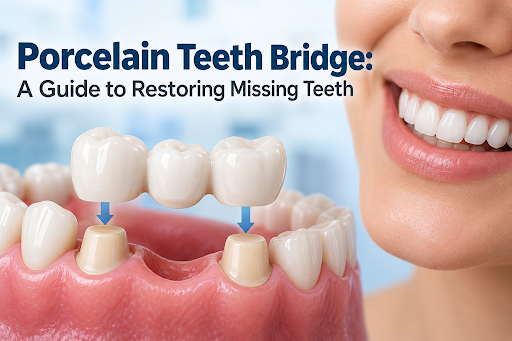
Missing teeth can affect more than the appearance of a smile. They may make chewing uncomfortable, influence speech, and create challenges when keeping the surrounding teeth clean. A dental bridge offers one way to fill these gaps with an artificial tooth supported by natural teeth or dental implants.
A porcelain teeth bridge is often considered by patients who want a fixed replacement that blends with their natural teeth. However, choosing the right restoration involves more than selecting a material or matching a tooth shade. The position of the missing tooth, the health of nearby teeth, bite pressure, and long-term care requirements all play a role in determining whether this treatment is appropriate.
Understanding How a Porcelain Teeth Bridge Works
A porcelain teeth bridge is a custom-made dental restoration that fills the space left by one or more missing teeth. The replacement tooth, called a pontic, is connected to supporting structures that hold it in position. Depending on the design, these supports may be natural teeth fitted with crowns or dental implants placed in the jawbone.
Porcelain and other ceramic materials are valued for their ability to replicate the colour and appearance of natural teeth. Dental professionals consider the shade, contour, size, and position of the replacement tooth when planning the restoration.
Not every bridge follows the same design. Some rely on crowns placed over neighbouring teeth, while others use bonded wings or implant support. The dentist determines which approach may work best after examining the patient’s teeth, gums, bite, and overall oral health.
Benefits of Choosing a Porcelain Bridge
A missing tooth can leave a noticeable gap, particularly when it affects the front of the mouth. Porcelain restorations can be designed to complement the surrounding teeth, making them an option for patients who want a natural-looking result.
Depending on the individual case, a dental bridge may offer several advantages:
- Improved appearance: A tooth-coloured replacement can help create a more complete and balanced smile.
- Restored chewing function: Filling the gap may make it easier to bite and chew certain foods.
- Support for speech: Replacing missing teeth can help address speech difficulties associated with some tooth gaps.
- A fixed restoration: Unlike a removable partial denture, a conventional fixed bridge is secured in place and is not removed by the patient for daily use.
- A customised fit: The restoration is designed around the patient’s mouth, tooth arrangement, and functional needs.
Although these benefits can make a porcelain teeth bridge worth considering, treatment outcomes depend on proper planning and the condition of the supporting structures. A dental examination is necessary to determine whether the advantages outweigh the limitations in a particular case.
Exploring the Different Types of Dental Bridges
The best bridge design depends on how many teeth are missing, where the gap is located, and what can safely support the replacement.
Traditional dental bridge
This design uses crowns placed on the natural teeth beside the gap. The artificial tooth sits between these supporting crowns. Traditional bridges are commonly considered when the neighbouring teeth can provide adequate support. Preparing these teeth usually requires removing some enamel, which cannot be reversed.
Cantilever dental bridge
A cantilever bridge is attached to a supporting tooth or teeth on only one side of the gap. Because the support is concentrated on one side, the design may place additional stress on the supporting tooth. It is therefore suitable only in selected situations where the location and bite forces are appropriate.
Maryland dental bridge
A Maryland bridge uses small wings bonded to the backs of adjacent teeth to hold the replacement tooth in place. This approach can preserve more natural tooth structure than a conventional bridge. It is often considered for selected front-tooth replacements, although its suitability depends on the bite and the condition of the supporting teeth.
Implant-supported bridge
An implant-supported bridge uses dental implants anchored in the jawbone instead of relying primarily on neighbouring natural teeth. It may be considered when several adjacent teeth are missing. Implant placement involves surgery and a healing period, so treatment generally takes longer than a straightforward conventional bridge.
Porcelain may be incorporated into different bridge designs, but the final material and construction depend on the clinical requirements of the restoration.
What Happens During the Treatment Process?
Getting a porcelain teeth bridge usually involves a consultation, preparation, fabrication, and placement. The number of appointments and overall timeline vary according to the type of bridge and whether other dental procedures are required.
During the initial visit, the dentist examines the gap, checks the health of the gums and surrounding teeth, and evaluates how the teeth meet when biting. Dental X-rays or other imaging may be recommended to assess the supporting structures.
For a traditional bridge, the supporting teeth are prepared so that the crowns can fit securely. The dentist then records the shape of the teeth using digital scanning or impressions. A dental laboratory uses these records to create the custom restoration. A temporary bridge may be fitted while the permanent one is being made.
At the fitting appointment, the dentist checks the bridge’s appearance, fit, and bite before securing it. Adjustments may be needed to ensure that the restoration feels comfortable and functions properly.
Because conventional bridge preparation involves removing tooth enamel, patients should discuss the benefits, potential risks, and alternative treatments before agreeing to the procedure.
How to Maintain Your Dental Bridge
A dental bridge requires consistent care to help protect the supporting teeth and surrounding gums. Although the replacement tooth itself cannot develop decay, the natural teeth supporting a conventional bridge remain vulnerable to cavities and gum disease.
An effective maintenance routine includes:
- Brush twice daily: Use fluoride toothpaste and a soft-bristled toothbrush to clean the bridge and surrounding teeth.
- Clean beneath the bridge: Use a floss threader, specialised bridge floss, or an appropriate interdental cleaning aid to remove trapped food and plaque.
- Attend regular dental visits: Professional examinations allow the dentist to check the restoration, supporting teeth, and gum tissue.
- Avoid excessive pressure: Chewing ice, biting hard objects, and using teeth to open packaging can damage dental restorations.
- Report changes promptly: Pain, bleeding gums, an unusual bite, cracks, or a loose bridge should be assessed by a dental professional.
With appropriate care, a bridge can remain functional for years. Its lifespan varies according to the materials used, the patient’s oral hygiene, bite forces, and the condition of the supporting teeth. Dental bridges are not permanent for life, so regular monitoring remains important.
Porcelain Teeth Bridge vs. Dental Implants
Patients replacing missing teeth may need to decide between a conventional bridge and a dental implant. Neither option is automatically better for every situation, as each has different treatment requirements and long-term considerations.
A conventional bridge can restore a missing tooth without requiring implant surgery. However, it generally relies on neighbouring teeth for support and may require those teeth to be reshaped. An implant replaces the root portion of the missing tooth with a fixture placed in the jawbone, which supports a crown or bridge after healing.
The decision may depend on several factors, including:
- The number and location of missing teeth.
- The health and strength of neighbouring teeth.
- The amount and condition of the available jawbone.
- Gum health and overall dental health.
- Treatment duration, cost, and personal preferences.
- The cleaning and maintenance requirements of each option.
A dentist can explain the expected benefits, limitations, and risks of both approaches after completing an individual assessment. In some cases, a removable partial denture may also be worth discussing.
Conclusion
A porcelain teeth bridge can help replace missing teeth while improving the appearance of a smile and restoring aspects of everyday oral function. Its success depends on selecting an appropriate design, ensuring adequate support, and maintaining healthy teeth and gums.
Before choosing this treatment, patients should understand how the bridge will be supported, whether neighbouring teeth need preparation, how long the process may take, and what ongoing care will involve. Comparing bridges with dental implants and other replacement options can also help clarify the available choices.
Ultimately, the most suitable restoration is the one that meets the patient’s dental needs while accounting for long-term oral health. A consultation with a qualified dentist can provide a personalised treatment recommendation and help establish realistic expectations for care and durability.