
Construction businesses today face rising material prices, labor shortages, tight deadlines, and increasing client expectations. Managing projects with spreadsheets or disconnected systems often leads to costly mistakes, delays, and poor communication.
This is why more contractors are investing in construction software. A modern solution helps businesses manage projects, budgets, teams, suppliers, and documents from one centralized platform. The result is better cost control, improved productivity, and healthier profit margins.
Whether you’re a small contractor or a growing software construction company, the right technology can transform how you manage projects and your bottom line.
Why Cost Control Is a Challenge in Construction
Construction projects involve many moving parts:
- Material purchasing
- Labor scheduling
- Equipment management
- Supplier coordination
- Client communication
- Budget tracking
- Invoicing
Without a centralized system, even small mistakes can become expensive.
Common issues include:
- Incorrect cost estimates
- Duplicate purchases
- Project delays
- Missed invoices
- Poor resource allocation
- Time-consuming paperwork
These problems directly reduce profitability.
How Construction Software Reduces Business Costs
1. More Accurate Project Estimation
One of the biggest reasons projects exceed budget is inaccurate estimates.
Modern construction software allows contractors to create detailed cost estimates using historical project data, labor costs, supplier pricing, and material databases.
More accurate calculations help businesses:
- Submit competitive bids
- Avoid underpricing projects
- Reduce unexpected expenses
- Improve forecasting
Better estimates lead to higher profit margins before the project even begins.
2. Better Project Planning
Poor scheduling often causes delays that increase labor costs and equipment expenses.
Construction software makes it easier to:
- Create project timelines
- Assign responsibilities
- Track milestones
- Monitor deadlines
- Identify scheduling conflicts early
With everyone working from the same schedule, teams spend less time waiting and more time completing work.
3. Real-Time Budget Tracking
Many contractors only discover budget overruns after significant money has already been spent.
Construction software provides real-time visibility into:
- Material costs
- Labor expenses
- Equipment usage
- Purchase orders
- Project budgets
Managers can quickly identify cost overruns and make adjustments before they impact overall profitability.
4. Reduce Manual Administrative Work
Manual paperwork consumes valuable time.
Contractors often spend hours every week creating invoices, updating spreadsheets, managing documents, and preparing reports.
Automation allows teams to:
- Generate invoices automatically
- Track expenses
- Store project documents
- Manage approvals
- Create reports instantly
Less administration means employees can focus on revenue-generating work.
Improve Resource Utilization
Every idle worker or unused machine costs money.
Construction software helps businesses optimize resources by providing clear visibility into:
- Employee availability
- Equipment allocation
- Material inventory
- Project workloads
Managers can allocate resources efficiently, preventing unnecessary overtime and reducing equipment downtime.
Improve Communication Across Teams
Miscommunication is one of the biggest causes of project delays.
When office staff, site managers, subcontractors, and suppliers all use different communication methods, important information gets lost.
A centralized platform keeps everyone connected through:
- Shared project updates
- Document management
- Task assignments
- Progress tracking
- Instant notifications
Better communication leads to fewer mistakes and faster project completion.
Better Supplier Management Saves Money
Material costs account for a significant portion of every construction project.
Construction software allows businesses to:
- Compare supplier pricing
- Track purchase orders
- Monitor deliveries
- Maintain supplier records
- Prevent duplicate orders
Improved supplier management helps reduce procurement costs while ensuring projects stay on schedule.
Faster Invoicing Improves Cash Flow
Many construction companies experience cash flow problems simply because invoices are delayed.
Construction software streamlines invoicing by:
- Creating invoices directly from completed work
- Tracking payment status
- Sending reminders
- Managing outstanding balances
Faster invoicing means businesses receive payments sooner and maintain healthier cash flow.
Reduce Costly Human Errors
Manual processes often lead to:
- Data entry mistakes
- Incorrect calculations
- Missing documents
- Duplicate invoices
- Scheduling conflicts
Automation significantly reduces these risks.
By keeping all project information in one place, contractors avoid expensive errors that affect both budgets and client satisfaction.
Make Better Business Decisions with Real-Time Reporting
Construction software provides valuable insights into company performance.
Business owners can monitor:
- Project profitability
- Labor productivity
- Budget performance
- Equipment usage
- Revenue trends
- Outstanding invoices
These reports help identify opportunities to improve efficiency and maximize profits.
Improve Customer Satisfaction
Happy clients often become repeat customers.
Construction software improves customer experience through:
- Accurate project updates
- Faster communication
- Transparent budgeting
- Digital document sharing
- On-time project delivery
Satisfied clients are more likely to recommend your business, reducing future marketing costs.
Support Business Growth Without Increasing Overhead
As construction businesses grow, manual management becomes increasingly difficult.
Hiring additional administrative staff simply to manage paperwork increases operating costs.
Instead, construction software allows companies to manage more projects without significantly increasing overhead expenses.
This creates a scalable business model where profits grow alongside project volume.
Why Every Software Construction Company Needs Modern ERP Solutions
A growing software construction company (software bouwbedrijf) must manage multiple projects, employees, subcontractors, suppliers, and clients simultaneously.
Without integrated systems, scaling operations becomes difficult.
An all-in-one construction ERP solution simplifies:
- Project planning
- Cost estimation
- Customer management
- Work orders
- Supplier management
- Invoicing
- Financial tracking
- Document management
This creates a more organized workflow that supports long-term growth while protecting profit margins.
Supporting Payroll and Financial Operations
Project management is only one part of running a successful construction business.
Companies operating internationally, particularly in Europe, also need efficient payroll and financial administration.
For example, businesses working in the Dutch market often combine their construction management platform with payroll processing services Netherlands to ensure employees are paid accurately while remaining compliant with local regulations.
Likewise, many growing contractors choose payroll outsourcing Netherlands to reduce administrative workload, improve payroll accuracy, and allow internal teams to focus on delivering successful construction projects instead of handling complex payroll processes.
Combining operational software with reliable payroll services creates a stronger foundation for sustainable business growth.
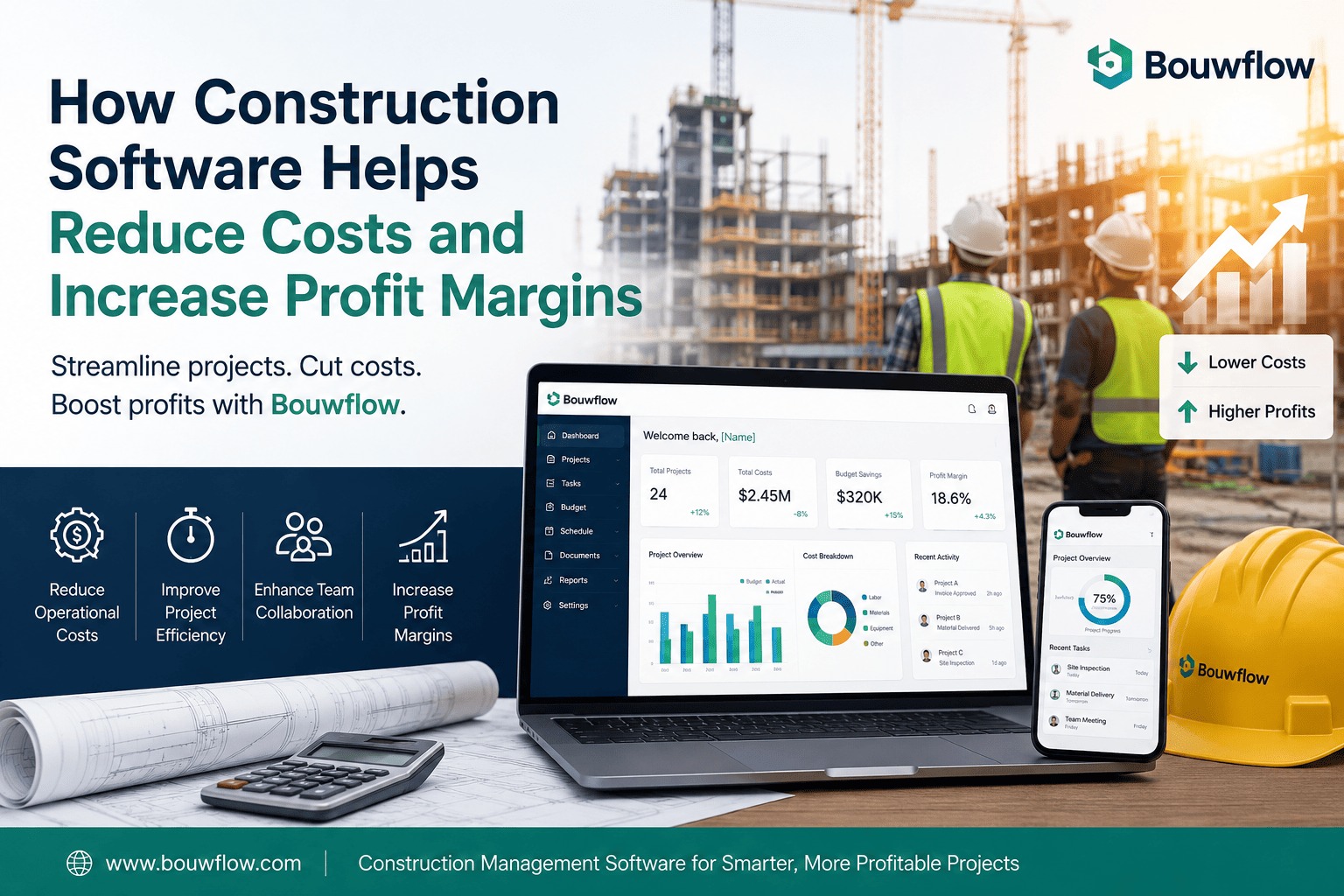
Why Bouwflow Helps Construction Companies Increase Profitability
Bouwflow is designed specifically for construction businesses looking to improve efficiency and profitability.
Instead of juggling multiple disconnected tools, contractors can manage everything from one platform, including:
- Project planning
- Cost estimation
- Work orders
- Supplier management
- Customer management
- Digital document signing
- Invoicing
- Financial tracking
- Reporting
With real-time visibility into every project, Bouwflow helps businesses reduce unnecessary costs, improve productivity, and complete projects more profitably.
Conclusion
Increasing profit margins isn’t only about winning more projects—it’s about managing every project more efficiently.
Modern construction software helps contractors reduce manual work, improve project planning, control budgets, streamline communication, and make better business decisions. These improvements lead to lower operating costs, better cash flow, and stronger long-term profitability.
Whether you’re an established contractor or a growing software construction company, investing in the right technology can provide a significant competitive advantage. Platforms like Bouwflow give construction businesses the tools they need to simplify operations, reduce costs, and build a more profitable future.