
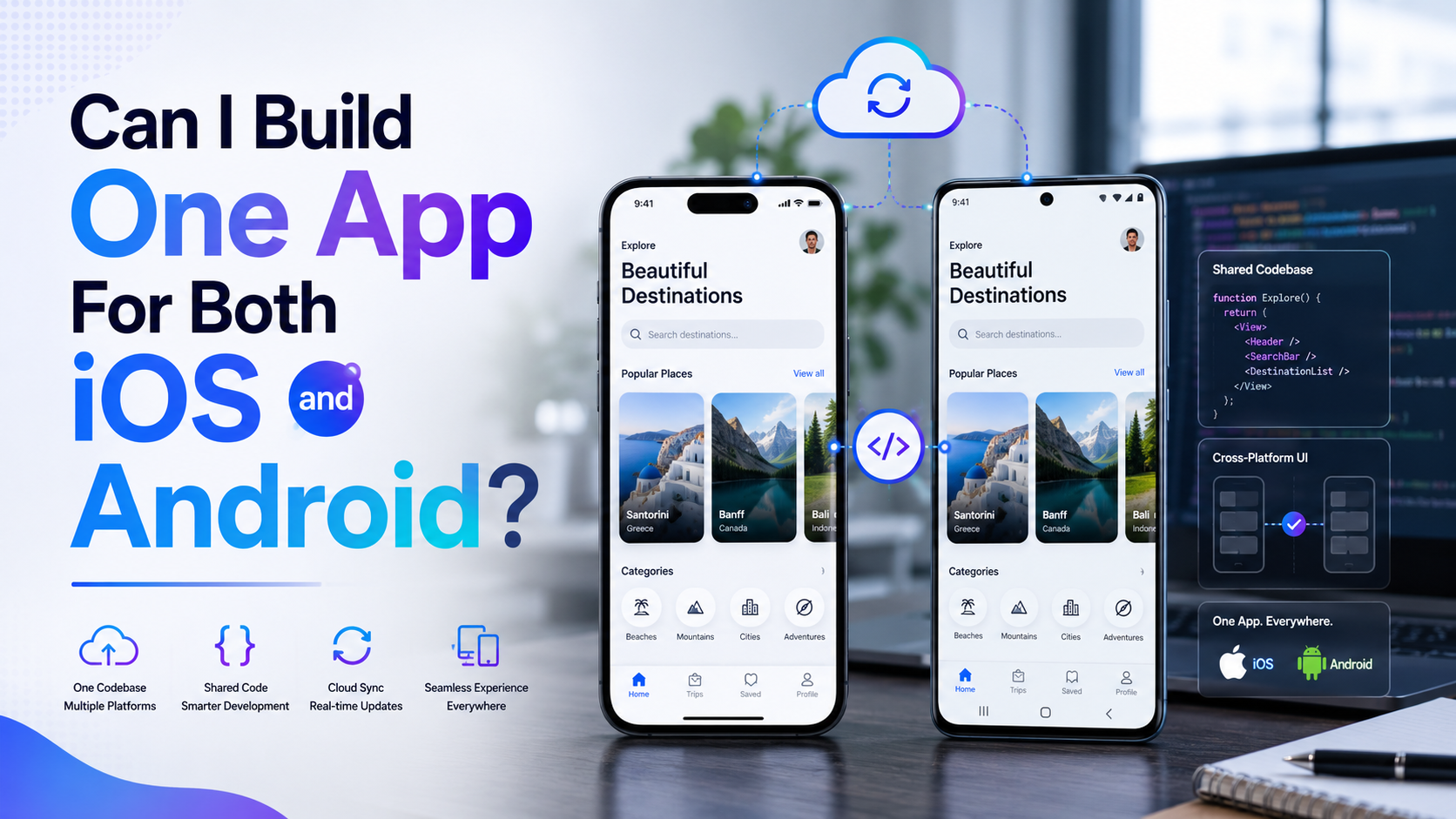
Yes, you can. And in a lot of cases, it actually makes more sense than building two separate apps.
The idea that iOS and Android always need different builds comes from an older way of working. Back then, teams had to maintain two completely separate codebases. Twice the effort, twice the cost, twice the time.
That’s changed quite a bit.
Now, many teams build a single product that runs on both platforms. If you talk to any experienced cross-platform app development company, this is usually one of the first options they’ll bring up, unless there’s a strong reason not to use it.
Still, the decision is not as simple as “one size fits all.” There are trade-offs, and it helps to understand what you’re actually choosing.
Why do people prefer a single app in the first place
Most founders don’t start with technology. They start with a constraint.
Usually, time or money.
Building two native apps means duplicating a lot of work. Even if the features are identical, you are still maintaining two versions of everything. Updates, bug fixes, testing cycles. It adds up quietly in the background.
A shared approach avoids that split.
It also helps when you’re not fully sure how the product will evolve. If you expect changes, experiments, or feature adjustments, having one codebase is simply easier to manage.
What “one app for both platforms” actually means
It doesn’t mean iOS and Android magically become the same thing.
What cross-platform app development really means is this: the core logic of the app is written once, and then adapted to run on both systems.
Tools like Flutter or React Native handle most of that translation work. Developers still deal with platform-specific details when needed, but they’re not rebuilding everything from scratch.
Think of it like writing one script that gets performed in two different theatres. Same story, slightly different stage setup.
Where cross-platform works well
Some apps fit this model almost naturally.
Anything where the core experience is consistent tends to work fine.
A few examples:
- Booking apps
- Delivery platforms
- E-commerce apps
- Fitness tracking tools
- Internal business dashboards
In these cases, the logic matters more than deep hardware integration.
Apps like Airbnb are a good reference point. The experience feels consistent across devices because the structure of the app is not heavily dependent on platform-specific behavior.
Same with apps like Uber. The flow is mostly about location, requests, and updates. The device matters less than the system behind it.
Where it starts to get tricky
Not every app behaves nicely in a shared setup.
Some products rely heavily on device-level features. Camera processing, AR overlays, low-latency graphics, and background sensors. That’s where things start to stretch.
Gaming is a good example. High-performance 3D games often need tighter control over hardware. The same goes for apps that depend heavily on augmented reality or real-time rendering.
In those cases, native development can still be the safer route.
It’s less about ideology and more about control.
Performance concerns, and what’s real vs outdated
There’s a lingering belief that cross-platform apps are slow. That used to be a more valid concern years ago.
Now, most performance issues come from architecture choices, not the framework itself.
Bad data handling, unoptimized images, poorly structured APIs. Those create lag long before the platform choice becomes a problem.
In well-built apps, users usually don’t even notice what the underlying tech stack is.
What about design differences between iOS and Android?
This part gets overlooked often.
Even if you use a single codebase, the experience shouldn’t feel forced into one pattern.
iOS users expect certain navigation styles. Android users are used to others. Ignoring that creates friction, even if the app technically works fine.
So in practice, good teams don’t try to make everything identical. They keep the structure consistent but still respect how each platform behaves.
It’s a small detail, but it changes how “natural” the app feels.
Maintenance is where things get interesting
This is where a shared codebase usually wins.
Instead of fixing a bug twice, you fix it once.
Instead of updating features separately, you push changes across both platforms together.
Over time, that difference becomes noticeable. Especially when the product starts growing and updates become more frequent.
For teams shipping new features regularly, this alone can be a strong reason to avoid splitting development paths.
When separate native apps still make sense
There are situations where splitting is still the better choice.
High-performance games. AR-heavy apps. Hardware-specific tools. Anything that pushes the device to its limits.
In those cases, squeezing out maximum performance matters more than saving development time.
It’s not about cross-platform being “better” or “worse.” It’s about matching the approach to what the app is trying to do.
The real decision isn’t technical
This is the part people often miss.
Choosing between one app and two isn’t really a technology debate. It’s a product decision.
Ask yourself a few simple things:
- How complex is the app going to be?
- How fast do you need to launch?
- Are you planning frequent changes?
- Do you actually need deep hardware features?
The answers usually point in one direction without much debate.
Final thought
Yes, you can absolutely build one app for both iOS and Android.
For many products, it’s the practical choice. Faster to build, easier to maintain, and simpler to evolve.
But it’s not a universal rule. Some apps need the extra control that comes from building separately.
The important part is not picking the trend. It’s understanding what your product will actually demand once real users start using it.
That’s where the right decision becomes obvious.