
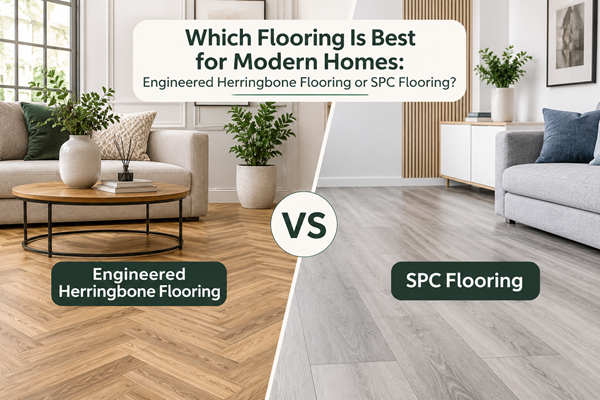
Choosing the right flooring is a big deal if you want your home to feel comfortable, look good, and still hold up over time. Flooring changes how the whole room looks, but it also affects day to day comfort, how easy it is to maintain, and the long-term durability. Because there are so many choices, most homeowners end up comparing engineered herringbone flooring, traditional engineered flooring, and SPC flooring just to see what fits best for their lifestyle and their budget.
Each type brings its own benefits. Engineered wood tends to add natural warmth and a nice elegance, herringbone patterns bring a more refined visual rhythm, and SPC flooring is often chosen for practicality and moisture resistance. If you get the differences right, then it becomes easier to pick something that matches your interior goals, your routine, and what you’re willing to spend.
What Makes Engineered Herringbone Flooring a Stylish Choice?
Homeowners who like to mix traditional workmanship with a more modern interior vibe make engineered herringbone flooring a favourite. The signature zigzag pattern creates a visual movement, so the space looks more detailed and a little more sophisticated, even without trying too hard.
Instead of plain straight planks, herringbone flooring uses rectangular planks arranged in an interlocking style. That layout gives you a timeless effect, and it usually looks great in living rooms, dining areas, hallways, and even open-plan layouts where you want the design to flow naturally.
Some key advantages include:
- Timeless appearance: The herringbone style blends nicely with both traditional looks and modern spaces.
- Natural wood finish: Real wood surfaces bring warmth, texture, and character, not just “something flat”.
- Structural stability: The engineered layers help reduce movement from temperature changes and humidity shifts.
- Versatile styling: It can suit minimalist interiors, classic spaces, industrial themes, and luxury settings.
What Is Engineered Flooring and How Does It Work?
Typically, there is a real hardwood face layer on top, and underneath that sits a stable core, often built from cross-layered wood or plywood. So you still get that real wood look, but the whole thing tends to move a little less when humidity and temperature shift, even though it’s still wood.
That top hardwood layer is what brings the natural grain, colour depth, and texture you expect from solid hardwood. Below it, the layers are stacked in a way that helps the floor behave more steadily, so expansion and contraction don’t get out of hand as easily.
A big reason people choose engineered flooring is versatility. You can find it in many plank widths, overall thicknesses, different finishes, and even a range of wood species. Because of that, it usually fits in with lots of interior styles, whether you’re going for something modern, classic, or something just in between.
Some key upsides that people talk about include, but it depends on the actual product:
- Authentic appearance: that real top layer shows natural grain patterns and tactile texture.
- More stability: the layered build helps control seasonal movement.
- Design flexibility: various shades, surface treatments, and plank sizes give you more options.
- Long-term appeal: when you pick a quality engineered wood product and maintain it properly, it can stay attractive for years.
One thing to keep in mind, though, is moisture-prone areas. Whether engineered flooring works there really depends on the exact product specs, how it’s installed, and what the manufacturer says to do, because not every version is equally moisture-tolerant.
What Is SPC Flooring and Why Is It Popular?
SPC flooring is a rigid-core vinyl product that is made with mineral fillers plus polymers, so it ends up feeling pretty solid underfoot.
It has turned up everywhere lately because it’s a sensible stand-in for traditional wood floors. The rigid centre gives dimensional stability, so it doesn’t move around as much, and the top decorative layer can mimic natural wood, stone, and other looks, even when you get up close.
A lot of people like it for things like:
- Water resistance: SPC flooring is usually waterproof, so it works in rooms that deal with moisture.
- Durability: There’s a wear layer that helps shield it from daily scuffs, stains, and surface wear.
- Low maintenance: Most times, a quick sweep and a damp mop will handle it.
- Design variety: You can find wood-effect and stone-effect finishes; it’s not just one style.
- Installation convenience: Many options come with click-lock installation systems, which make the process easier for some people.
In busy homes, rental spaces, and basically anywhere where simple care matters, SPC flooring is especially useful. Still, you shouldn’t ignore the wear layer quality, the way the core is built, and how well the subfloor is prepped before installation.
| Feature | Engineered Herringbone Flooring | SPC Flooring |
| Material | A real wood face on top of an engineered core | A mineral-polymer rigid core |
| Appearance | True, natural wood look | Printed wood or stone looks |
| Design | That very clear herringbone layout – you can’t really miss it. | Lots of other options, planks and tile styles, and patterns. |
| Water resistance | Depends a lot on the way it’s built and installed. | Usually waterproof in daily situations |
| Maintenance | Needs proper wood floor care, not just any cleaner. | Pretty low effort, straightforward to maintain. |
| Comfort | That warm natural wood sensation underfoot | Feels firmer, even a bit rigid |
| Refinishing | Can often be redone, depending on the wear layer thickness | Usually not; it generally can’t be sanded and refinished. |
The most standout thing would be the material itself. As we can see, engineered herringbone flooring gives that genuine wood character, while SPC flooring leans more toward practical performance, especially moisture resistance.
Final Thoughts
So, which flooring is best for modern homes, engineered herringbone flooring or SPC flooring? Honestly, it depends on what you care about most, not just what looks good in the photos.
Engineered herringbone flooring is a solid choice if you’re the homeowner who wants real wood character, classic layouts, and those polished, put-together interior vibes. It adds natural beauty with a stable layered structure, and it just feels … purposeful. On the other hand, SPC flooring leans more toward people who prefer practical benefits, easy upkeep, and a pretty dependable setup, especially for rooms that can handle moisture or the normal spills and rougher traffic.
Instead of choosing on appearance alone, think through your room needs, how you live day to day, the actual installation situation, and what you want long-term. When you decide like that, your home looks better and works better.