
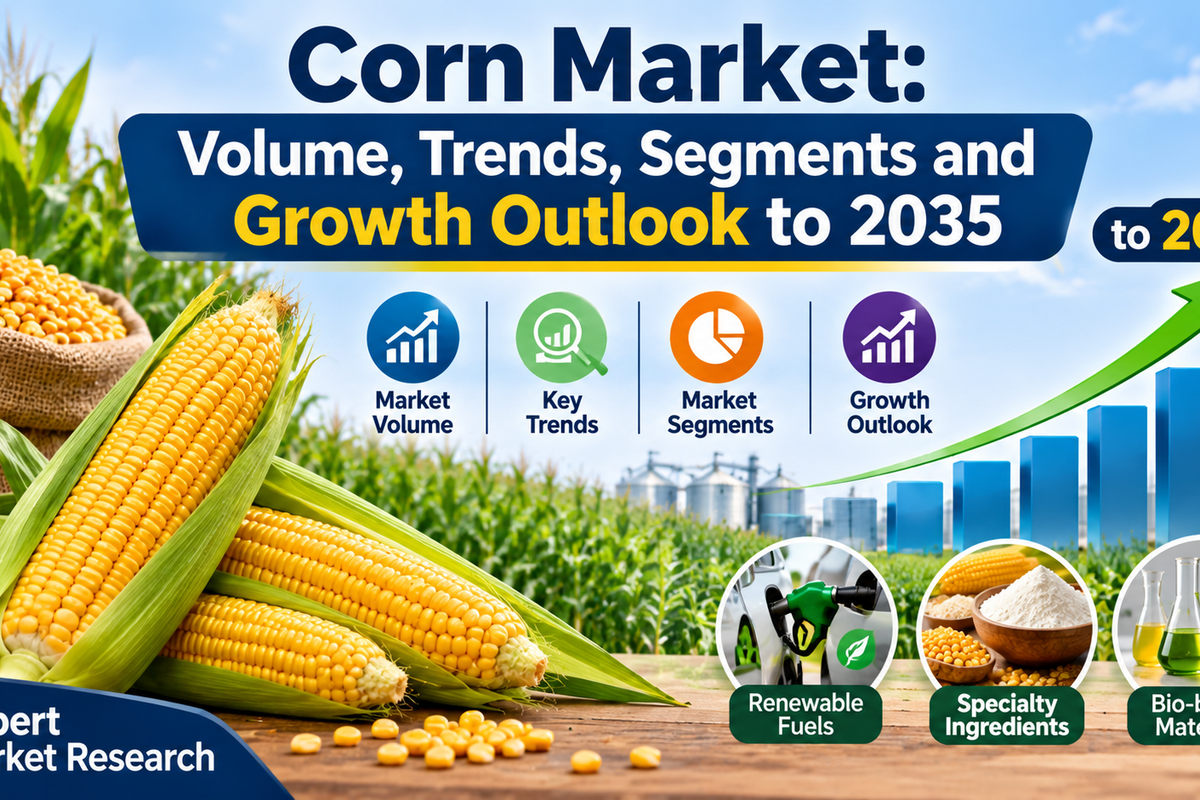
Corn is one of the most widely grown and traded crops in the world, feeding livestock, supplying food manufacturers and powering renewable fuel production. Its role is expanding well beyond the farm gate, as processors turn it into specialty starches, sweeteners, bioplastics and low-carbon fuels. This article looks at the volume outlook, growth drivers, trends, segments and leading companies shaping the sector through 2035.
The global corn market attained a volume of 1,196.45 MMT in 2025 and is projected to expand at a CAGR of 1.10% through 2035, reaching 1,334.77 MMT. Rising use of bio-based production and specialty ingredients is prompting processors to build technologically advanced refineries and sign long-term agreements for industrial usage.
Market Size and Forecast
- Volume in 2025: 1,196.45 MMT
- Projected volume in 2035: 1,334.77 MMT
- CAGR (2026-2035): 1.10%
- Fastest-growing region: Asia Pacific
- Largest region: North America
Key Growth Drivers
Bioethanol and Renewable Fuel Demand
Governments are raising renewable energy and decarbonization targets, which makes corn an increasingly strategic fuel feedstock. Ethanol producers are expanding capacity and adding carbon capture technology to cut lifecycle emissions. In February 2025, POET announced investments to expand carbon capture at several US bioprocessing plants, and in May 2026, 3tentos received approval to operate a new corn ethanol plant in Brazil.
Demand for Specialty Food Ingredients
Food manufacturers want specialized starches, functional sweeteners and clean-label ingredients for baking, dairy, beverages and pharmaceuticals. In May 2026, Ingredion and Sanstar formed a partnership to expand specialty corn ingredient solutions for India’s food and pharmaceutical markets, while Cargill opened a corn milling plant in Gwalior in March 2025 to add starch capacity.
Animal Feed Requirements
Corn is a key energy source for poultry, cattle and swine. Growth in meat and milk production in emerging economies keeps feed demand steady, and modern livestock operations need a reliable supply of digestible, nutrient-rich grain.
Key Trends and Recent Developments
- Digital agriculture: Satellite imagery, AI analytics, drones and variable-rate fertiliser tools are improving yields and lowering input costs. In June 2026, Chandigarh University developed an AI model that predicts corn yields in India using satellite and weather data.
- Advanced seed technology: In June 2026, Beck’s, RAGT and Phytoform partnered to develop AI-engineered corn traits, and Origin Agritech advanced a GMO variety in China’s National Demonstration Plot.
- Regenerative farming: In December 2025, Varaha and Kellanova launched a regenerative corn farming project with smallholder farmers in India.
- Traceability programmes: Agribusinesses are using digital systems to track grain from farm to processing plant, supporting sustainable sourcing goals.
- Bioplastics and industrial uses: Companies such as NatureWorks are expanding Ingeo biopolymer production from renewable feedstocks like corn, supported by policies such as the European Green Deal.
- Convenience foods: In February 2026, Fresh4U launched ready-to-eat sweet corn products.
Market Segmentation
By Source
Conventional corn dominates because of its high yields, cost-effectiveness and strong logistics for food processing, animal nutrition and biofuels. Organic corn is growing as food processors seek certified, natural ingredients for snacks, cereals, baby food and beverages.
By Application
The application mix includes food and beverages, animal feed, ethanol production and others such as pharmaceuticals, bioplastics and fermentation products. Animal feed is the largest application, while ethanol production is the most promising, supported by clean energy policies and industrial decarbonisation.
By Region
North America leads thanks to large, mechanised farms, efficient grain handling and advanced processing. Asia Pacific is the fastest-growing region, driven by urbanisation, livestock production and food processing investment. Europe focuses on quality food and sustainable sourcing, Latin America remains important for production and exports, and the Middle East and Africa are growing on rising feed demand and grain imports.
Competitive Landscape
Competition is increasingly shaped by value addition, digitalisation and sustainable sourcing rather than volume alone. Leading companies include:
- Archer Daniels Midland Company: corn sweeteners, starches, ethanol and feed ingredients
- Cargill, Inc.: corn syrup, starches, ethanol and animal nutrition
- CHS Inc.: farmer-owned cooperative offering grain marketing, storage and logistics
- Bunge Limited: corn origination, trade, storage and processing
Other notable players are Bayer AG (Monsanto), Del Monte Foods Inc., Corteva, Inc., The Scoular Company and COFCO Corporation.
Outlook
According to Expert Market Research , although volume growth is expected to remain modest, the corn market is shifting towards higher-value applications, including renewable fuels, specialty ingredients, and bio-based materials. Companies that invest in precision farming, traceable supply chains, and value-added processing will be best positioned to capitalize on emerging opportunities through 2035.
Frequently Asked Questions
1. What was the corn volume in 2025? The volume reached approximately 1,196.45 MMT in 2025.
2. What is the expected growth rate? It is projected to grow at a CAGR of 1.10% between 2026 and 2035, reaching about 1,334.77 MMT by 2035.
3. Which application leads demand? Animal feed is the largest application, while ethanol production is expected to grow faster.
4. Which region is growing fastest? Asia Pacific is the fastest-growing region, while North America is the largest.
5. Who are the major players? Major players include Archer Daniels Midland, Cargill, CHS Inc., Bunge Limited, Bayer AG, Corteva and COFCO Corporation.