
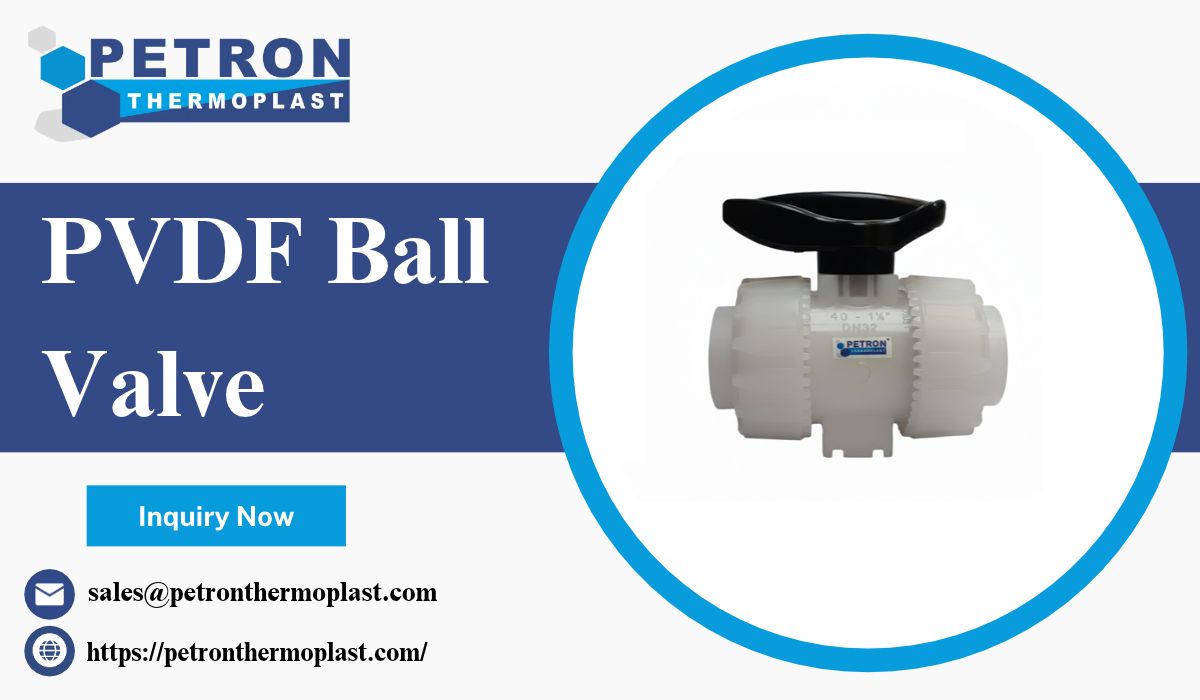
Industrial fluid management requires suitable valves to control the movement of liquids through pipelines, storage systems, and processing equipment. In industries that handle corrosive chemicals and specialized process fluids, selecting the correct valve material is an important part of pipeline design. A PVDF Ball Valve is widely considered for applications where chemical compatibility, temperature performance, and reliable flow control are important.
PVDF stands for Polyvinylidene Fluoride, a high-performance thermoplastic material used in demanding industrial environments. PVDF ball valves are designed to control fluid flow through a rotating ball mechanism. They are used in selected chemical processing, pharmaceutical, water treatment, and industrial applications. Petron Thermoplast manufactures thermoplastic products for industrial piping and fluid-handling requirements, including project-based product needs.
What Is a PVDF Ball Valve?
A PVDF ball valve is a quarter-turn valve that uses a spherical ball with a bore through its centre to control fluid movement. When the handle or actuator rotates the ball by 90 degrees, the valve changes between open and closed positions.
In the open position, the ball’s bore aligns with the pipeline, allowing fluid to pass through. In the closed position, the bore turns away from the flow path, stopping the passage of fluid.
The valve body is manufactured from PVDF, which offers resistance to many chemicals and useful mechanical properties for industrial applications. Its suitability depends on the chemical being handled, operating temperature, pressure, and valve design.
Importance of PVDF Ball Valves in Industrial Fluid Management
Industrial facilities often transfer acids, chemicals, process liquids, and other fluids through complex pipeline networks. Valves are required at different points to isolate equipment, control flow, and support maintenance activities.
PVDF ball valves provide several useful characteristics for suitable industrial installations.
- Chemical resistance: PVDF offers resistance to many aggressive chemicals, depending on concentration and temperature.
- Corrosion resistance: As a non-metallic material, PVDF does not experience electrochemical corrosion.
- Quick operation: The quarter-turn mechanism allows convenient opening and closing.
- Compact design: Ball valves are available in configurations suitable for different pipeline layouts.
- Temperature capability: PVDF can be used within specified operating temperature limits.
- Industrial versatility: These valves are considered for chemical handling, water treatment, and selected process applications.
Types of PVDF Ball Valves
Different industrial applications require different valve configurations. Common PVDF ball valve types include:
- Two-Way PVDF Ball Valve
A two-way ball valve has one inlet and one outlet. It is commonly used to start or stop fluid flow in a pipeline.
- Three-Way PVDF Ball Valve
A three-way valve has three connection ports and can be used to divert or mix compatible fluid streams. The flow arrangement depends on the internal ball design.
- Manual PVDF Ball Valve
Manual valves use a handle for operation. They are suitable for pipeline locations where operators can access the valve directly.
- Actuated PVDF Ball Valve
Actuated valves use pneumatic or electric actuators to operate the ball. They can be integrated into automated industrial control systems when compatible with the valve design.
- Flanged PVDF Ball Valve
Flanged valves use bolted flange connections to connect with compatible pipeline components. They are often considered for installations requiring detachable connections.
- Socket-End PVDF Ball Valve
Socket-end valves are designed for compatible thermoplastic joining systems. The joining method must follow the manufacturer’s installation instructions.
Technical Specifications of PVDF Ball Valves
Before purchasing a PVDF ball valve, buyers should review its technical specifications. These details help determine whether the valve is suitable for the intended fluid-handling application.
| Parameter | General Technical Details |
| Valve Material | Polyvinylidene Fluoride (PVDF) |
| Valve Type | Ball Valve |
| Operating Mechanism | Quarter-turn |
| Available Configurations | Two-way, three-way, subject to product range |
| Operation | Manual or actuated, depending on design |
| Connection Type | Socket, threaded, flanged, or other available options |
| Ball Material | As specified in the valve design |
| Seat Material | Selected according to application and manufacturer design |
| Pressure Rating | Depends on valve size, design, and operating temperature |
| Temperature Range | According to material grade and product datasheet |
| Applications | Chemical processing, water treatment, industrial fluid handling |
Key Features of PVDF Ball Valves
PVDF ball valves offer several features that make them suitable for specialized industrial fluid management systems.
- Resistance to Many Chemicals
PVDF provides resistance to a wide range of chemicals. This characteristic makes it useful for selected chemical transfer applications. However, compatibility should be verified for the exact chemical, concentration, and operating temperature.
- Corrosion Resistance
Unlike conventional metallic valve bodies, PVDF does not undergo electrochemical corrosion. This can help reduce corrosion-related concerns in compatible applications.
- Quarter-Turn Operation
The quarter-turn design provides straightforward operation. Operators can open or close the valve with a 90-degree handle movement.
- Leak-Control Considerations
Properly selected seats, seals, and installation practices are important for achieving the required sealing performance. Leakage performance should be verified against the valve manufacturer’s specifications.
- Lightweight Construction
PVDF valves are generally lighter than comparable metal valves, which can simplify handling and installation.
- Automation Compatibility
Certain PVDF ball valve models can be equipped with suitable actuators for remote operation and integration into automated systems.
Industrial Applications of PVDF Ball Valves
PVDF ball valves are used in several industries where material compatibility and controlled fluid movement are important.
Chemical Processing Plants: Used for isolating and controlling compatible acids, chemicals, and process liquids in production lines.
Pharmaceutical Industry: Selected for suitable process and utility systems where material cleanliness and fluid compatibility are important.
Water Treatment Facilities: Used in compatible chemical dosing, treatment, and water handling systems.
Electronics Manufacturing: Certain PVDF valve systems are considered for specialized high-purity chemical distribution applications.
Metal Processing Industry: Used in selected chemical transfer lines, surface treatment installations, and process equipment connections.
Power Generation: Applied in compatible chemical handling and water treatment systems within power facilities.
Industrial Manufacturing: Used in process pipelines where the valve material meets the fluid and operating requirements.
How to Select the Right PVDF Ball Valve?
Selecting the correct valve requires more than checking its material and size. Buyers should consider the complete operating conditions of the pipeline.
- Identify the Fluid
Determine the exact chemical or liquid passing through the valve. Check its concentration and temperature to verify compatibility with PVDF and all wetted valve components.
- Confirm Pressure Requirements
Check the operating pressure and any possible pressure variations. The valve’s pressure rating must be suitable for the actual operating temperature and system conditions.
- Select the Correct Valve Size
The valve diameter should match the pipeline design and required flow capacity. Consider pressure drop and flow characteristics where relevant.
- Choose the Connection Type
Select socket, threaded, flanged, or another compatible connection according to the existing pipeline arrangement.
- Check Seat and Seal Materials
The ball valve’s seats and seals are important because they contact the fluid and contribute to shut-off performance. Confirm their compatibility with the process fluid.
- Consider Manual or Automated Operation
Manual valves are suitable for accessible locations. Pneumatic or electric actuators may be appropriate where remote operation or process automation is required.
- Review Technical Documentation
Request the product datasheet, pressure-temperature information, dimensions, and applicable standards before finalizing the order.
Benefits of Using PVDF Ball Valves
When correctly selected and installed, PVDF ball valves can support industrial fluid management in several ways:
- Suitable for many chemical handling applications.
- Resistance to electrochemical corrosion.
- Convenient quarter-turn operation.
- Availability in different connection configurations.
- Lightweight construction compared with many metal alternatives.
- Options for manual and automated operation, depending on model.
- Application in specialized industrial and process piping systems.
Why Choose Petron Thermoplast?
Petron Thermoplast manufactures thermoplastic products for industrial piping and fluid-handling applications. The company focuses on product requirements for different industrial sectors, including chemical processing and pipeline infrastructure.
For PVDF ball valve requirements, buyers can discuss their application details and required specifications with Petron Thermoplast.
Key reasons to contact Petron Thermoplast include:
- Industrial thermoplastic product manufacturing.
- Product solutions for different piping applications.
- Customized requirements based on project specifications.
- Support for bulk industrial enquiries.
- Coordination for domestic and international project requirements.
- Assistance with product selection and technical information.
Maintenance Tips for PVDF Ball Valves
Regular inspection can help maintain suitable valve operation and identify potential problems.
- Inspect the valve body and connections for visible damage.
- Check the handle or actuator for smooth operation.
- Examine connections for signs of leakage.
- Follow the manufacturer’s cleaning and maintenance instructions.
- Avoid operating the valve outside its specified pressure and temperature limits.
- Replace worn seats or seals with compatible components.
- Follow appropriate safety procedures before carrying out maintenance.
Conclusion
PVDF ball valves are useful components in industrial fluid management systems where chemical compatibility, corrosion resistance, and controlled flow are important. Their quarter-turn operation and availability in different configurations make them suitable for selected chemical processing, pharmaceutical, water treatment, and manufacturing applications.
Choosing the right PVDF Ball Valve requires careful consideration of fluid compatibility, operating pressure, temperature, valve size, connection type, and sealing materials. Petron Thermoplast provides thermoplastic manufacturing solutions for industrial piping requirements. Contact Petron Thermoplast to discuss PVDF ball valve specifications, customized requirements, and bulk enquiries for domestic and international projects.