
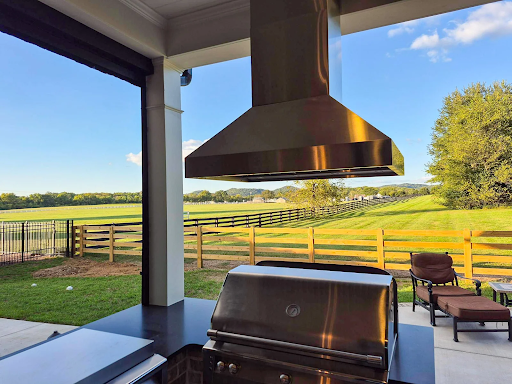
An open cooking area changes the way a kitchen handles smoke, steam, and grease. Without a wall behind the cooktop, air can move around the rising plume from several directions. Choosing island range hoods requires attention to capture coverage, ceiling support, duct routing, and sightlines rather than appearance alone.
Begin With the Cooking Zone
Measure the cooktop itself, including its usable cooking area and any integrated griddle. The dimensions of the island cabinet do not establish the ventilation coverage required above it.
The supplied collection recommends a hood at least as wide as the cooktop and suggests six inches of additional width overall for island installations. Treat that as guidance while checking the chosen appliances and available space. Wider island range hoods still need suitable depth and installation height to provide useful coverage.
Understand Air Movement
Doors, windows, supply-air outlets, and nearby fans can disturb the cooking plume. A powerful blower does not automatically eliminate those effects. The location and capture area of the canopy matter alongside its airflow rating.
Before finalising island range hoods, discuss the room’s airflow with the installer. Avoid assuming that increasing motor capacity will correct a poorly positioned intake. The objective is a balanced arrangement that captures cooking vapour without unnecessary noise or structural complications.
Select a Suitable Form
Suspended Canopies
These hang below the ceiling with a chimney concealing the duct and support assembly. They remain visible from all sides and can become a major design feature.
Slim Profiles
A low-profile canopy can preserve a more open view across the room. Check that the slimmer appearance still suits the cooking task and installation requirements.
Ceiling-Flush Designs
The source collection includes a 42-inch ceiling-flush option. This is a different installation arrangement from a conventional suspended canopy, so its structural, ducting, and clearance requirements must be reviewed separately.
The variety among island range hoods makes the mounting format an important early decision.
Measure Ceiling Height Correctly
Record the finished ceiling height, cooking-surface height, and proposed bottom clearance. Use those measurements with the selected product’s chimney dimensions and permitted adjustment range.
The collection gives general guidance of 28–36 inches above the cooktop for island installation. However, the individual hood and cooking appliance instructions govern. Resolve any conflict with the manufacturers before work begins rather than simply choosing the most convenient height.
Check sightlines with a lightweight mock-up. A canopy that looks balanced on a plan may obstruct views or feel uncomfortable in everyday use.
Confirm Structural Support
Ceiling-mounted equipment requires framing capable of carrying its load through the specified fixing arrangement. Decorative ceiling material alone is not suitable support.
Locate joists and identify any need for blocking or an engineered support detail. Do not alter roof trusses or other structural members without appropriate professional guidance. Early coordination is particularly useful when the preferred canopy position does not align with existing framing.
Plan the Exhaust Route
For ducted island range hoods, the route usually travels overhead before reaching an exterior termination. Review the outlet size, available route, bends, and potential conflicts with other building services.
Discuss these points before ceiling finishes are completed:
- Required duct dimensions.
- The permitted discharge arrangement.
- Access for connections and servicing.
- Exterior termination position.
- Any make-up air provisions.
Some models in the collection support recirculating conversion with charcoal filters. Compatibility is product-specific, and recirculation does not exhaust humidity outdoors.
Compare Features for Daily Use
The source selection includes different blower capacities, LED lighting, stainless-steel construction, and several control arrangements. Certain products have specifically identified outdoor-rated finishes. Verify features on the exact configuration rather than applying a category description to every model.
Sound information should be compared at useful operating settings. Multiple speeds help adapt extraction to the cooking task, but maximum airflow alone does not explain everyday comfort or capture performance.
Make Maintenance Accessible
Check that filters can be removed safely at the intended mounting height. Controls should be reachable, and lighting replacement should not require dismantling decorative finishes.
The collection recommends regular grease-filter cleaning and, for compatible ductless installations, charcoal-filter replacement every three to six months depending on use. Follow the selected model’s manual where its instructions are more specific.
Conclusion
An effective island installation combines suitable coverage, controlled air movement, sound framing, compatible ducting, and practical maintenance. Homeowners comparing a 42-inch vent hood should first establish whether its mounting format and dimensions suit the cooking zone. Plan the complete system before making the canopy the centrepiece.