
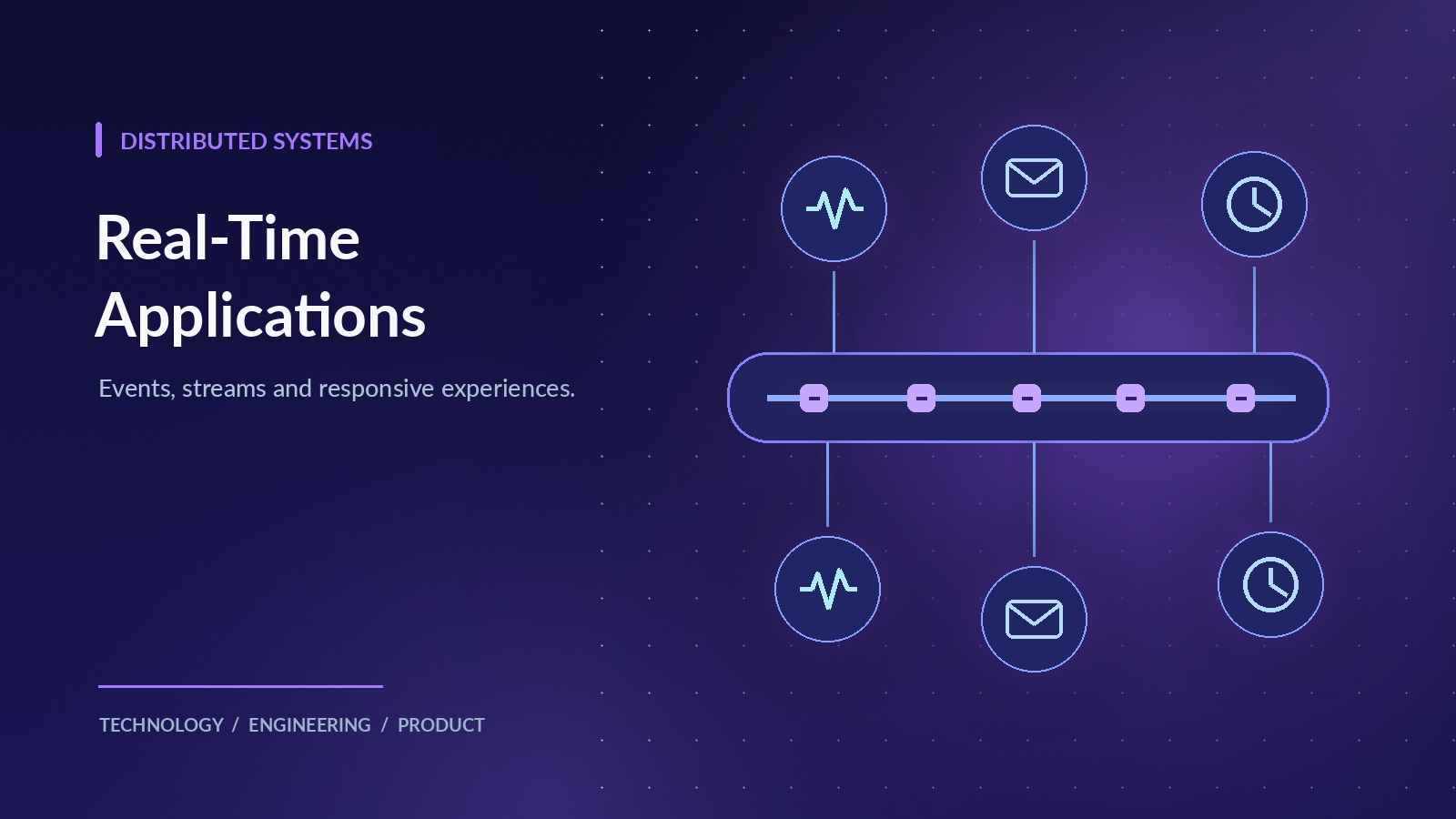
Modern digital products are increasingly expected to respond immediately to changing information.
Customers want instant order updates, live notifications, real-time collaboration, and continuously updated dashboards. Businesses also rely on applications that can process new information quickly and coordinate activities across multiple systems.
These requirements introduce technical challenges that traditional request-and-response applications may not fully address.
Engineering teams must consider data synchronization, message processing, application performance, and how systems respond when individual components become unavailable.
An event-driven architecture can help organizations manage these requirements, provided it is designed and implemented carefully.
What Are Real-Time Applications?
Real-time applications deliver information or respond to events with sufficiently low latency for their intended use.
Examples include messaging platforms, collaborative editing tools, live tracking systems, financial dashboards, and online multiplayer applications.
However, real-time does not necessarily mean every action happens instantly.
Different products have different latency expectations.
A collaborative document editor may require updates to appear quickly, while an order tracking system may tolerate a short delay between changes.
Understanding these expectations helps engineering teams select appropriate technologies.
An application should be designed around its actual business and user requirements rather than an arbitrary pursuit of the lowest possible latency.
Understanding Event-Driven Architecture
Event-driven architecture is a software design approach in which components communicate by producing and responding to events.
An event represents something that has happened within a system.
For example, an e-commerce platform might generate an event when an order is confirmed.
Other services can respond by updating inventory, preparing shipment information, or sending a customer notification.
Instead of requiring every component to communicate directly with every other component, an event-driven approach can introduce messaging infrastructure that distributes relevant information.
This may improve flexibility, but it also creates additional responsibilities involving message delivery, ordering, monitoring, and error handling.
Businesses should evaluate whether these benefits justify the architectural complexity.
Access Specialized Backend Engineering Expertise
Real-time applications may require expertise in asynchronous programming, messaging systems, databases, distributed architecture, and cloud infrastructure.
Some projects also involve technologies such as WebSockets, message brokers, or event streaming platforms.
Not every existing development team has experience building these systems at production scale.
Businesses collaborating with extended development teams can introduce backend specialists and infrastructure engineers who work alongside their internal development departments.
For example, additional engineers might help build a notification service while existing developers focus on the application’s core customer experience.
Architectural decisions should remain aligned with the broader product strategy.
Integrating specialists into established code review, testing, and deployment processes helps maintain consistency throughout development.
Design Reliable Event Processing
Event-driven applications need to handle situations where messages are delayed, duplicated, or temporarily unavailable.
For example, a system processing an order confirmation should not create multiple shipments simply because the same event is delivered more than once.
Developers may need to implement idempotent processing, which allows repeated operations to produce the intended result without unintended duplicate effects.
Messaging systems should also provide appropriate mechanisms for handling failed processing attempts.
Depending on the technology, this may involve retries, message retention, or separate queues for events that require investigation.
Engineering teams should document the expected behavior of important events and identify the consequences of processing failures.
Reliable event handling is essential when application components depend on asynchronous communication.
Manage Data Consistency
Distributed applications often store information across multiple services.
When one service updates its data, related changes may take additional time to appear elsewhere.
This is commonly associated with eventual consistency.
For example, an online store might confirm an order before its reporting dashboard reflects the latest transaction.
Such behavior may be acceptable if the product clearly accounts for it.
However, some operations require stronger consistency guarantees.
Payments, inventory reservations, and critical account changes may need carefully designed coordination mechanisms.
Engineering teams should identify which workflows require immediate consistency and which can tolerate temporary differences.
Making these decisions early can prevent confusing behavior and expensive architectural changes later.
Select the Right Communication Technologies
Different real-time requirements call for different technologies.
WebSockets can support persistent communication between clients and servers.
Server-Sent Events can be useful when an application primarily needs to deliver updates from a server to a browser.
Message brokers and streaming platforms can support asynchronous communication between backend services.
However, choosing a technology should depend on the application’s communication patterns, scale, and operational needs.
Introducing a complex streaming platform for a small notification feature may create unnecessary maintenance work.
Technical leaders should evaluate how each option fits the existing architecture and development team’s capabilities.
Monitor System Health and Message Delivery
Real-time systems require clear operational visibility.
Teams should monitor processing delays, message backlogs, connection stability, application errors, and important end-user workflows.
For example, an alert may be necessary when a notification queue grows continuously or when critical events fail to process.
Distributed tracing and structured logging can help engineers investigate interactions across services.
Monitoring should also consider whether customers receive information within the expected time.
A messaging system that appears healthy at the infrastructure level may still produce a poor user experience if updates arrive too late.
Operational measures should therefore connect technical performance with product expectations.
Test Under Realistic Conditions
Testing event-driven applications requires more than verifying that individual functions work correctly.
Engineering teams should evaluate how components behave when events arrive out of order, services restart, connections drop, or processing becomes delayed.
Load testing can help identify system limitations when many events are generated simultaneously.
Integration tests should verify important workflows across connected services.
Where appropriate, fault-injection testing can reveal whether the application recovers predictably from failures.
These practices help teams identify problems before they affect production users.
Final Thoughts
Real-time functionality can improve digital experiences and support more responsive business operations.
However, successful implementation requires thoughtful architecture, reliable messaging, strong testing, and operational monitoring.
By combining internal product expertise with specialized engineering capabilities, technology companies can develop real-time applications that remain maintainable as usage and complexity increase.
The goal is not simply to process information faster. It is to deliver timely, dependable information that supports real customer needs.