
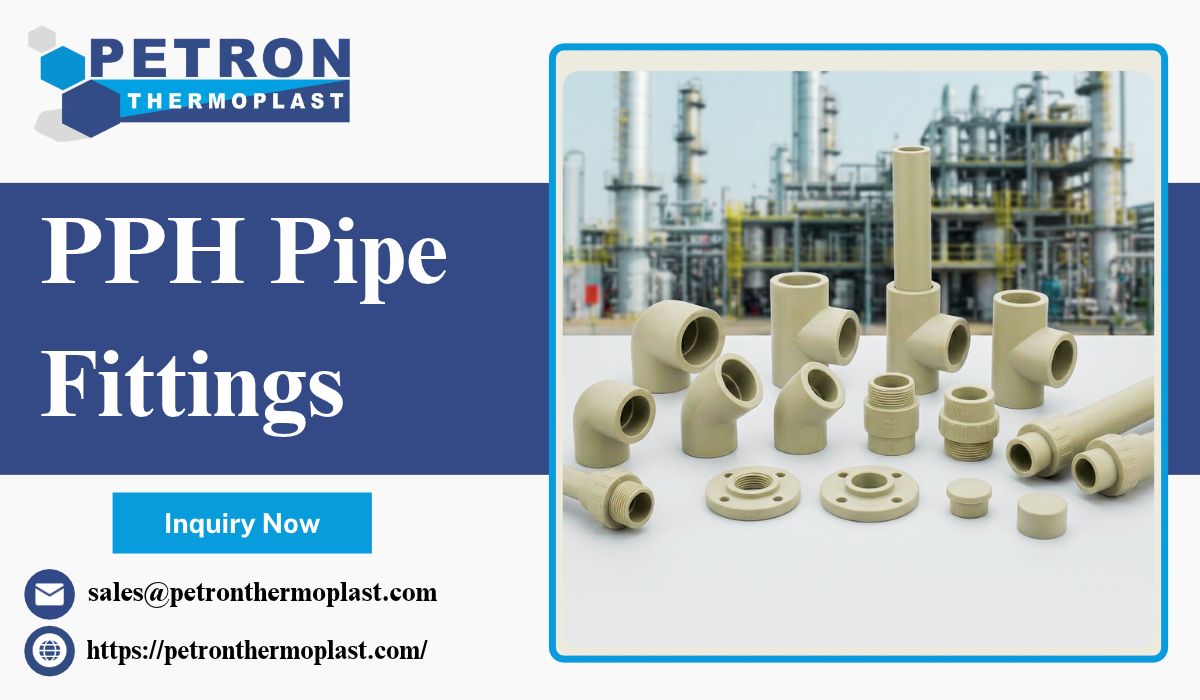
Chemical manufacturing plants require reliable piping systems to transfer process fluids, chemicals, and industrial liquids between different production areas. Every component in these systems plays an important role in maintaining smooth operations. Selecting suitable pipe fittings is particularly important because they connect pipeline sections, change flow direction, create branch connections, and support equipment integration.
Best PPH Pipe Fittings for Chemical Manufacturing Plants are designed for industrial applications where material compatibility, temperature resistance, and mechanical performance must be considered carefully. PPH, also known as homopolymer polypropylene, is a thermoplastic material used in various chemical processing and industrial piping applications.
Petron Thermoplast offers industrial thermoplastic product solutions for customized piping requirements. Selecting the right PPH fittings involves evaluating the chemical being transported, operating temperature, pressure, pipeline dimensions, and installation conditions.
What Are PPH Pipe Fittings?
PPH pipe fittings are components manufactured from polypropylene homopolymer. They are used to connect compatible PPH pipelines and create different configurations within an industrial piping network. These fittings are commonly considered for chemical transfer, process piping, industrial fluid handling, and selected water treatment applications.
PPH is valued in suitable industrial environments for its chemical resistance, relatively low weight, and fabrication possibilities. However, its suitability depends on the specific chemical, concentration, temperature, pressure, and operating conditions. Different fitting configurations allow engineers to design piping systems around machinery, storage tanks, pumps, valves, and processing equipment.
Why Choose PPH Pipe Fittings for Chemical Manufacturing Plants?
Chemical manufacturing facilities handle different liquids and process conditions. Selecting suitable piping components helps support safe and efficient fluid transportation.
- Chemical Resistance
One of the major reasons PPH is considered for chemical processing applications is its resistance to many acids, alkalis, and other industrial chemicals. Its compatibility varies depending on the chemical concentration, temperature, exposure duration, and operating conditions.
Before selecting PPH fittings, always verify chemical compatibility using reliable technical data and manufacturer recommendations.
- Temperature Resistance
PPH can be used in certain industrial temperature ranges, depending on the product design and operating conditions. Temperature affects its mechanical strength and pressure-bearing capability.
Engineers should evaluate the actual operating temperature and pressure together rather than relying on a general material temperature limit.
- Lightweight Construction
Compared with many conventional metal piping components, PPH fittings are relatively lightweight. This can make transportation, handling, and installation more convenient, especially in large industrial facilities.
- Corrosion Resistance
PPH does not experience conventional metallic rusting. This makes it a useful material option in suitable corrosive environments where compatible thermoplastic piping systems are preferred.
- Flexible Piping Configurations
Chemical plants often have complicated pipeline layouts. PPH fittings are available in different configurations that help create branch connections, direction changes, and transitions between pipe sizes.
Types of PPH Pipe Fittings Used in Chemical Plants
Different fittings perform different functions within a process pipeline.
- PPH Elbow
A PPH elbow changes the direction of fluid flow. Common configurations include 45-degree and 90-degree elbows, depending on the available product range.
They are used around equipment, tanks, walls, and other installation obstacles.
- PPH Tee
A PPH tee creates a branch connection from the main pipeline. It allows a process line to distribute fluid to different sections of a chemical manufacturing facility.
- PPH Reducer
A reducer connects pipeline sections with different diameters. It is useful when a process line transitions between larger and smaller pipe sizes.
- PPH Coupling
A coupling joins two compatible pipe sections. It is used in pipeline assembly, extension, and maintenance applications.
- PPH Flange
PPH flanges provide detachable connections between compatible pipeline components and industrial equipment. They are commonly considered where inspection, maintenance, or equipment replacement requires a removable joint.
- PPH Stub End
A PPH stub end is used with a compatible backing flange to create a detachable pipeline connection. It can be useful in larger industrial piping installations.
- PPH End Cap
An end cap closes the end of a pipeline. It may be used for a suitable pipeline termination or an unused connection.
Applications of PPH Pipe Fittings in Chemical Manufacturing Plants
PPH fittings are used in several industrial processes where the material is technically suitable.
- Chemical processing units: Connecting compatible chemical transfer and process pipelines.
- Acid handling systems: Used in selected acid transfer applications after compatibility verification.
- Alkali processing plants: Supporting suitable alkaline chemical distribution systems.
- Fertilizer manufacturing: Connecting compatible process and utility piping networks.
- Water treatment facilities: Used in selected chemical dosing and treatment systems.
- Pharmaceutical manufacturing: Supporting suitable industrial utility and process applications.
- Electroplating facilities: Connecting compatible chemical circulation and treatment lines.
- Industrial storage systems: Connecting tanks with pumps, valves, and associated process equipment.
Benefits of Using Properly Selected PPH Fittings
When selected and installed correctly, PPH pipe fittings can offer several advantages for compatible industrial applications.
Reduced corrosion concerns: PPH does not undergo conventional metallic rusting, making it suitable for certain corrosive environments.
Convenient handling: Its relatively low weight can simplify transportation and installation.
Multiple connection options: Compatible PPH systems can use suitable fusion or flanged connections.
Customized pipeline layouts: Different fitting configurations help engineers plan complex process networks.
Equipment integration: Suitable fittings help connect pipelines with tanks, pumps, valves, and other equipment.
Maintenance planning: Detachable flange connections can provide access to selected equipment and pipeline sections.
Actual performance depends on material grade, design, installation quality, and operating conditions.
How to Select the Right PPH Pipe Fittings Manufacturer?
Choosing the right manufacturer is important for chemical plants handling bulk procurement and customized industrial projects.
Consider the following points before placing an order:
- Check product specifications: Review material details, dimensions, and applicable pressure and temperature limits.
- Confirm chemical compatibility: Share the exact chemical name, concentration, and operating temperature.
- Select appropriate fitting types: Prepare a list of elbows, tees, reducers, flanges, and other required components.
- Verify connection compatibility: Ensure fittings match the selected pipe system and jointing method.
- Discuss customization: Provide drawings and dimensions if standard configurations do not meet project requirements.
- Review quality documentation: Request relevant technical datasheets and inspection documents.
- Plan bulk procurement: Confirm quantities, packing requirements, availability, and delivery schedules.
Why Choose Petron Thermoplast?
Petron Thermoplast works with industrial thermoplastic products and customized piping requirements. For chemical manufacturing projects, buyers can discuss their required PPH pipe fittings, dimensions, quantities, and application details.
Project enquiries may include:
- Customized PPH pipe fitting requirements
- Different fitting types and sizes
- Industrial chemical transfer applications
- Bulk procurement requirements
- Project-specific piping configurations
- Technical specifications and product documentation
- Domestic and international delivery enquiries
Conclusion
Choosing the best PPH pipe fittings for chemical manufacturing plants requires careful evaluation of chemical compatibility, temperature, pressure, fitting dimensions, and connection methods. Properly selected fittings help create an organized piping network for compatible industrial processes.
From elbows and tees to reducers, flanges, and couplings, every component should match the pipeline design and operating requirements. Chemical manufacturers should also consider product documentation, bulk availability, and delivery planning when sourcing fittings for large projects. Contact Petron Thermoplast to discuss your PPH pipe fittings requirements for chemical processing facilities, industrial installations, and customized piping projects.