
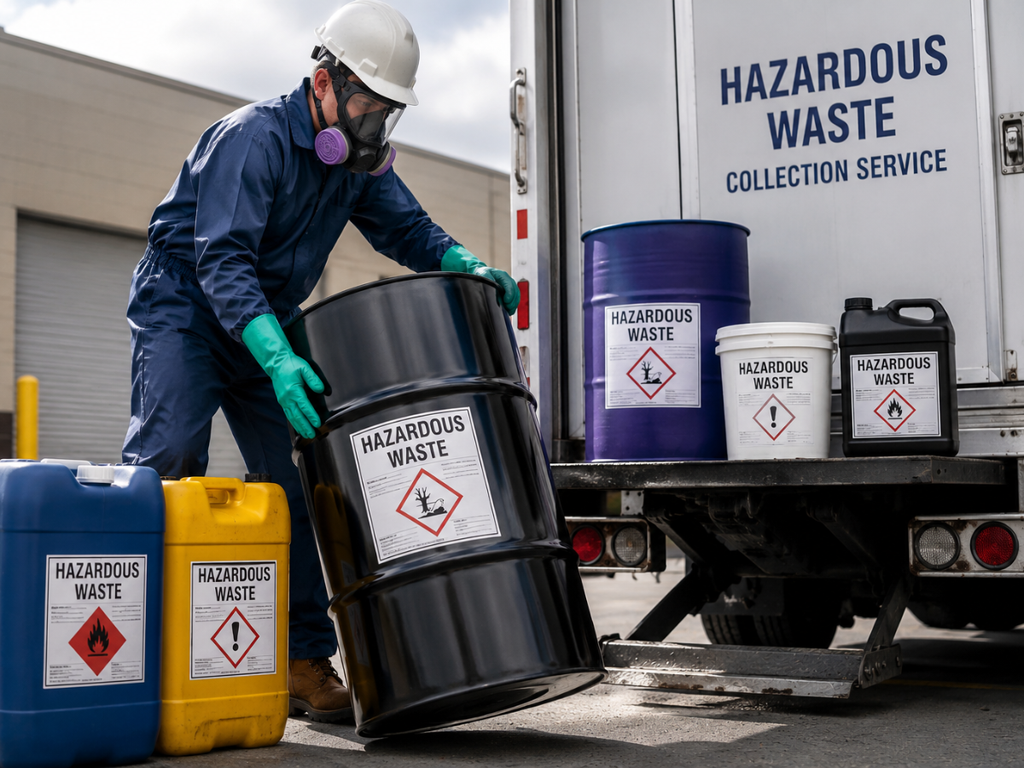
Businesses that generate hazardous materials have an important responsibility to identify, contain, store, transport, and dispose of those materials properly. Healthcare facilities, laboratories, medical offices, pharmacies, manufacturers, and other organizations can generate waste that presents risks to workers, the public, and the environment if it is mishandled.
Hazardous waste pickup is one part of a larger waste management process. Before arranging collection, a business needs to understand what type of waste it generates, whether the material is regulated as hazardous waste or regulated medical waste, and which requirements apply to its handling and transportation. In Virginia, the Department of Environmental Quality (DEQ) regulates hazardous waste under the Virginia Hazardous Waste Management Regulations, while regulated medical waste is governed separately under Chapter 121.
What Is Hazardous Waste?
Hazardous waste is not simply any waste that seems dangerous. Under Virginia’s regulatory framework, hazardous waste can be identified because it exhibits characteristics such as ignitability, corrosivity, reactivity, or toxicity, or because it appears on specific regulatory lists.
Examples can include certain:
- Solvents and cleaning chemicals
- Laboratory chemicals
- Pesticides
- Batteries and certain lamps
- Contaminated materials
- Unused commercial chemical products
- Certain pharmaceutical wastes
The classification depends on the material’s properties, composition, source, and applicable regulations. A business cannot simply assume that every chemical-containing material is hazardous waste.
How Is Hazardous Waste Identified?
Virginia DEQ states that facilities generating solid waste must determine whether their waste meets the definition of hazardous waste. Businesses can use appropriate generator knowledge or, when necessary, have materials analyzed to determine their characteristics.
This determination is important because the classification affects how waste must be accumulated, labeled, transported, treated, stored, and disposed of.
A useful first step is to create an inventory of waste streams. Organizations can document the material’s name, source, physical state, ingredients, safety information, and approximate quantities. Safety Data Sheets can also provide useful information about chemical properties, although they do not replace the required regulatory waste determination.
What Is Regulated Medical Waste?
Regulated medical waste is a distinct category from hazardous waste.
Virginia DEQ defines regulated medical waste as a subset of solid waste that requires more stringent management because of potential exposure to pathogens capable of transmitting infectious disease. Examples include certain blood-contaminated materials, pathological waste, infectious laboratory materials, and contaminated sharps.
Healthcare facilities can generate both regulated medical waste and hazardous waste. A medical office, for example, may produce contaminated sharps while also generating pharmaceutical or chemical waste that falls under a different regulatory framework.
Understanding this distinction helps organizations avoid placing incompatible waste streams into the same containers or using an inappropriate disposal method.
Why Is Proper Segregation Important?
Waste should be separated according to its applicable category as close as practical to the point where it is generated.
Mixing different waste streams can increase handling risks and may complicate regulatory compliance. It can also turn otherwise non-regulated material into a more complicated waste stream.
Virginia’s regulated medical waste rules establish specific requirements for packaging, labeling, storage, transportation, treatment, and disposal.
For example, regulated medical waste generally requires appropriate packaging and labeling, while contaminated sharps must be placed in puncture-resistant containers. Virginia guidance states that red bags are used for regulated medical waste except sharps, which must go directly into puncture-resistant containers.
What Should Businesses Consider Before Pickup?
Before arranging collection, organizations should know what material is being removed and how much is generated.
Important considerations include:
- Waste classification: Determine whether the material is hazardous waste, regulated medical waste, pharmaceutical waste, or another category.
- Quantity: Track how much waste is generated over time.
- Packaging: Use containers appropriate for the waste.
- Labeling: Apply required labels and markings.
- Storage: Keep waste in an appropriate accumulation or storage area.
- Pickup schedule: Arrange collection before storage areas become overcrowded.
- Documentation: Maintain required records and shipping documentation.
- Destination: Confirm that the receiving facility is authorized to accept the particular waste stream.
These steps make the pickup process safer and more predictable.
How Does Hazardous Waste Pickup Work?
The exact process depends on the type and quantity of waste involved.
Generally, a business first identifies and characterizes the waste. The material is then placed into suitable containers and labeled according to applicable requirements. A qualified transporter can collect the waste and take it to an authorized facility for treatment, storage, or disposal.
Virginia DEQ explains that facilities involved in treating, storing, or disposing of hazardous waste may require permits unless a specific exemption applies.
For businesses, this means pickup should not be viewed as simply moving unwanted material away from a facility. The waste remains subject to applicable requirements throughout its management chain.
How Is Regulated Medical Waste Collected?
Regulated medical waste follows its own requirements in Virginia.
Generators are required to package, label, store, and arrange for removal of regulated medical waste. Virginia DEQ states that generators must arrange for regulated medical waste to be transported offsite to a facility permitted to receive it for transfer, treatment, or disposal. Untreated regulated medical waste cannot simply be placed in ordinary trash or disposed of at a conventional solid waste landfill.
Treatment facilities use approved methods, which can include autoclaving, incineration, or other permitted treatment technologies.
This regulatory structure helps ensure that potentially infectious material is treated appropriately before final disposal.
What About Pharmaceutical Waste?
Pharmaceutical waste requires particular attention in healthcare settings.
Certain discarded pharmaceuticals may qualify as hazardous waste and are subject to specific requirements. Virginia DEQ explains that hazardous waste pharmaceuticals generated by healthcare facilities are governed under the federal Hazardous Waste Pharmaceuticals Rule, commonly known as Subpart P, with applicable Virginia requirements.
One especially important rule concerns disposal through drains. Hazardous waste pharmaceuticals generally cannot be discharged through sewer systems under the applicable sewer prohibition. Virginia DEQ states that healthcare facilities are prohibited from discharging hazardous waste pharmaceuticals into sewer systems that pass through to publicly owned treatment works.
Facilities should therefore establish a dedicated pharmaceutical waste procedure rather than treating unwanted medications as ordinary liquid waste.
How Should Waste Be Stored Before Pickup?
Temporary storage should prevent leaks, spills, unauthorized access, and accidental exposure.
The appropriate storage setup depends on the waste type. Businesses should consider container compatibility, container condition, secondary containment where appropriate, ventilation requirements, access controls, and labeling.
For regulated medical waste, Virginia’s regulations establish specific storage and handling requirements. Packages must be properly closed, sealed, and protected from leakage or damage.
Hazardous chemical waste may have additional requirements based on its characteristics and generator category.
Why Is Employee Training Important?
Waste procedures are only effective when employees understand them.
Training should cover waste identification, container selection, labeling, spill response, storage procedures, and escalation protocols. Employees should know what to do when they encounter an unknown chemical, damaged container, leaking package, or incorrectly discarded sharp.
Training should also explain which waste materials must never be placed into ordinary trash, recycling containers, sinks, or other inappropriate disposal routes.
Regular reviews can help organizations identify recurring mistakes and update procedures when waste streams or regulations change.
What Should You Look for in a Waste Service Provider?
When evaluating a waste collection provider, businesses should consider whether the provider is equipped to handle the specific waste streams being generated.
Questions worth asking include:
- What types of waste does the provider accept?
- How is the waste classified before pickup?
- What packaging requirements apply?
- What documentation is provided?
- Where is the waste transported?
- Is the receiving facility authorized for the relevant waste?
- How are emergency spills or damaged containers handled?
- What records should the generator retain?
Businesses should also distinguish between providers that handle regulated medical waste and those equipped for hazardous waste. The appropriate service depends on the material being collected.
How Can Businesses Reduce Waste?
Waste reduction can begin before disposal.
Organizations can review purchasing practices, inventory controls, chemical usage, and product expiration dates. Ordering appropriate quantities can reduce the amount of unused material that eventually becomes waste.
Healthcare facilities can also improve segregation so ordinary waste is not unnecessarily placed into regulated waste streams.
However, cost reduction should never override safety or regulatory requirements. Materials should always be classified and managed according to the rules applicable to them.
Why Do Virginia Regulations Matter?
Virginia has specific regulatory requirements for both hazardous waste and regulated medical waste.
The Virginia DEQ explains that hazardous waste is regulated under the Virginia Hazardous Waste Management Regulations, while regulated medical waste is managed under Chapter 121. The state’s regulated medical waste rules were amended, with the current regulations taking effect March 15, 2023.
Because regulations can change and requirements vary according to waste type and generator status, businesses should use current state guidance when developing their procedures.
Conclusion
Effective hazardous waste pickup begins long before a collection vehicle arrives. Businesses first need to identify their waste streams, determine the applicable classifications, use appropriate containers, maintain proper storage areas, and keep required records. In Virginia, hazardous waste and regulated medical waste follow different regulatory frameworks, making accurate classification especially important. For healthcare organizations, health care waste management should address the different categories generated by daily operations, including contaminated sharps, infectious materials, pharmaceuticals, chemicals, and ordinary waste. Each stream may have different packaging, storage, transportation, treatment, and disposal requirements.