
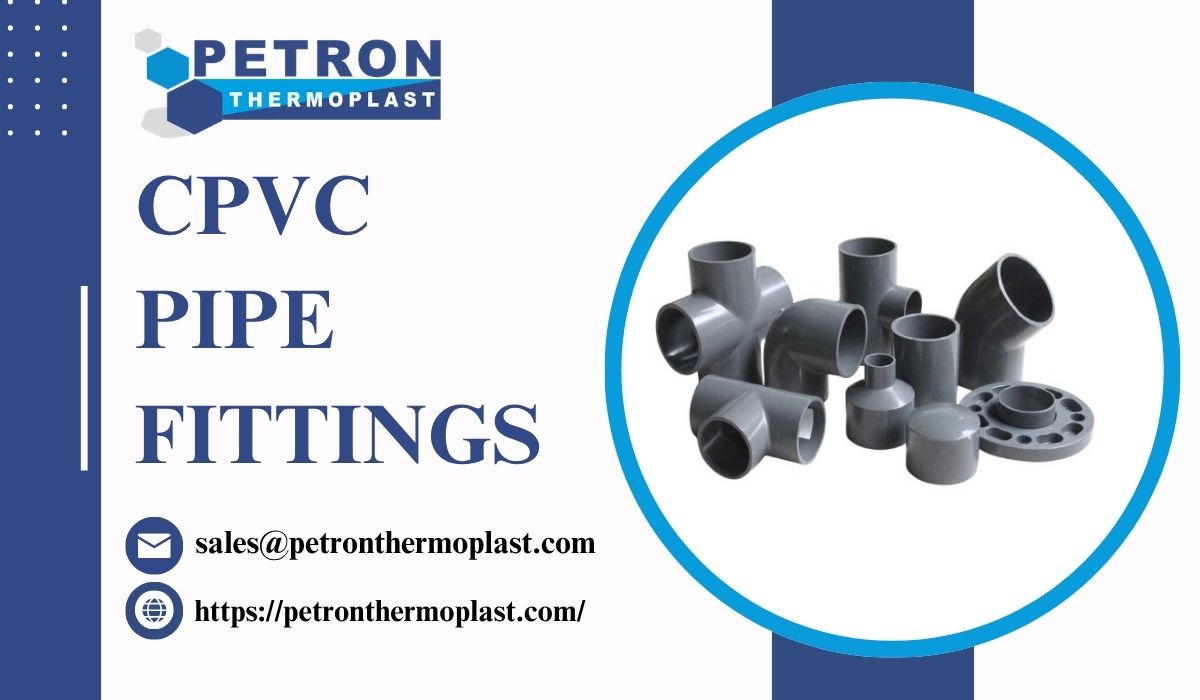
Industrial piping systems require reliable components to maintain smooth fluid transfer, secure connections, and efficient plant operations. While pipes form the main pathway for fluid movement, CPVC pipe fittings are essential for connecting pipelines, changing flow direction, creating branches, reducing pipe sizes, and connecting pipes with valves, tanks, pumps, and other equipment.
For large industrial projects, standard fittings may not always match the required piping configuration. This is why custom CPVC pipe fittings are increasingly useful for applications where specific dimensions, connection types, sizes, or layouts are required.
Petron Thermoplast provides CPVC pipe fittings for industrial applications, including customized requirements and bulk supply. Buyers can specify fitting type, size, quantity, connection arrangement, and application requirements when planning their procurement.
What Are CPVC Pipe Fittings?
CPVC stands for Chlorinated Polyvinyl Chloride. CPVC pipe fittings are piping components manufactured from CPVC material and designed to connect compatible CPVC pipes and components.
They are available in different shapes and configurations to accommodate various piping layouts.
Common CPVC fittings include:
- CPVC Elbow
- CPVC Tee
- CPVC Reducer
- CPVC Coupling
- CPVC Union
- CPVC Flange
- CPVC Adapter
- CPVC Bush
- CPVC Cross
- CPVC End Cap
- CPVC Socket Fittings
- Custom CPVC Fittings
The correct fitting depends on pipe dimensions, pressure, temperature, fluid compatibility, connection method, and application.
Why Choose Custom CPVC Pipe Fittings?
Industrial piping systems can have different layouts, equipment positions, and space restrictions. A standard fitting may not always provide the required connection.
Custom CPVC fittings can be designed or fabricated according to project-specific requirements, where technically feasible.
Some advantages include:
- Application-specific dimensions
- Flexible connection configurations
- Better integration with existing piping
- Suitable options for unusual layouts
- Reduced need for multiple adapters
- Improved space utilization
- Support for specialized industrial projects
- Availability for bulk requirements
Custom solutions can be particularly useful when working on chemical processing plants, water treatment systems, manufacturing facilities, and other industrial installations.
Applications of CPVC Pipe Fittings
CPVC fittings are used in various industrial and commercial piping applications where the material is suitable.
1. Chemical Processing
Chemical processing facilities often require piping systems for transferring compatible acids, alkalis, salts, and other fluids. CPVC fittings can be used in applications where their chemical and temperature resistance is appropriate.
2. Water Treatment
CPVC fittings can be incorporated into selected water treatment systems, filtration systems, and process water pipelines.
3. Chemical Storage Systems
Storage tanks require piping connections for filling, draining, circulation, transfer, and other operations. CPVC fittings can be used where the stored or transferred fluid is compatible.
4. Industrial Fluid Transfer
Manufacturing plants may use CPVC piping for moving water, chemicals, and other compatible process fluids between different sections of the facility.
5. Industrial Utility Systems
CPVC fittings can also be used for suitable utility and service lines where temperature, pressure, and chemical conditions are within the material’s operating limits.
6. Process Industries
Industries involved in chemical processing, surface treatment, manufacturing, and other processes can use CPVC fittings for suitable fluid-handling applications.
Types of Custom CPVC Pipe Fittings
Different piping layouts require different fitting configurations.
CPVC Elbow
CPVC elbows are used to change pipeline direction. Common configurations include 45-degree and 90-degree elbows.
CPVC Tee
A tee provides a branch connection from a main pipeline and is useful for distributing fluid to different process lines.
CPVC Reducer
Reducers connect pipes with different diameters and allow the pipeline size to transition from one diameter to another.
CPVC Coupling
Couplings connect two compatible pipes and are commonly used to extend piping systems.
CPVC Union
A union creates a detachable connection that can make equipment maintenance and pipeline servicing easier.
CPVC Flange
Flanges provide bolted connections between piping components, tanks, valves, pumps, and other equipment.
CPVC Adapter
Adapters help connect CPVC piping with different connection arrangements or compatible components.
CPVC Bush
A CPVC bush can reduce the connection size and is useful when joining components with different diameters.
Benefits of Bulk CPVC Pipe Fittings Supply
Large industrial projects often require significant quantities of fittings in different sizes and configurations. Buying in bulk can simplify procurement and help maintain consistency throughout the installation.
Key benefits include:
- Consolidated procurement
- Availability of multiple sizes
- Consistent product specifications
- Easier project planning
- Reduced procurement delays
- Competitive bulk pricing
- Better inventory planning
- Support for large industrial requirements
For large projects, it is useful to work with a supplier capable of handling multiple fitting types and quantities under one order.
Technical Factors to Consider
Selecting CPVC fittings should involve more than simply matching the pipe diameter. The operating environment must also be considered.
| Parameter | Important Consideration |
|---|---|
| Pipe Size | Required nominal diameter |
| Fitting Type | Elbow, tee, reducer, flange, coupling, etc. |
| Pressure | Normal and maximum operating pressure |
| Temperature | Normal and maximum operating temperature |
| Fluid | Chemical, water, process fluid, etc. |
| Concentration | Important for chemical compatibility |
| Connection | Socket, threaded, flanged, or custom |
| Quantity | Required project volume |
| Installation | Existing layout and available space |
Correct technical selection helps reduce leakage, connection problems, and premature component failure.
CPVC Pipe Fittings for Chemical Applications
One of the important advantages of CPVC is its resistance to many chemicals. However, CPVC is not automatically suitable for every chemical application.
Chemical compatibility can depend on:
- Chemical type
- Concentration
- Operating temperature
- Exposure duration
- Pressure
- Fluid flow conditions
- Mechanical stresses
Before placing a bulk order, buyers should provide complete application information to the manufacturer or technical supplier.
This is especially important for aggressive chemical environments and elevated-temperature applications.
Custom Sizes and Configurations
Custom fabrication can help address situations where standard fitting dimensions are not suitable.
Depending on technical feasibility, custom CPVC solutions may include:
- Special dimensions
- Custom branch arrangements
- Non-standard reducers
- Custom adapters
- Special flange configurations
- Project-specific connection arrangements
- Custom fabricated components
The manufacturer should receive detailed drawings or specifications whenever a project requires a non-standard configuration.
Quality Considerations for Bulk Orders
When ordering hundreds or thousands of fittings, product consistency becomes particularly important. Variations in dimensions or connection quality can create installation difficulties and affect project timelines.
Important quality checks may include:
- Dimensional accuracy
- Wall thickness
- Connection dimensions
- Fitting geometry
- Surface finish
- Material consistency
- Visual inspection
- Packaging condition
For large projects, buyers can also discuss inspection procedures, documentation, and technical specifications before confirming the order.
CPVC Fittings vs. Conventional Metal Fittings
CPVC can offer practical benefits compared with certain metal materials in suitable applications.
| Feature | CPVC Fittings | Metal Fittings |
|---|---|---|
| Corrosion resistance | Good for compatible chemicals | Depends on metal/alloy |
| Weight | Lightweight | Generally heavier |
| Handling | Easier | More demanding |
| Maintenance | Generally low | May require corrosion protection |
| Installation | Relatively simple | Depends on joining method |
| Chemical compatibility | Application dependent | Application dependent |
The correct choice should always be based on the actual process conditions rather than material preference alone.
How to Select the Right CPVC Pipe Fittings
Before ordering, industrial buyers should prepare complete technical details.
Step 1: Identify the Fitting Type
Determine whether you need elbows, tees, reducers, couplings, unions, flanges, adapters, or other fittings.
Step 2: Confirm Pipe Sizes
Provide the pipe diameter and required fitting dimensions.
Step 3: Specify the Fluid
Mention whether the system handles water, chemicals, process fluids, or another medium.
Step 4: Provide Operating Conditions
Share pressure and temperature information.
Step 5: Specify Connection Requirements
Confirm whether the fitting requires socket, threaded, flanged, or another connection.
Step 6: Share Quantity
For bulk orders, provide the required quantity for each fitting type and size.
Step 7: Provide Drawings for Custom Products
If a special configuration is required, technical drawings or dimensions can help the manufacturer understand the requirement.
Why Choose Petron Thermoplast?
Petron Thermoplast provides CPVC pipe fittings for industrial piping and fluid-handling applications. The product range can support standard and customized requirements based on fitting type, size, connection, quantity, and application.
Customers can discuss requirements involving:
- Custom CPVC fittings
- Multiple fitting sizes
- Bulk industrial quantities
- Chemical piping applications
- Water treatment systems
- Process piping
- Custom connections
- Project-specific configurations
For bulk procurement, customers can share their product list and project requirements to discuss suitable supply options.
Industries We Serve
CPVC pipe fittings can be used in various industries where their technical characteristics are suitable.
These may include:
- Chemical processing
- Water treatment
- Pharmaceutical applications
- Manufacturing
- Surface treatment
- Metal finishing
- Industrial utilities
- Chemical storage
- Process industries
- General industrial fluid handling
The final material selection should always be based on the actual operating environment.
Conclusion
Custom CPVC Pipe Fittings for Bulk Industrial Supply can provide an effective solution for projects that require reliable connections, specialized configurations, and large quantities of piping components.
CPVC fittings offer benefits such as lightweight construction, corrosion resistance, and suitability for many industrial fluid-handling applications. Customization can provide additional flexibility when standard fittings do not match a project’s dimensions or layout.
For successful procurement, buyers should consider fitting type, size, fluid compatibility, pressure, temperature, connection method, quantity, and installation requirements.
Petron Thermoplast provides CPVC pipe fittings for industrial applications, including bulk orders and custom requirements.
Looking for custom CPVC pipe fittings for your industrial project? Contact Petron Thermoplast with your required sizes, fitting types, quantities, and technical specifications to discuss your requirement.
FAQs
1. Can CPVC pipe fittings be customized?
Yes. Depending on the design and technical feasibility, CPVC fittings can be customized for specific dimensions, connections, reducers, adapters, and industrial configurations.
2. Are CPVC fittings suitable for chemical applications?
CPVC can be suitable for many chemical applications, but compatibility must be verified based on the chemical, concentration, temperature, and operating conditions.
3. Can I buy CPVC fittings in bulk?
Yes. CPVC fittings can be supplied in bulk quantities for industrial projects, piping installations, and large procurement requirements.
4. What types of CPVC fittings are available?
Common types include elbows, tees, reducers, couplings, unions, flanges, adapters, bushes, crosses, and end caps.
5. What information is needed for a custom CPVC fitting?
Important details include fitting type, dimensions, pipe size, connection method, fluid, pressure, temperature, quantity, and technical drawings where applicable.
6. Does Petron Thermoplast supply custom CPVC pipe fittings?
Yes. Petron Thermoplast supplies CPVC pipe fittings for industrial applications and can discuss custom and bulk requirements based on project specifications.