
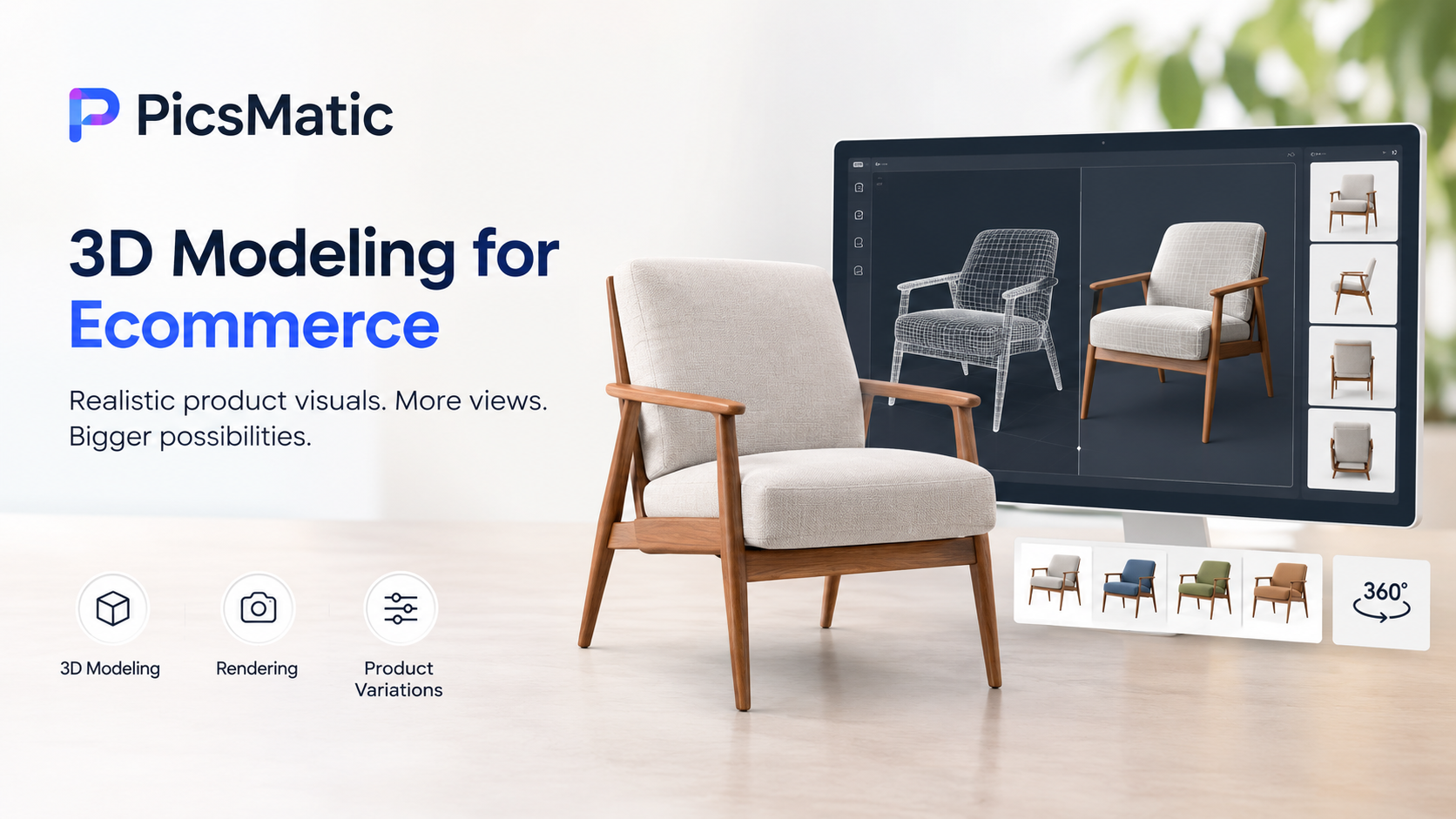
Selling products online is not only about having good photographs. Customers want to understand what a product looks like, how it is designed, what materials it uses, and sometimes even how it will look in a different color or configuration.
That is where 3D modeling for ecommerce can make a real difference. Instead of depending entirely on traditional product photography, businesses can create realistic digital versions of their products and use them across websites, marketplaces, advertisements, catalogs, and interactive shopping experiences.
For brands with multiple products, variations, or frequent launches, 3D models can also be reused for different marketing needs. PicsMatic provides professional 3D modeling solutions that can turn product references, images, drawings, or specifications into detailed digital models.
What Is 3D Modeling for Ecommerce?
3D modeling for ecommerce is the process of creating a digital three-dimensional representation of a physical product.
Unlike a regular product photograph, a 3D model can be viewed from different angles and adapted for different uses. Depending on the project, the model can be rendered into realistic product images, animations, interactive experiences, or AR/VR applications.
For online retailers, this can be useful when:
- A product has several colors or configurations
- A new product is not yet available for a full photoshoot
- Multiple product views are required
- Products need to be shown in different environments
- Customers need a closer look at product details
- The same product assets need to be reused across multiple marketing channels
Why Are Businesses Using 3D Product Models for Online Stores?
Traditional photography still has an important place in ecommerce, but it can become complicated when a business has hundreds of SKUs or products that require multiple variations.
A 3D model can provide more flexibility after it has been created.
For example, a furniture company could create one detailed model and use it to show different colors, materials, room settings, and viewing angles without arranging a completely new photoshoot for every variation.
The same approach can work for electronics, footwear, jewelry, home décor, appliances, automotive accessories, and other products.
What Can Professional 3D Product Modeling Include?
Professional 3D Product Modeling and Rendering Services can involve much more than simply creating a digital object.
Depending on the requirements, the workflow may include:
Custom 3D Modeling
Models can be created from CAD files, blueprints, sketches, measurements, reference photographs, or product specifications.
The objective is to reproduce the product’s shape, proportions, surface details, materials, and important design elements as accurately as possible. PicsMatic states that its team can work from blueprints, reference photos, or even an initial product idea.
3D Rendering
Once a model is created, it can be rendered into realistic images with appropriate lighting, materials, textures, reflections, and shadows.
This can be particularly useful when you need product visuals before arranging a conventional photoshoot.
3D Asset Creation and Management
A finished model can become a reusable digital asset rather than a one-time image.
Businesses can repurpose 3D assets for product pages, marketing images, videos, interactive experiences, and AR/VR applications.
Product Configurators
Some products are available in different colors, materials, sizes, or configurations. A 3D product configurator can allow shoppers to see those options digitally before making a purchase.
This is especially useful for customizable furniture, automobiles, kitchens, fashion products, accessories, and other configurable products.
How Does 3D Modeling Compare With Traditional Product Photography?
Both methods have their place. The right choice depends on the product and the type of content you need.
| Requirement | Traditional Photography | 3D Product Modeling |
|---|---|---|
| Physical product required | Usually yes | Not always |
| Multiple product variations | May require additional setup | Can be created from one model |
| Change colors/materials | May require another shoot | Can be digitally modified |
| Different camera angles | Requires additional photographs | Can be rendered from multiple angles |
| Virtual/AR applications | Limited | Well suited |
| Reusable digital asset | Mainly individual photos | Model can support multiple outputs |
| Product visualization before production | Difficult | Possible with suitable references |
The biggest advantage is flexibility. A well-built model can become the foundation for many different visual outputs instead of being limited to one set of photographs.
Can 3D Models Replace Product Photography?
Not always.
For some products, real photography remains the best option because customers need to see the actual product, material, texture, or real-world environment.
3D modeling works particularly well when a brand needs:
- Multiple product variations
- Detailed product visualization
- Images before physical production
- Interactive product experiences
- AR/VR-ready assets
- Consistent visuals across large product catalogs
- Product images that are difficult or expensive to photograph
In many ecommerce workflows, 3D and photography can complement each other rather than compete with each other.
How Can 3D Modeling Improve Ecommerce Product Presentation?
A strong product page needs visuals that help shoppers understand the product quickly.
3D models can support this by providing:
More viewing angles: Customers can see details that may not be visible in a single photograph.
Consistent presentation: Products can be rendered with controlled lighting, backgrounds, and camera positions.
More variations: Different colors, finishes, and configurations can be visualized without photographing every variation.
Interactive experiences: 3D assets can be used for interactive viewers and product configurators.
Marketing flexibility: The same model can be adapted into still images, animations, videos, and immersive experiences.
For traditional product images that need cleanup, retouching, or consistent presentation, businesses can also use eCommerce product photo editing services alongside their 3D workflow.
Which Industries Can Benefit From Ecommerce 3D Modeling?
3D modeling can be useful across a wide range of industries.
Furniture and Home Décor
Furniture often comes in multiple sizes, finishes, fabrics, and colors. A detailed 3D model can help shoppers understand how the product may look before purchasing.
PicsMatic has also worked on furniture and interior décor projects combining product photo editing, 3D modeling, and lifestyle imagery.
Jewelry
Jewelry requires close attention to small details, reflections, gemstones, and metal finishes. 3D visualization can provide additional ways to present these details online.
For conventional jewelry imagery, jewelry photo retouching services can also help improve product photographs while preserving realistic details.
Fashion and Accessories
Fashion brands can use 3D assets to visualize products, create variations, and explore interactive experiences. Traditional fashion imagery can still be supported with fashion photo editing services for catalog and campaign images.
Electronics
Electronic products often have precise shapes, ports, buttons, finishes, and technical details. 3D models can help present these features from multiple viewpoints.
Automotive Accessories
Custom parts and accessories can benefit from interactive visualization, particularly when shoppers want to understand how different options may look on a vehicle.
Furniture and Interior Products
For furniture retailers, realistic models can be placed into different environments to give shoppers a better idea of scale and appearance.
When conventional furniture photographs require cleanup or background changes, furniture photo editing services can complement the 3D workflow.
What Information Is Needed to Create a 3D Product Model?
You do not necessarily need a CAD file to begin a 3D modeling project.
Depending on the product and required accuracy, useful references can include:
- Product photographs
- CAD files
- Blueprints
- Technical drawings
- Product measurements
- Sketches
- 360-degree photographs
- Material references
- Color references
- Product specifications
The more accurate the source information, the easier it is to reproduce the product correctly. PicsMatic notes that its team can work with CAD files and blueprints, but can also create models from photographs, sketches, wireframes, or product specifications.
What Should You Look for in a 3D Modeling Service?
Choosing a 3D modeling partner should not be based only on price. The quality of the final model matters because small inaccuracies can become obvious when the product is displayed from different angles.
Before choosing a provider, consider:
| Factor | What to Check |
|---|---|
| Modeling quality | Realistic shape, proportions, and details |
| Texturing | Accurate materials, colors, and finishes |
| Rendering | Natural lighting, shadows, and reflections |
| Scalability | Ability to handle multiple products |
| Turnaround | Delivery time for your project size |
| Revisions | Process for requesting changes |
| File formats | Compatibility with your intended platform |
| Security | Protection of product information and assets |
| Experience | Relevant industry portfolio and examples |
It is also useful to request a sample before committing to a large project.
Why Choose PicsMatic for 3D Product Modeling?
PicsMatic combines 3D modeling expertise with professional image editing capabilities, making it possible to manage different parts of a product visualization workflow under one service provider.
Its 3D services include custom modeling, 3D asset creation and management, realistic rendering, and product configurator development. The team also works with tools such as Blender, Maya, and KeyShot for rendering and visualization.
The company states that its 3D models can be created for products including furniture, electronics, jewelry, fashion accessories, and other commercial products.
For businesses that also need clean product photographs, background removal services can be used to create clean product cutouts and consistent backgrounds for ecommerce listings.
Is 3D Modeling Worth It for an Ecommerce Business?
It can be, especially when a business sells products with multiple variations or needs a large amount of visual content.
The value is not limited to creating one attractive image. A well-designed 3D model can become a reusable digital asset for product pages, advertising, catalogs, social media, interactive viewers, and AR/VR experiences.
For businesses with large product ranges, that flexibility can make the content production process easier to manage and scale.
Conclusion
Ecommerce shoppers cannot physically touch or examine a product before purchasing, so strong visual presentation matters.
3D modeling for ecommerce gives brands another way to show products with greater flexibility, detail, and consistency. From realistic renders and product configurators to AR/VR experiences and reusable marketing assets, a single model can support multiple stages of the customer journey.
If your business is looking for realistic, scalable product visualization, PicsMatic’s 3D Product Modeling and Rendering Services can help turn product references into detailed digital assets for ecommerce and marketing applications.
FAQs
Q1. What is 3D modeling for ecommerce?
3D modeling for ecommerce is the creation of a digital three-dimensional version of a physical product. The model can be rendered into product images or used for interactive, AR, VR, and configurator experiences.
Q2. Can a 3D model be created without CAD files?
Yes. Depending on the product, a 3D model can be created using reference photographs, sketches, measurements, wireframes, or product specifications. CAD files and blueprints can help improve precision but are not always required.
Q3. What products can be converted into 3D models?
Many products can be modeled, including furniture, jewelry, electronics, fashion accessories, home décor, appliances, and automotive products. The exact workflow depends on the product’s complexity and the available reference material.
Q4. Can 3D models be used for Amazon or other ecommerce websites?
Yes, depending on the platform’s supported formats and requirements. 3D models can also be rendered into standard product images for ecommerce listings, websites, advertisements, and catalogs.
Q5. Can one 3D model be used for multiple product variations?
Yes. When the model is built appropriately, variations such as colors, materials, finishes, and certain design options can be created digitally without photographing every version.
Q6. How long does 3D product modeling take?
The timeline depends on the product’s complexity, the number of models, level of detail, and required outputs. Simple models can take a few days, while highly detailed models, animations, or complex projects may take longer.
Q7. Is 3D modeling more affordable than product photography?
It depends on the project. While there is an initial modeling cost, a reusable 3D asset can support multiple images, variations, marketing materials, and interactive experiences, potentially reducing the need for repeated photoshoots.
Q8. Can 3D models be used for AR and VR?
Yes. Properly prepared 3D assets can be optimized for augmented and virtual reality applications, allowing customers to experience products in more interactive ways.