
A solar project can be ready for installation, but the permit package may still need work.
Maybe the roof layout is correct, yet the electrical diagram shows an older equipment configuration. Maybe the equipment schedule does not match the latest design. Or perhaps the application is missing information that the reviewing authority expects to see.
These problems are frustrating because they are often preventable.
Good solar permit design is not simply about drawing solar panels on a roof. It is about creating a coordinated package in which the site conditions, electrical system, equipment, calculations, notes, and application information all describe the same proposed project.
For U.S. projects, requirements can differ by jurisdiction and project type. That means a permit package should be prepared around the actual project and applicable authority rather than copied blindly from an older job.
So, what should a solar team check before submitting?
Why Permit Packages Get Delayed
A permit review can slow down when information is incomplete, inconsistent, unclear, or difficult to verify.
The problem may be small.
One equipment model may be outdated.
One drawing may show a different module count.
A service rating may be entered incorrectly.
A roof obstruction may be missing from the layout.
A revision may have been made to one sheet but not another.
None of these issues necessarily means the entire project is wrong. But they can create questions that require clarification or correction.
The solution is not simply to create more pages.
The better approach is to make every page serve a clear purpose and ensure the package remains coordinated.
1. Start With Reliable Project Information
The quality of the final permit package depends heavily on the information used at the beginning.
Before designing the array, collect the available project information.
Depending on the job, this may include:
- Property address
- Roof information
- Site photos
- Existing electrical service details
- Main panel information
- Existing solar equipment
- Proposed solar equipment
- Module specifications
- Inverter information
- Battery information, if applicable
- Proposed equipment locations
- Utility information
- AHJ requirements
Do not assume that information from an old project is automatically correct for a new one.
Even two homes in the same neighborhood can have different roof structures, electrical equipment, service configurations, and permitting requirements.
A strong design process begins by confirming the inputs before building the drawings.
2. Design the Roof Layout Around the Actual Property
One of the most visible parts of a residential solar package is the roof layout.
It should represent the actual property as accurately as the available project information allows.
Before placing modules, identify important roof conditions such as:
- Roof planes
- Ridges
- Hips
- Valleys
- Dormers
- Skylights
- Chimneys
- Plumbing vents
- Existing roof equipment
- Roof edges
- Other relevant obstructions
Then consider how the proposed array fits within those conditions.
Avoid starting with a desired module count and forcing the roof to accommodate it.
Instead, start with the roof and determine what layout makes sense.
This approach can reduce redesign work later, especially when an obstruction or roof geometry issue is discovered before submission rather than after review.
3. Keep the Electrical Design Connected to the Roof Design
A solar permit is more than a roof drawing.
The electrical documentation needs to describe the proposed system that the roof layout represents.
For example, if the final roof layout contains 24 modules but the electrical documentation still reflects 26 modules, the package contains an obvious inconsistency.
The same principle applies to:
- Module model
- Inverter model
- Microinverter quantity
- Battery equipment
- Disconnects
- Main service equipment
- System capacity
- Equipment quantities
Every major design change should trigger a review of the related documentation.
This is one of the most important habits in solar permit design because a revision rarely affects only one page.
4. Check the Equipment Schedule Before Submission
Equipment information should be treated as a design-control point.
Before submitting, compare the equipment schedule against the final design.
Ask:
Are these the exact models being proposed?
Are the quantities correct?
Does the electrical diagram show the same equipment?
Does the physical layout agree with the equipment information?
A late equipment substitution can create problems if the old model remains somewhere in the package.
For example, an installer might replace one inverter with another after the initial design. If the equipment schedule changes but the single-line diagram does not, the documents no longer describe one consistent system.
The same issue can occur with batteries, rapid shutdown equipment, disconnects, panels, and other components.
5. Build Permit Drawings as One Coordinated Package
A permit package should not feel like several unrelated documents placed into one PDF.
Each drawing should connect to the others.
The site plan should agree with the roof layout.
The roof layout should agree with the electrical documentation.
The electrical diagram should agree with the equipment schedule.
The application should agree with the final system.
That is the basic purpose of coordinated solar permit services.
The service itself is not the goal.
The goal is a package where the reviewer can move from one part of the project to another without finding unexplained differences.
6. Don’t Forget the Application Information
Design teams sometimes spend most of their attention on drawings and leave the application for the end.
That can be risky.
The application is part of the project record, so important information should be checked against the final design.
Review items such as:
- Project address
- System size
- Module quantity
- Equipment information
- Battery information
- Service information
- Applicant information
- Project scope
- Other required fields
A permit package can contain technically detailed drawings while still having outdated application information.
A final quality-control check should therefore compare the application with the finished design.
7. Use the Correct Requirements for the Project Location
There is no universal permit checklist that works identically for every U.S. jurisdiction.
Requirements can vary between cities, counties, utilities, and project types.
This matters when a company installs solar across multiple markets.
A workflow that works in one city may need adjustments somewhere else.
For that reason, solar permitting services should be approached with the specific AHJ and project scope in mind.
Before submission, verify the applicable requirements rather than relying entirely on a previous project’s template.
The objective is not to make every package different.
It is to make each package accurate for its actual jurisdiction.
8. Treat Revisions as a Full-Package Review
A revision is where many inconsistencies begin.
Imagine the homeowner changes the inverter.
The designer updates the equipment schedule.
But the single-line diagram still shows the old model.
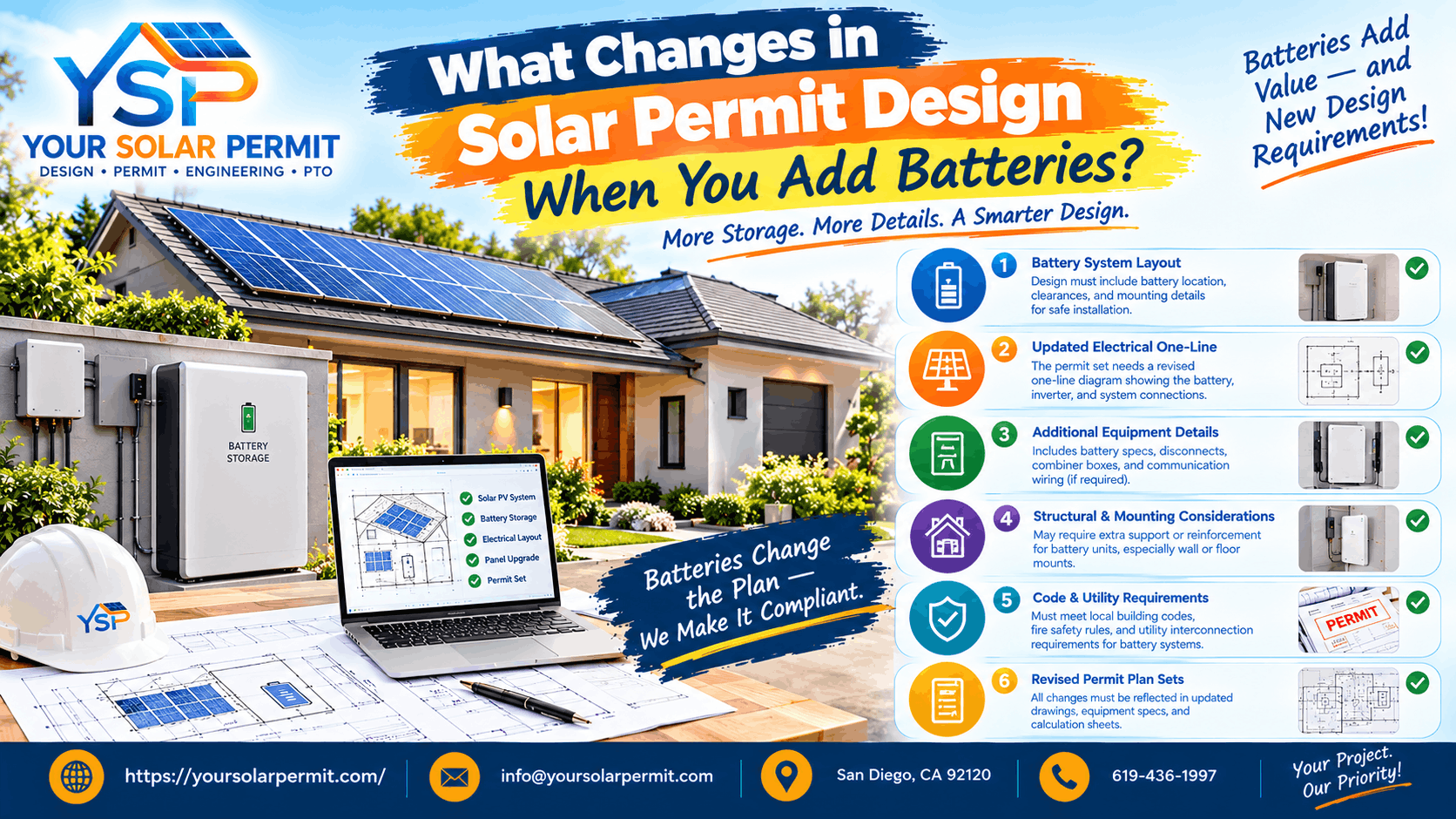
Or the homeowner decides to add battery storage.
The battery is added to the equipment list but not to the relevant electrical documentation.
A better process is to treat major changes as a trigger for a mini design audit.
Whenever something important changes, ask:
What else does this change affect?
Review the related drawings, schedules, calculations, notes, and application information.
This takes more discipline than changing one line, but it can prevent a much larger correction later.
9. Know When Residential and Commercial Work Need Different Attention
Residential and commercial solar projects can have very different design and permitting workflows.
A residential project may involve a relatively compact roof, one service, and a smaller equipment set.
A commercial project can involve larger arrays, multiple electrical components, more complex site conditions, structural considerations, utility coordination, and additional review requirements.
That is why commercial solar permit services should not simply be treated as a larger version of residential permitting.
The documentation process should be based on the actual project scope.
For commercial work, early coordination can be particularly valuable because a design change may affect more drawings, calculations, equipment, and project stakeholders.
10. Don’t Treat Local Permitting as an Afterthought
Local requirements matter even when the technical solar design is similar.
For example, installers working in Southern California may handle projects in several cities where the general solar concept is similar but the local submission process differs.
A company researching solar permit services Chula Vista should check the current City of Chula Vista process rather than assume another city’s workflow applies.
The same principle applies when looking for solar permit services Irvine.
The keyword is not what determines the workflow.
The actual jurisdiction does.
What Makes a Permit Package Easier to Review?
A reviewer should be able to understand the proposed system without having to guess what changed.
That means the package should answer basic questions clearly:
- What is being installed?
- Where is it being installed?
- What equipment is being used?
- How does the equipment connect?
- What electrical service is involved?
- How many modules are proposed?
- Where are the disconnects?
- Is battery storage included?
- Are the drawings internally consistent?
- Does the application match the plans?
Clarity matters.
A complicated project does not necessarily need confusing documentation.
In fact, the more complicated the project becomes, the more valuable a clean and coordinated package can be.
When Should a Solar Permit Specialist Review the Package?
A second review can be especially useful before submission.
That does not mean someone needs to redesign the entire project.
Instead, a solar permit specialist can focus on common coordination problems:
- Missing project information
- Conflicting equipment models
- Module-count differences
- Inconsistent system sizes
- Missing notes
- Drawing coordination
- Application mismatches
- Local submission requirements
The purpose of this review is quality control.
It is much easier to correct a documentation issue before submission than after a reviewer sends a correction request.
What Is the Difference Between Solar Design and Permitting?
Solar design and permitting are closely connected, but they are not exactly the same task.
Design determines what the proposed system should look like and how it should function.
Permitting documentation communicates that proposed system to the authority reviewing the project.
That is why solar design and permitting need to remain coordinated.
A design change should flow into the permit documentation.
Likewise, a permitting requirement discovered during preparation may require the design to be reviewed.
Treating the two processes as completely separate can create unnecessary rework.
When a Dedicated Solar Permit Service Helps
Some installers have internal designers.
Others outsource some or all of their documentation.
For teams that need additional support, a dedicated solar permit service can help organize the process around a repeatable workflow.
The exact scope varies by provider.
Depending on the project, support may involve:
- Solar layout preparation
- Electrical documentation
- Equipment coordination
- Permit drawing preparation
- Revision work
- Application support
- Pre-submission quality checks
The important thing is to establish the scope clearly before work begins.
How YOUR SOLAR PERMIT Can Help
YOUR SOLAR PERMIT can support installers that need organized solar design and permitting documentation for residential and other solar projects.
A practical workflow can include reviewing project information, preparing coordinated drawings, checking equipment details, handling design revisions, and performing a final documentation review.
The value is not simply producing a PDF.
The goal is to help create a permit package that reflects the actual proposed installation.
For installers managing multiple projects, a consistent process can also make revisions easier to track and reduce the chance of carrying outdated information from one version into another.
The exact scope should always be matched to the project and jurisdiction.
A Simple Pre-Submission Checklist
Before submitting a solar permit package, run through this checklist.
Project Information
- Is the property address correct?
- Is the project scope current?
- Are existing conditions represented accurately?
- Are local requirements checked?
Roof Layout
- Are roof planes accurate?
- Are obstructions shown?
- Is the module count correct?
- Are applicable layout requirements addressed?
Electrical Design
- Is the service information correct?
- Does the single-line diagram match the final system?
- Are equipment models current?
- Are quantities correct?
Documentation
- Do the drawings agree with each other?
- Does the equipment schedule match?
- Are calculations updated where required?
- Are notes and labels current?
Application
- Does the application match the drawings?
- Is the system information correct?
- Are equipment details consistent?
- Are all required documents included?
This checklist cannot guarantee permit approval because the applicable AHJ makes the final determination.
Its purpose is to catch preventable documentation problems before submission.
Common Mistakes That Create Unnecessary Corrections
Copying an Old Project Without Checking It
Templates save time, but outdated information can create problems.
Designing Around a Target Module Count
The roof should drive the layout, not the other way around.
Updating Only One Drawing
Major changes should trigger a review of all affected documents.
Using Different Equipment Models in Different Places
One project should have one consistent equipment story.
Ignoring Local Requirements
A familiar workflow may not apply to another jurisdiction.
Treating the Application as an Administrative Detail
Application information should match the final technical design.
Submitting Without a Final QA Review
A short final review can identify simple inconsistencies before the package reaches plan review.
FAQs
What is solar permit design?
Solar permit design is the process of preparing the technical drawings and supporting documentation needed to communicate a proposed solar installation for permit review. It can include site layouts, roof layouts, electrical diagrams, equipment information, calculations, notes, and other project-specific documents.
What do solar permitting services include?
The scope varies by provider, but solar permitting services can include permit drawing preparation, electrical documentation, equipment coordination, revisions, application support, and pre-submission review.
What is the difference between solar design and permitting?
Solar design focuses on developing the proposed system, while permitting focuses on documenting that system for review by the applicable authority. In practice, the two need to remain coordinated because design changes can affect permit documents.
Why are solar permits delayed?
Delays can result from incomplete applications, inconsistent drawings, outdated equipment information, missing documentation, local requirement issues, or corrections requested during plan review.
Do solar permit services cover commercial projects?
Some providers support commercial projects, but the scope should be confirmed for each project. Commercial installations can involve more complex electrical, structural, site, and utility considerations than typical residential projects.
When should I use solar permit specialists?
A solar permit specialist can be useful when an installer has a high project volume, works across multiple jurisdictions, needs additional drawing support, or wants a dedicated pre-submission review.
What are residential solar permit services?
Residential solar permit services generally refer to design and documentation support for home solar installations. Depending on the provider, they may include roof layouts, electrical diagrams, equipment schedules, revisions, and permit-package preparation.
Are solar permit requirements the same in every U.S. city?
No. Requirements and submission processes can vary by jurisdiction, project type, utility, and applicable codes. The current requirements for the actual project location should be checked before submission.
What should a solar permit package include?
The required package depends on the project and AHJ. Common documentation can include a site or roof plan, electrical diagram, equipment information, calculations where required, notes, application forms, and other jurisdiction-specific documents.
How can installers reduce solar permit corrections?
Start with accurate project information, use the correct local requirements, coordinate the roof and electrical design, keep equipment information consistent, update all affected documents after revisions, and perform a final QA review before submission.
Final Takeaway
A strong solar permit package is not simply a collection of drawings.
It is a coordinated explanation of one proposed project.
The roof layout should match the property.
The module count should match the electrical design.
The equipment schedule should match the selected equipment.
The electrical diagram should match the physical installation.
The application should match the final package.
And the local submission requirements should be checked for the actual jurisdiction.
That is the foundation of effective solar permit design.
When installers build this coordination into the workflow from the beginning, they can identify many documentation problems before submission instead of discovering them during plan review.
For a busy solar company, that difference can make the permitting process easier to manage and revisions easier to control.