
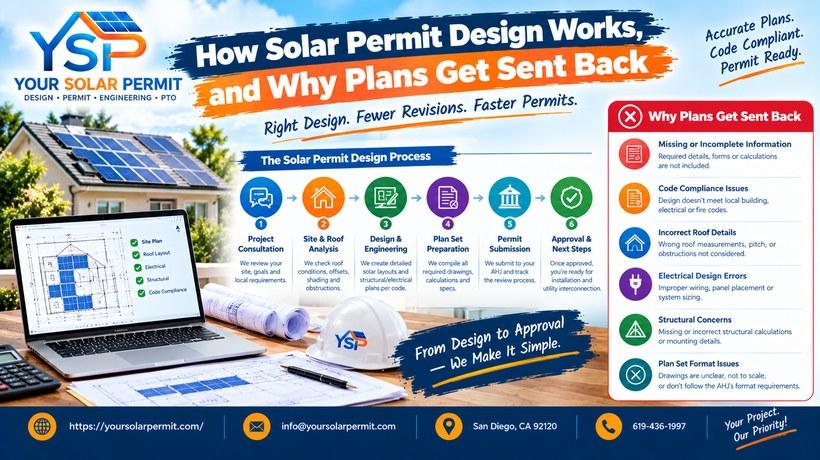
Solar permit design is the package of drawings, calculations, and labels a building department needs before it lets you install a PV system. Get it right and approval can move fast. Get it wrong and the plan comes back with a page of comments while your crew waits.
This guide covers what a permit plan set contains and why authorities having jurisdiction (AHJs) send so many of them back. You’ll also see how to spot a solid design before it goes out the door. It’s written for installers, contractors, and developers across the USA, though homeowners can follow along too.
In this guide
- What Is Solar Permit Design?
- What Goes Into a Solar Permit Plan Set?
- Why Do AHJs Reject Solar Plans?
- Residential Solar Permit Services vs. Commercial: What Changes?
- Does the City Matter? Solar Permit Services in Chula Vista vs. Irvine
- How Do You Choose a Solar Permit Specialist?
- Can Instant Permitting Replace a Plan Set?
- Solar Permit Design FAQs
What Is Solar Permit Design?
Solar permit design is the process of turning a solar project into a code-compliant plan set that a building department can review and approve. It covers where the panels go, how the system connects electrically, how the roof or ground structure carries the load, and which safety labels the reviewer expects to see.
An AHJ is just the office with the final say. Usually that’s a city or county building department, and sometimes a fire marshal or utility gets a vote too. Each one reads plans through its own checklist.
That’s the catch. A design isn’t finished because the math works. It’s finished when a reviewer can open the file, find what they need in a minute, and sign off.
Timing matters here too. Many installers hold off on scheduling a crew until the permit lands. So every day a plan sits in review is a day the whole job sits still.
This is also why solar design and permitting belong together. A drafter who has never seen your AHJ’s checklist is guessing, and plan check staff don’t reward guessing.
What Goes Into a Solar Permit Plan Set?
A residential solar plan set usually includes a cover sheet, site plan, array layout, single-line electrical diagram, structural details, equipment specifications, and required labels. Commercial sets add heavier load calculations and utility details. Contents vary by AHJ, so the local checklist beats any generic template.
Here’s what each piece does:
- Cover sheet and general notes: project address, system size, and the code editions the design follows.
- Site plan. A scaled drawing showing where the array, inverter, disconnects, and meter sit on the property.
- Array layout. Panel positions, roof setbacks, and the walkways firefighters need for access.
- The single-line diagram, which traces the electrical path from panel to grid with wire sizes and breaker ratings.
- Structural details. How the racking attaches, and whether the roof can handle the extra weight.
- Cut sheets for every component, plus the warning labels that go on site.
Rapid shutdown deserves its own mention because it shows up on the diagram, the layout, and the labels. Beginning with the 2014 NEC, the National Fire Protection Association has required it for PV circuits on buildings. Under the 2023 edition, DC conductors inside the array boundary must drop to 80 volts or less within 30 seconds, according to the IAEI’s code breakdown.
Good solar permit design shows the chosen shutdown method once, clearly, and then makes every sheet agree with it. And the code edition matters. AHJs adopt NEC editions on their own schedules, so the cover sheet should name the one that applies locally.
Why Do AHJs Reject Solar Plans?
AHJs usually reject solar plans for missing or mismatched information, not bad engineering. Common causes include layouts that disagree with the electrical diagram, absent structural details, equipment that doesn’t match the spec sheets, and wrong or missing labels. Fixing those before submission costs far less than a second review cycle.
Think about the person on the other side of the counter. NREL reports that many permitting officials receive 100 or more solar applications a week, with 45 to 90 minutes of review per project. Nobody in that chair has time to decode a messy drawing. They flag it and move on.
Typical examples of what gets a plan returned:
- The layout shows 24 panels, but the diagram shows 22.
- The inverter on the cut sheet isn’t the inverter on the drawings.
- Roof type or pitch is missing, so the structural check can’t even start.
- Labels point to the wrong rapid shutdown approach.
- The design ignores a local amendment, like a wider setback.
None of these is a hard engineering problem. They’re attention problems, which is why they’re so common. A drafter at 11 p.m. will cheerfully put 22 panels on one page and 24 on the next.
Strong solar permit design treats consistency as a feature, so every sheet agrees with every other sheet before anything goes out.
A simple habit catches most of this. Read the set the way a reviewer would. Put the layout and the single-line diagram side by side, count the panels on both, match every model number to its cut sheet, and confirm the labels fit the shutdown method you chose. It takes maybe ten minutes, and it can save a whole review round.
Residential Solar Permit Services vs. Commercial: What Changes?
Residential solar permit services focus on speed and standard rooftop layouts, while commercial solar permit services add heavier structural review, larger electrical equipment, and often utility coordination. Both end in a plan set ready for the AHJ, but a commercial file usually runs longer and gets more eyes.
Homes tend to follow a pattern. A pitched roof, a main panel, a handful of strings. Reviewers expect a clean, familiar layout, and they get suspicious when it’s missing. Ground mounts and detached structures break that pattern, because they add foundations, trenching, and different fire access rules.
Commercial work raises the stakes. Flat roofs bring ballast or penetrations, equipment gets bigger, conduit runs get longer, and the utility often wants its own documents. The structural sheets matter more here because a mistake costs more.
The core of solar permit design stays the same either way: prove the system is safe and buildable, and show it meets code. What changes is the depth of proof.
Providers of solar permitting services often price the two tracks separately, so ask what each tier includes before you compare quotes.
Does the City Matter? Solar Permit Services in Chula Vista vs. Irvine
Yes. Each city or county building department can set its own submission format, extra sheets, and review steps. Chula Vista and Irvine are both in Southern California but sit under different jurisdictions, so a plan set formatted for one may need changes before the other accepts it.
Say you’re shopping for solar permit services in Chula Vista and your next job is in Irvine. Chula Vista sits in San Diego County, Irvine in Orange County, and each city runs its own building department. Then the utility adds another layer.
The same logic applies everywhere in the USA. Wind, snow, and seismic loads vary by location, and the structural sheets have to reflect them. Some cities add their own amendments to the electrical code. A plan set isn’t a one-size-fits-all hoodie.
Local knowledge is what separates generic solar permit design from a file that matches the building department’s own checklist. So when you hire help, ask which AHJs they’ve worked with and how they keep up with local changes.
How Do You Choose a Solar Permit Specialist?
Look for solar permit specialists who ask for your AHJ and utility up front, provide stamped drawings where required, and handle revisions without extra drama. Turnaround matters, but a fast plan set that gets rejected is slower than a careful one that passes the first time.
Plenty of installers draft in-house, and that works at low volume. But once the pipeline grows, one overloaded drafter becomes the bottleneck for every install date. Outside help can flatten that, as long as the work is accurate.
Ask a few blunt questions. Do they confirm the adopted code edition, and will they fix AHJ comments without a surprise charge? Who reviews the structural and electrical sheets? A good solar permit service answers all of it without hedging.
Whichever route you pick, send complete inputs. That means the site address, main panel details, roof photos or measurements, equipment choices, and the system size. Gaps at the start turn into back-and-forth emails later, and nobody enjoys those.
Your Solar Permit is a San Diego-based team that serves installers in all 50 states. According to its website, typical turnaround is 24 to 48 hours, and its scope covers residential, commercial, and industrial projects, with PE-stamped structural and electrical documents and revision support.
The company says it builds each solar permit design around the local AHJ’s requirements. That’s the right way to do it.
Can Instant Permitting Replace a Plan Set?
Not entirely. Platforms like SolarAPP+ approve eligible residential systems automatically when they pass a code check, but the system still needs accurate design data behind it. Complex, commercial, or unusual projects usually go through standard plan review.
NREL describes SolarAPP+ as a free online platform that instantly issues permits for residential PV or PV-plus-storage systems that pass an automated compliance check. Its data shows the full process, from plan review through inspection, runs about 14.5 business days shorter than traditional permitting.
The catch is coverage. Only jurisdictions that adopt the platform offer it, so plenty of projects still land on a human reviewer’s desk.
And automation rewards tidy inputs. Even in an instant-permit city, solar permit design still has to be right before anyone clicks submit. The software just catches a mismatch sooner.
Solar Permit Design FAQs
How long does solar permit design take?
At Your Solar Permit, typical turnaround is 24 to 48 hours once the project details are in, according to its website. Approval after submission runs on a different clock, and the AHJ controls it. That clock can be instant in an automated jurisdiction and considerably longer elsewhere.
Does pricing differ for homes and commercial projects?
Yes. Pricing depends on project type, size, and complexity, so no single number fits everyone. Residential and commercial solar permit design are priced separately, and Your Solar Permit lists both rate pages on its website so you can check before ordering.
Do I need a PE stamp?
It depends on the AHJ and the project. Many commercial and structurally complex jobs call for engineer-stamped drawings, while some residential jurisdictions accept unstamped plans. Check the local checklist first, because a missing stamp is an easy reason for a return.
What do solar permitting services actually cover?
Most handle plan set drafting and revisions after plan check, formatted to the AHJ’s rules. Some add engineering stamps, utility interconnection paperwork, or permission to operate (PTO) support. Ask for a written scope so you know what you’re paying for.
Can I reuse one plan set in a different city?
Rarely as-is. The electrical logic may carry over, but code references, load values, notes, and formatting usually change. Treat the old file as a starting point, not a final submission.
Does adding a battery change the design?
Yes. Storage adds equipment, labels, and sometimes placement or fire-safety rules, so it belongs on the single-line diagram and notes from the start. Tell your designer before drafting begins, not after plan check comes back.
Planning your next install and want the plan set to clear review the first time? Your Solar Permit can look at your site details and scope a design built for your AHJ.