
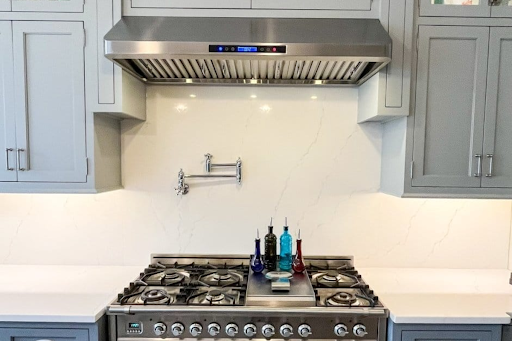
An under-cabinet range hood provides ventilation while occupying the space beneath an upper cabinet. This compact arrangement makes sizing, airflow, installation, and maintenance especially important. A properly selected hood can help remove smoke, grease, steam, and cooking odors without interfering with cabinet storage or the kitchen layout. For homeowners comparing models, an under-cabinet hood of 30 inches is commonly suited to kitchens with a similarly sized cooking surface, but width alone should not determine the choice.
Start With the Installation Space
Before considering performance specifications, measure the available cabinet area. Check the opening width, depth, height above the cooktop, and electrical connections. The hood must have enough clearance for safe operation and convenient access to controls. Manufacturer instructions and local codes should take priority over general spacing recommendations.
The ventilation route deserves equal attention. A ducted hood needs appropriately sized ductwork with a practical path outdoors. Some units can operate in a ductless configuration, which may simplify installation where outdoor venting is unavailable. However, recirculating systems depend on additional filtration and do not remove heat and moisture like exterior exhaust.
Match Airflow to Cooking Habits
CFM, or cubic feet per minute, indicates how much air a blower can move. More airflow can be useful for frequent frying, searing, grilling, or other high-heat cooking, but maximum CFM is not automatically the best choice. Duct size, duct length, elbows, makeup air requirements, and capture area all influence real-world performance.
A useful selection process considers how often high-heat cooking occurs. Someone who mainly simmers may have different ventilation requirements from someone who regularly cooks with a wok or uses high-output burners.
Consider Capture Area and Filter Design
The hood should cover the cooking surface effectively, particularly the front burners where rising fumes can move forward before reaching the intake. Depth is therefore important alongside width. The under-cabinet hood of 30 inches should be evaluated based on the actual dimensions of the range or cooktop and the available cabinet configuration.
Filters are equally important because they intercept grease before it reaches the blower and ductwork. Washable metal filters can reduce recurring replacement needs, while some ductless systems require replaceable charcoal or carbon filters. Whichever design is used, regular cleaning is essential because accumulated grease can restrict airflow and increase the burden on the ventilation system.
Look Beyond the Blower
Noise can affect whether homeowners use a hood consistently. A powerful blower may be louder than needed for simple tasks. Multiple fan speeds allow ventilation to match the cooking situation. Lighting is another practical feature because effective illumination can make the cooking surface easier to see without requiring additional fixtures.
Controls should be accessible and straightforward, allowing users to change fan speed and lighting without reaching awkwardly over cookware.
Maintenance Determines Long-Term Performance
Even a well-built ventilation system can lose effectiveness when maintenance is neglected. Filters should be cleaned according to cooking frequency, while the blower area and surrounding surfaces should be checked for grease accumulation. Electrical connections, fasteners, and duct joints should also be inspected when maintenance or installation issues arise.
These habits can extend the useful service life of any under-cabinet hood of 30 inches, or many other sizes, and make problems easier to identify. Excessive vibration, unusual noise, declining airflow, persistent odors, or visible corrosion can indicate that an inspection is needed.
Choose for Years, Not Installation Day
The best option is not necessarily the one with the highest airflow or the most features. It is the model whose dimensions, ventilation method, blower capacity, noise level, filtration, controls, and maintenance requirements fit the kitchen’s actual conditions. Installation quality is particularly important because poor duct routing or inadequate clearances can undermine otherwise capable equipment.
Conclusion
A range hood’s useful life depends on more than its initial construction. Appropriate sizing, correct installation, sensible operation, routine cleaning, and timely inspection all contribute to dependable ventilation over the years. Readers looking more closely at How Long Do Range Hoods Last? should consider these factors together rather than treating lifespan as a fixed number. Ultimately, an under-cabinet hood of 30 inches can remain effective for many years when its performance matches the cooking environment, and it receives consistent care.