
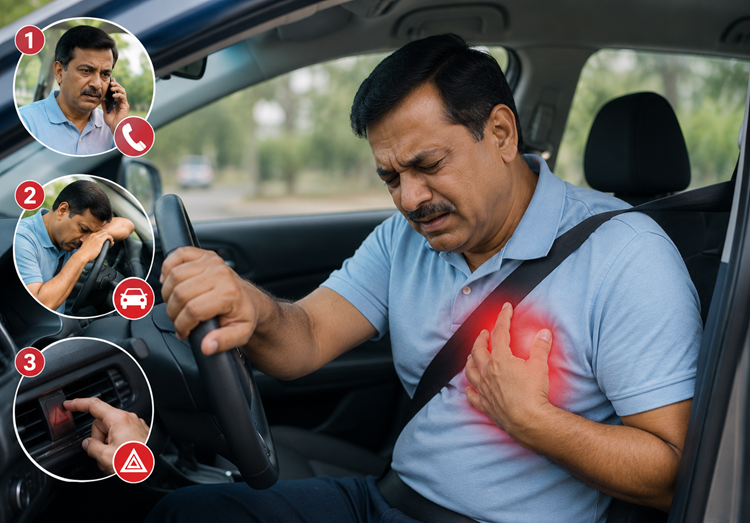
A heart attack is a scary occurrence. If it occurs while driving, it is the worst that can ever happen, as it puts many lives at risk, of the patient and of everyone else on the road. While driving, it usually starts as something that can easily be overlooked. Something as small as a little chest pressure, sudden sweating, or breathlessness. The Indian instinct is to keep driving and take care of it later when we reach the destination. Something that is precisely not supposed to happen.
Why Does a Heart Attack Happen?
A heart attack occurs when the oxygen-rich blood flow to the heart is blocked. If the blockage is left untreated and is not given immediate medical attention, there’s a greater risk of permanent heart muscle damage. Indian government treatment guidelines describe acute myocardial infarction as a time-sensitive emergency.
Heart Attack Warning Signs While Driving
One of the first warning signs of a heart attack while driving includes chest discomfort, chest pressure, tightness or heaviness and discomfort spreading toward arms and jaw. Other warning signs are difficulty breathing, nausea and dizziness. It is advised to pull over and seek emergency help immediately. The most important rule is to stop driving if you experience these symptoms, even when you’re unsure if it’s a heart attack.
As and when these symptoms begin while on the road, one must never try to push themselves to reach home or hospital. Instead, switch on the hazard lights and immediately pull over at a safe space, call the nearest emergency medical service, clearly explain your symptoms to them, and follow their advice.
It is always better to call for emergency medical assistance than to try and reach the hospital yourself. The emergency medical team begins their assessment and treatment right from the time when they get to you, till the time the patient reaches the hospital’s emergency room.
Aspirin For Heart Attack
Aspirin is one of the oldest medicines that is still in use today. Chemically known as Acetylsalicylic Acid, Aspirin is a non-steroidal anti-inflammatory drug (NSAID), which is used as a lifesaving medicine that effectively minimises heart attack symptoms, including chest pain and tightness, and reduces the risk of heart attack.
Aspirin is a medicine that cardiologists have trusted for a long time, in terms of improving blood flow and extending the time in an emergency situation until medical help arrives.
The main reason for Aspirin usage in heart attack situations is the fact that it does not allow the platelets to stick together, thus minimising the risk of blood clot formation and help in thinning blood.
One must remember that not every chest discomfort calls for Aspirin consumption. The safest way to administer an Aspirin dose is to seek immediate emergency medical assistance and follow the emergency team’s instructions.
What Dose Of Aspirin Is Recommended
To many patients’ surprise, it takes very little Aspirin to minimise the risk of a heart attack. If you’re wondering what dose of Aspirin is needed to protect your heart, it primarily depends on the cardiologist’s recommendation, but is usually prescribed between 75 mg and 100 mg daily.
India’s National Health Mission’s standard treatment guideline specifies a 300mg Aspirin dose, while a 2026 ICMR Standard Treatment Workflow for STEMI lists a 325 mg loading dose.
Risks Of Aspirin Use
While Aspirin can effectively reduce blood clot formation, in some patients who administer Aspirin for a long time, it also increases the risk of internal bleeding. In such patients, prescribing Aspirin is not as simple and straightforward; it depends on multiple factors including the patient’s age, their medical history, their heart health, and their overall cardiovascular risk assessment.
Possible Aspirin side effects include:
Allergic reactions:
Hypertensive patients are prone to developing allergic reactions from the consumption of Aspirin. These reactions can manifest as symptoms such as rashes, nasal congestion, hives, or, in some cases, Asthma attacks.
Tinnitus:
Long-term consumption of Aspirin can sometimes trigger Tinnitus (ringing or buzzing in the ears). Usually, these symptoms fade as the Aspirin dose is reduced or when its consumption is stopped.
How To Prevent Heart Attack: Heart-healthy Lifestyle Is Better Than Aspirin
Aspirin matters. But what matters more after a heart attack is a sustainable, heart-healthy lifestyle. The best way to prevent a heart attack is a routine that keeps blood pressure in check and bad cholesterol within its limits. A lifestyle where a healthy weight is maintained and being active is non-negotiable. Where smoking is not an option and sleep is sound. With heart, shortcuts never work. Consistency and discipline are the only ways to go.
Halt: Give Your Heart the Attention It Needs
A heart attack while driving is one of those scenarios where hesitation, doubt or confusion can cost valuable time, in some cases even life. The safest and smartest way to deal with such situations is to recognise the warning signs and follow the prescribed steps till the patient gets to the hospital’s emergency room. Knowing what to do in the first few minutes in an emergency scenario is as important as the procedures that are followed inside the emergency room. When there’s doubt, always seek a proper medical diagnosis and consult your doctor.