
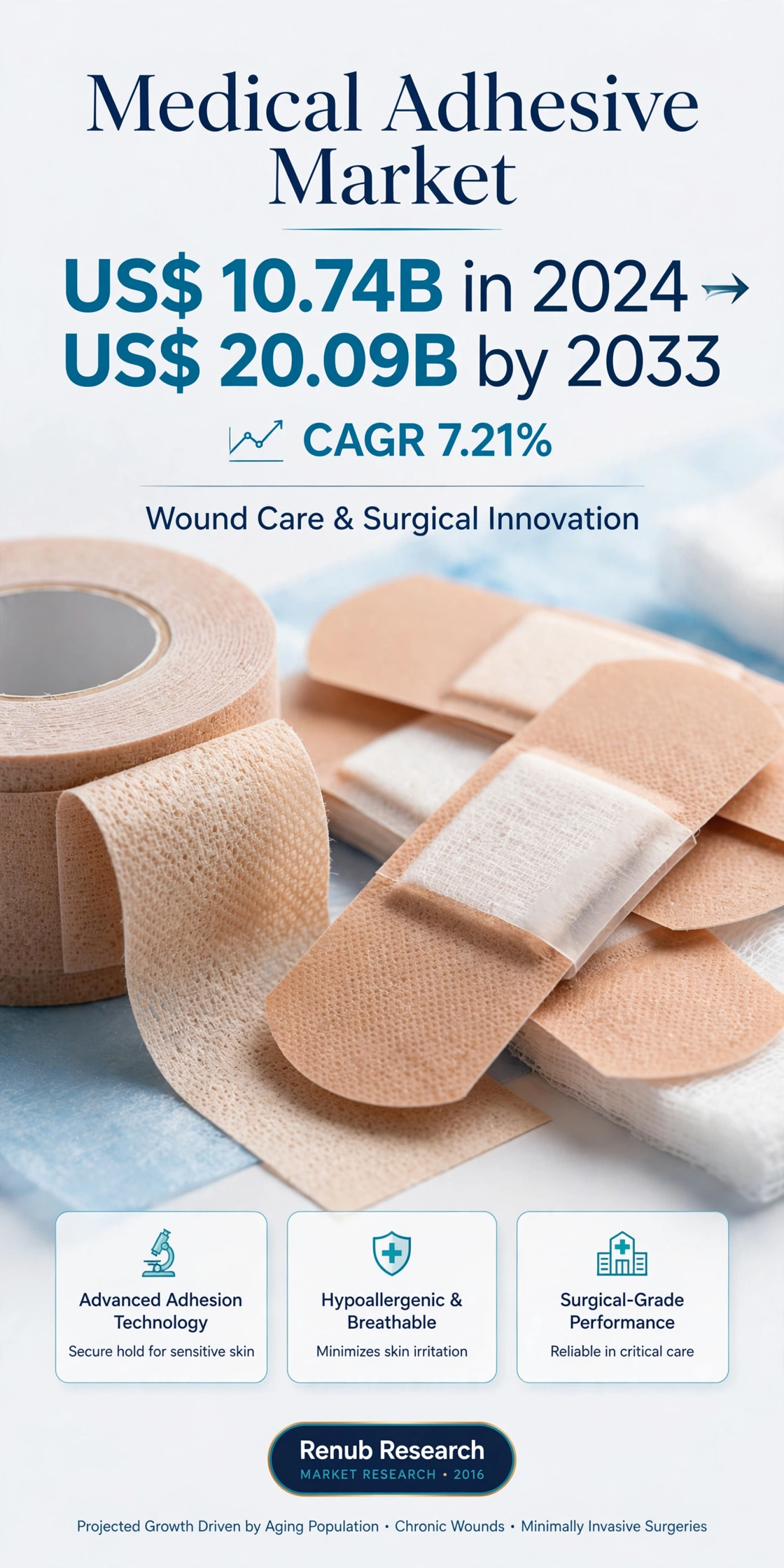
The medical adhesives market is undergoing a fundamental shift, moving from simple wound-closure agents to high-tech, biocompatible bonding solutions essential for modern healthcare. According to recent market projections, the global medical adhesives market is expected to reach US$ 25.34 billion by 2034, rising from US$ 13.25 billion in 2025. This growth reflects a robust CAGR of 7.47% during the 2026–2034 forecast period.
Driven by the global transition toward minimally invasive surgery, the explosion of wearable health technology, and an aging population requiring chronic wound care, these specialized bonding agents have become the “silent glue” holding the modern medical device ecosystem together.
Understanding the Medical Adhesives Industry
Medical adhesives are engineered materials designed to safely bond biological tissues or secure medical devices to the human body. Unlike industrial glues, these substances must meet rigorous biocompatibility, sterilization, and non-toxicity standards.
The industry categorizes these products into three primary functional roles:
- Internal/Surgical: Tissue sealants and glues used in operating rooms to replace or supplement sutures and staples.
- External/Wound Care: Pressure-sensitive tapes, antimicrobial dressings, and skin-friendly barriers.
- Device Assembly: Structural adhesives used to manufacture everything from catheters and dialysis machines to microfluidic diagnostic chips.
Key Growth Drivers: What is Fueling the Market?
1. The Shift to Minimally Invasive Surgeries (MIS)
As hospitals prioritize reduced recovery times and lower infection rates, MIS has become the gold standard. These procedures—such as laparoscopy and robot-assisted surgery—rely on advanced adhesive systems that can seal internal tissues rapidly and withstand physiological stress. Manufacturers are responding with LED-curable and quick-curing adhesives that offer the precision surgeons require while minimizing trauma to surrounding healthy tissue.
2. The Wearable Healthcare Revolution
The rise of remote patient monitoring—glucose monitors, cardiac patches, and smart sensors—has created a massive demand for skin-friendly, long-wear adhesives. These materials must maintain a reliable bond for days or weeks without causing dermatitis or irritation. Innovations in acrylic and silicone-based pressure-sensitive adhesives (PSAs) are currently the primary focus for R&D departments at major firms like 3M and Avery Dennison.
3. Chronic Wound Management
With the global increase in diabetes and age-related vascular conditions, the demand for advanced wound care (AWC) is surging. Clinicians now favor moisture-resistant, breathable, and antimicrobial adhesives that protect diabetic ulcers and surgical sites from external pathogens while promoting a healing environment.
Regional Market Analysis
United States: The Hub of Innovation
The U.S. remains the market leader, anchored by a constant flow of FDA approvals for adhesive-integrated medical technologies. Regulatory trends, such as accelerated coverage pathways for breakthrough devices, are shortening the time it takes for new adhesive applications to reach the market, particularly in the fields of vascular closure and continuous glucose monitoring.
Germany: Engineering Excellence
Germany’s mature medical technology sector processes over 16.8 million surgical procedures annually. The domestic market is heavily focused on high-end device assembly and professional-grade tissue sealants. The country’s emphasis on strict EU Medical Device Regulations (MDR) ensures that only the highest quality, most stable adhesives succeed in the local supply chain.
China: Scaling Manufacturing
China is the world’s largest consumer of surgical consumables, with over 70 million surgeries performed annually. National policies promoting “domestic self-reliance” are driving significant growth in local adhesive manufacturing, particularly for low-cost, high-volume consumables like surgical tapes and standard wound dressings.
Saudi Arabia: Vision 2030 Healthcare Modernization
Under Vision 2030, Saudi Arabia is rapidly expanding its clinical infrastructure. The Saudi Food and Drug Authority (SFDA) has been highly active, evaluating nearly 300 medical-device clinical studies in 2025 alone. The Kingdom represents a high-growth market for “long-wear” adhesives, driven by the high prevalence of diabetes and the need for modern chronic disease management tools.
Market Segmentation by Technology
- Acrylic Adhesives: Dominating the wearable device and tape market due to superior durability, moisture resistance, and customizable breathability.
- Dental Adhesives: A specialized segment seeing growth due to the rising demand for cosmetic dentistry (veneers/brackets) and restorative procedures among the elderly.
- Water-Based Adhesives: The fastest-growing segment in the “green” category, as hospitals and regulators pressure manufacturers to reduce Volatile Organic Compounds (VOCs) and environmental impact.
Challenges to Market Expansion
- Stringent Regulatory Landscapes: Compliance with the U.S. FDA and EU MDR requires years of clinical testing, creating high barriers to entry for startups.
- Technical Balancing Acts: Formulating an adhesive that is strong enough to hold a device but gentle enough to be removed from fragile, elderly skin without causing a “skin tear” remains a difficult engineering challenge.
- Supply Chain Volatility: Fluctuations in raw material costs for high-grade silicone and specialty polymers can impact production stability.
Frequently Asked Questions (FAQs)
1. What is the expected market size of medical adhesives by 2034? The market is projected to grow to US$ 25.34 billion by 2034, up from US$ 13.25 billion in 2025, representing a CAGR of 7.47%.
2. Which industry segment uses the most medical adhesives? Medical device assembly (catheters, pumps, sensors) and external wound care (surgical tapes and dressings) currently account for the largest share of global demand.
3. Why is silicone preferred for wearable medical devices? Silicone adhesives are highly biocompatible, hypoallergenic, and allow for gentle removal, making them ideal for long-term skin contact (e.g., continuous glucose monitors).
4. How does “minimally invasive surgery” impact this market? MIS reduces the size of incisions, increasing the reliance on specialized tissue glues and sealants instead of traditional, trauma-inducing sutures and mechanical staples.
5. What are “LED-curable” adhesives? These are advanced adhesives that harden instantly when exposed to specific light wavelengths, allowing surgeons to close wounds or bond device components with high precision and minimal heat.
6. Which regions are expected to show the fastest growth? Asia-Pacific (particularly China and India) and the Middle East (led by Saudi Arabia) are seeing the fastest growth due to expanding healthcare infrastructure and rising surgical volumes.
7. Are there eco-friendly trends in this market? Yes. There is a strong industry shift toward water-based, solvent-free adhesives that comply with VOC (Volatile Organic Compound) regulations, ensuring safer products for both patients and the environment.