
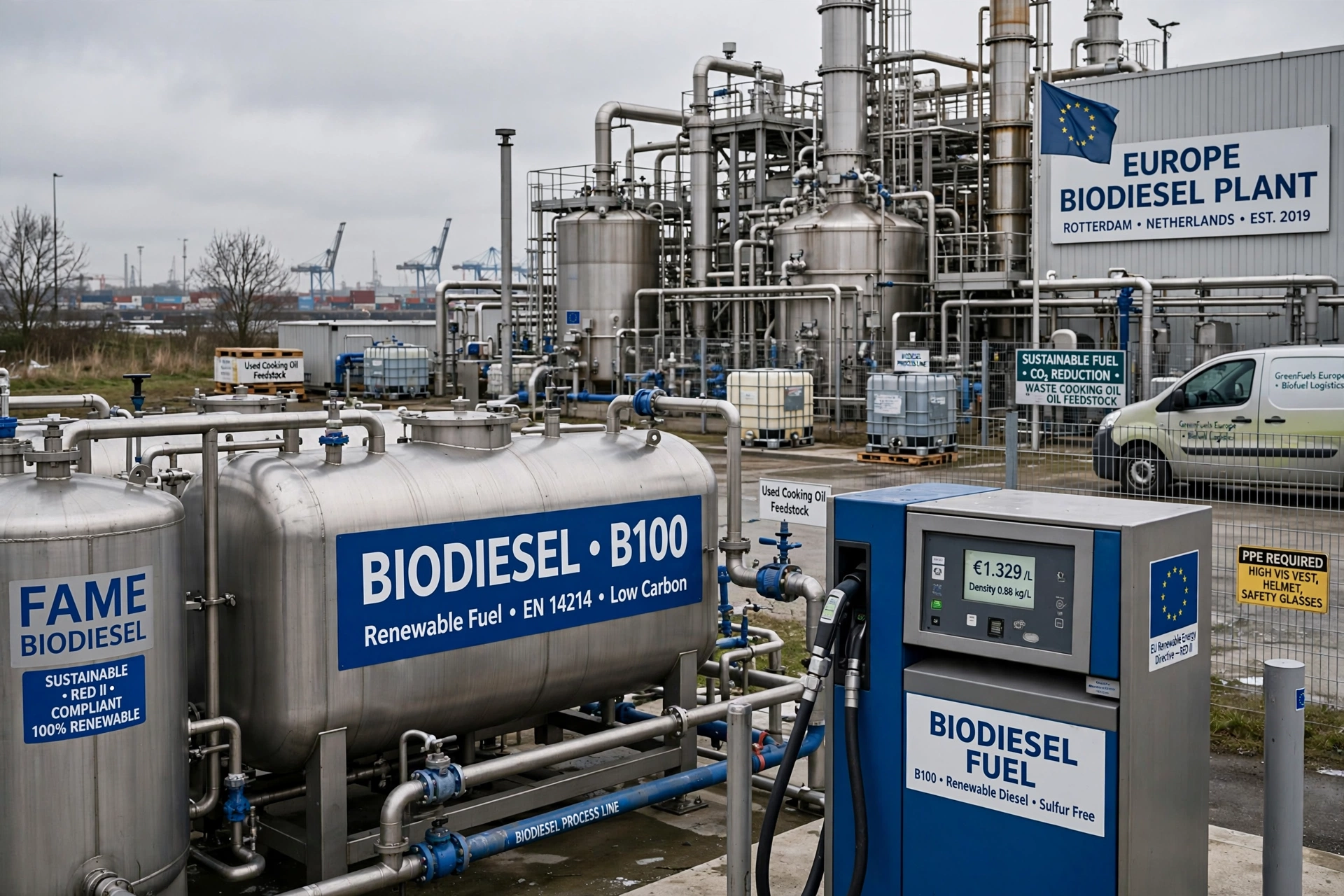
Executive Summary & Market Snapshot
Europe’s transition toward clean energy and sustainable transportation has placed renewable liquid fuels at the forefront of regional economic policy. The shift away from conventional fossil fuels is no longer merely an environmental objective; it has evolved into a strategic priority across the European continent. As European nations enforce rigorous carbon reduction mandates, biodiesel has established itself as an essential alternative to traditional petroleum-based diesel.
According to market research analysis by Renub Research, the Europe biodiesel market is projected to grow from US$ 19.63 billion in 2025 to US$ 32.38 billion by 2034. This indicates that the market is expected to expand at a compound annual growth rate (CAGR) of 5.72% between 2026 and 2034.
This steady growth is supported by a comprehensive regulatory framework across European Union member states and neighboring nations. Driven by ambitious climate targets, mandatory fuel blending directives, and accelerating adoption across commercial logistics fleets, marine transport, and industrial power applications, biodiesel remains a core component of Europe’s overall decarbonization strategy.
Europe Biodiesel Industry Outlook & Technical Fundamentals
Biodiesel is a clean-burning, renewable alternative to conventional petroleum diesel. It is synthesized through a chemical refining process known as transesterification, which reacts organic lipids—such as vegetable oils, recycled used cooking oil (UCO), and animal fats—with an alcohol in the presence of a catalyst. This process transforms complex triglycerides into fatty acid methyl esters (FAME) or hydrotreated vegetable oil (HVO) and renewable diesel.
The primary operational advantage of biodiesel lies in its direct compatibility with existing compression-ignition diesel engines and established fuel distribution infrastructure. It can be utilized in pure form or blended in varying proportions with petroleum diesel. Standard commercial formulations include B7 (containing 7% biodiesel) and B20, up to B100 utilized in dedicated commercial municipal or freight fleets.
From an environmental perspective, biodiesel delivers substantial lifecycle reductions in net greenhouse gas (GHG) emissions compared to standard petroleum products. When combusted, it produces significantly lower exhaust particulate matter, unburned hydrocarbons, and sulfur compounds. Because agricultural and organic feedstocks absorb carbon dioxide during their growth phase, the net carbon intensity of biodiesel is dramatically lower than fossil fuels.
European nations have integrated biodiesel into their energy security strategies to bolster domestic resilience, reduce reliance on imported crude oil, and comply with strict air quality standards. The buildout of advanced waste-to-energy conversion plants has further reinforced circular economy practices across the continent’s energy sector.
Primary Growth Drivers Accelerating Market Expansion
1. Stringent Environmental Mandates and Net-Zero Emission Goals
The primary growth driver powering the European biodiesel market is the aggressive implementation of regulatory policies designed to combat climate change. In 2023, the European Union adopted commission proposals structured to align climate, energy, transport, and taxation policies. This package aims to reduce net greenhouse gas emissions across the EU by at least 55% by 2030 compared to 1990 baseline levels.
These directives mandate that fuel suppliers incorporate a specified percentage of renewable content into transport fuels. Furthermore, as indicated in the European Commission Work Programme (COM/2025/870) published in March 2026, European legislative bodies are preparing a framework for renewable energy beyond 2030. This framework seeks to maintain Europe’s decarbonization momentum while safeguarding industrial competitiveness, energy security, and supply sustainability.
2. Demand for Circular Economy Solutions & Sustainable Mobility
Beyond government mandates, commercial fleet operators, shipping lines, and industrial users are actively seeking immediate, low-carbon energy solutions to satisfy corporate environmental standards. Biodiesel offers a drop-in or near-drop-in fuel that enables heavy transport operators to lower their operational carbon footprint without incurring the substantial capital costs of replacing existing vehicular fleets.
Simultaneously, the market is benefiting from a structural shift toward circular economy principles. Utilizing waste cooking oil (UCO) and animal fats from meat processing industries converts hazardous organic waste streams into valuable energy assets. This waste-derived production pathway dramatically lowers lifecycle emissions while preventing environmental pollution and land-use competition.
3. Government Incentives, Tax Exemptions, and Policy Support
To accelerate market adoption, numerous European governments provide financial mechanisms, including fuel duty tax reductions, production subsidies, and research grants. Public funding supports the development of second-generation and third-generation biofuel production methods, including advanced enzymatic catalysis. While public debate regarding land-use efficiency continues—such as discussions raised by organizations like Oxfam in September 2024 regarding crop-based biofuel caps—industry stakeholders maintain that sustainably sourced biodiesel remains vital for decarbonizing heavy transport sectors.
Industry Challenges: Feedstock Volatility & Clean Energy Competition
1. Feedstock Availability and Raw Material Price Volatility
Despite strong market demand, the European biodiesel industry faces operational challenges related to feedstock availability and cost stability. The industry relies on agricultural commodities, including rapeseed oil, sunflower oil, and imported soybean oil, as well as waste fats and oils. Supply fluctuates due to seasonal harvest yields, severe weather events, and global trade dynamics. Competition between agricultural land used for food production and energy crops creates pricing tension. While the industry is actively scaling non-food alternatives such as cover crops and municipal waste lipids, expanding these advanced feedstocks to commercial scale requires significant long-term capital investment.
2. Competition from Alternative Renewable Energy Technologies
Another strategic challenge facing the biodiesel sector is the rapid technological development of competing zero-emission technologies, notably battery electric vehicles (EVs) and green hydrogen fuel cells. European Union regulations mandating strict vehicle emission standards are driving rapid electrification across the light-duty passenger vehicle segment. However, while passenger cars transition toward electrification, heavy-duty long-haul trucking, maritime shipping, aviation, and off-grid industrial machinery face technical hurdles with battery weight and energy density. Consequently, these heavy transport and industrial sectors will continue to rely on energy-dense liquid biofuels for the foreseeable future.
In-Depth Market Segmentation: Applications & Feedstocks
By Application Segment
- Fuel Application: Holds the dominant share of the European market. Biodiesel is extensively consumed across road freight transportation, municipal bus systems, agricultural equipment, and maritime vessels. Mandatory blending obligations across European nations guarantee steady baseline demand from fuel distributors.
- Power Generation: Gaining momentum as industrial facilities and remote communities seek clean alternatives to conventional diesel generators. Waste-derived biodiesel allows operators to generate low-emission backup power using existing infrastructure.
- Others: Encompasses commercial heating oil blends for residential and commercial buildings, bio-based solvents, specialized industrial lubricants, and green chemical manufacturing.
By Feedstock Segment
- Vegetable Oil: Represents a foundation of European biodiesel production, utilizing rapeseed oil, sunflower oil, and soybean oil. Rapeseed oil is especially valued in central and northern Europe due to its superior cold-flow properties during winter months.
- Animal Fats: Represents a fast-growing segment driven by EU regulations that favor waste and residue-derived fuels. Utilizing tallow and slaughterhouse by-products reduces land-use impact while offering high greenhouse gas reduction scores.
Regional Analysis: Country-Level Dynamics Across Europe
Germany
Germany represents the largest biodiesel market in Europe, characterized by high refining capacity, advanced distribution networks, and strict greenhouse gas mitigation targets. The country leads in adopting waste-derived fuels and advanced bio-based energy. Demonstrating ongoing investment in renewable infrastructure, the Federal Network Agency in Germany announced major auctions supporting over 1 gigawatt of bioenergy capacity—specifically seeking bids for 726.7 MW of biomass power generation and 300 MW of biomethane production, open through April 1, 2026.
France
France is a major European producer and consumer of biodiesel, supported by its strong domestic agricultural sector producing rapeseed. France enforces active biofuel blending quotas to decarbonize its transport sector. On the industrial front, TotalEnergies opened an advanced plastic waste recycling facility with an annual capacity of 15,000 tons at its Grandpuits site in March 2026, marking a critical step in transforming the location into a Zero Crude industrial platform.
United Kingdom
The UK biodiesel sector is expanding under the Renewable Transport Fuel Obligation (RTFO), which incentivizes the adoption of waste-based fuels like used cooking oil. Infrastructure investments are advancing steadily; for example, in November 2025, planning permission was approved for a £50 million (€56 million) expansion of the Syntech Biofuel facility at Kingsnorth Industrial Estate on the Hoo Peninsula, designed to supply low-carbon fuel for major infrastructure projects.
Netherlands
The Netherlands serves as a central hub for European biofuel trading and processing due to the strategic port infrastructure of Rotterdam. In January 2026, energy price agency Argus launched new renewable fuel ticket prices for the Netherlands as the nation prepared for the implementation of the EU Renewable Energy Directive III (RED III), transitioning toward an overall emission savings compliance mechanism.
Other Key European Markets
- Italy & Spain: Major producers leveraging advanced waste collection networks and agricultural co-products.
- Belgium & Poland: Strategic refining centers supporting central European fuel blending mandates.
- Norway & Nordic Region: Pacesetters in advanced biofuel policies and sustainable transport integration.
- Russia, Greece, Romania, & Portugal: Key regional markets contributing feedstock supplies and developing local distribution systems.
Future Regulatory Roadmap & Strategic Outlook
The trajectory of the European biodiesel market over the coming decade will be shaped by regulatory refinements and technology integration. As European member states implement RED III directives, compliance standards are transitioning from volumetric blending metrics to total lifecycle carbon intensity reductions.
================================================================================
EUROPE BIODIESEL MARKET SUMMARY (2025–2034)
================================================================================
Base Year Market Value (2025)       : US$ 19.63 Billion
Forecast Market Value (2034)        : US$ 32.38 Billion
Compound Annual Growth Rate (CAGR)  : 5.72% (2026–2034)
Key Policy Framework                : EU Fit for 55 & RED III Directives
Dominant Application                : Transportation Fuel Blends
Leading Feedstock Types             : Vegetable Oils & Waste Animal Fats
================================================================================
Between 2026 and 2034, market growth will be reinforced by advances in hydrotreated vegetable oil (HVO), sustainable aviation fuel (SAF) co-processing, and digital feedstock traceability systems. By harnessing domestic agricultural strength and building circular waste supply chains, Europe continues to lead global efforts in sustainable liquid energy adoption.
Frequently Asked Questions (FAQs)
1. What is the forecasted size of the Europe biodiesel market by 2034?
According to market data from Renub Research, the Europe biodiesel market is projected to reach US$ 32.38 billion by 2034, expanding from US$ 19.63 billion in 2025 at a CAGR of 5.72% from 2026 to 2034.
2. What key factors are driving the growth of biodiesel in Europe?
The market is driven by strict EU greenhouse gas reduction mandates, mandatory fuel blending quotas, government financial incentives, and growing corporate demand for circular economy energy solutions.
3. What feedstocks are most commonly used in European biodiesel production?
European biodiesel is produced primarily using vegetable oils (such as rapeseed, sunflower, and soybean oil), recycled used cooking oil (UCO), and animal fats sourced from livestock processing.
4. How does biodiesel help European nations meet climate goals?
Biodiesel yields lifecycle greenhouse gas emission savings of 65% to 90% compared to conventional petroleum diesel, directly supporting the EU target of reducing net emissions by at least 55% by 2030.
5. What is the difference between standard FAME biodiesel and HVO renewable diesel?
FAME (fatty acid methyl esters) biodiesel is produced via transesterification and is typically blended in low percentages, whereas HVO (hydrotreated vegetable oil) is a drop-in hydrocarbon fuel that can replace petroleum diesel at up to 100% concentration.
6. Which European country represents the largest biodiesel market?
Germany is the largest consumer and producer of biodiesel in Europe, followed by France, the Netherlands, Spain, and the United Kingdom.
7. How do electric vehicles affect long-term demand for biodiesel in Europe?
While electric vehicles are reducing diesel demand in passenger cars, biodiesel remains crucial for decarbonizing heavy-duty freight transport, shipping, aviation, and off-grid power generation where electrification faces technical barriers.