
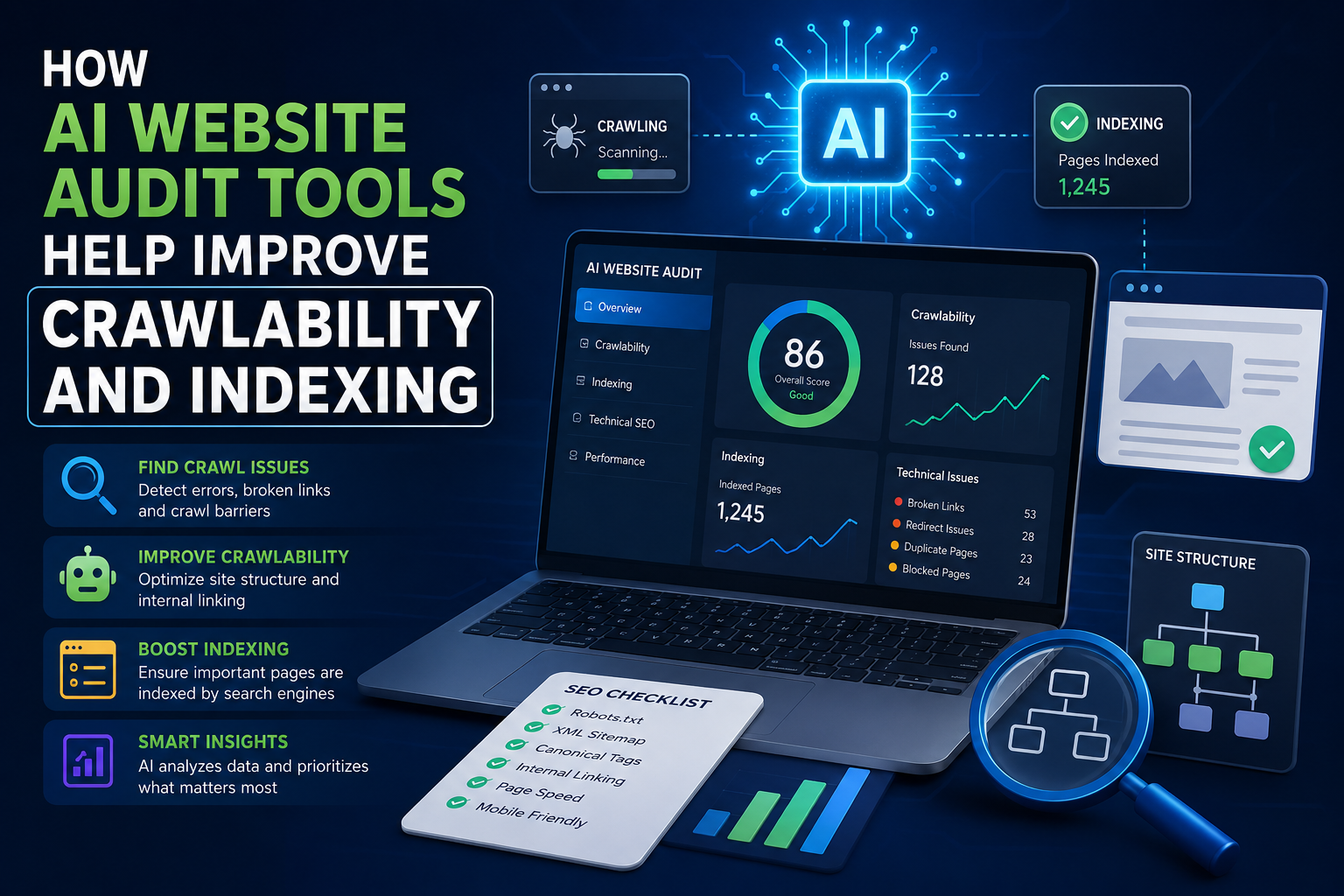
Search engines have become far better at understanding websites, but they still rely on one thing above everything else—efficient crawling and accurate indexing. If important pages cannot be discovered, or if search bots struggle to understand your site’s structure, even high-quality content can remain invisible in search results.
That is why many SEO professionals now rely on the best AI website SEO audit tool when reviewing technical performance. Instead of manually checking hundreds or even thousands of URLs, AI-powered systems analyse crawl paths, detect indexing barriers, identify duplicate content, and highlight technical issues within minutes. The goal isn’t to replace human expertise. It is to make technical analysis faster, more consistent, and easier to prioritise.
Understanding Crawlability and Indexing
Before fixing technical SEO issues, it helps to understand the difference between crawling and indexing.
Crawling is the process where search engine bots discover pages by following links.
Indexing happens after crawling, when search engines evaluate whether a page deserves to be stored in their database and shown in search results.
A website may have perfectly written content, yet still experience poor visibility because search engines never reach important pages or choose not to index them.
Some of the most common technical obstacles include:
- Broken internal links
- Incorrect robots.txt rules
- Missing XML sitemaps
- Duplicate pages
- Redirect chains
- Canonical tag conflicts
- Slow page loading
- JavaScript rendering issues
Finding these problems manually becomes increasingly difficult as websites grow.
How AI Changes Technical SEO Audits
Traditional audits often require moving between multiple SEO tools while exporting spreadsheets for analysis. AI introduces a different workflow by connecting technical signals and identifying patterns automatically.
Instead of simply listing hundreds of warnings, AI systems often group related issues together. For example, if dozens of pages remain unindexed because they share an incorrect canonical tag, the software recognises the pattern instead of presenting every page as an isolated problem.
This saves time while making technical priorities much clearer.
Another useful advantage is predictive analysis. Rather than only reporting current errors, some AI-driven platforms estimate which technical issues may have the greatest effect on crawl efficiency if left unresolved.
Identifying Crawl Barriers Faster
One practical advantage of AI audits is the ability to analyse massive websites without spending days reviewing reports manually. Whether managing an ecommerce store with thousands of product pages or a growing content website, AI can rapidly identify crawl budget waste, orphan pages, unnecessary redirects, duplicate URLs, and server response issues. These insights help technical teams focus on fixes that improve search engine accessibility instead of reviewing every page individually.
Detecting Indexing Problems Before Rankings Drop
Many websites lose traffic without realising that indexing issues appeared weeks earlier.
AI audit tools constantly monitor technical signals that influence indexing decisions, including:
- Pages blocked by robots directives
- Incorrect noindex implementation
- Soft 404 errors
- Duplicate content clusters
- Thin content pages
- Pagination issues
- Internal linking weaknesses
Instead of waiting until organic traffic falls, website owners can identify warning signs much earlier.
Imagine publishing twenty new blog posts. Everything appears normal.
A month later, only twelve are indexed.
Without monitoring, this problem could remain unnoticed. AI systems immediately flag missing indexed pages, making troubleshooting much easier.
AI Makes Internal Link Analysis Smarter
Internal links guide both users and search engine crawlers.
Unfortunately, many websites unintentionally create pages that receive almost no internal links. These are commonly called orphan pages.
AI-based audits evaluate the entire internal linking structure and identify pages that:
- Receive very few internal links
- Sit too deep within the website architecture
- Waste crawl budget
- Pass little internal authority
- Have inconsistent anchor text
Instead of counting links manually, AI visualises the relationship between pages, helping SEO professionals improve site architecture.
Prioritising Technical Fixes Instead of Chasing Every Warning
Not every technical issue deserves immediate attention.
One missing image alt attribute rarely has the same impact as thousands of redirected URLs or blocked category pages.
AI helps prioritise tasks based on overall technical importance.
For example, an audit might recommend addressing:
- Crawl errors affecting important pages
- Server response problems
- Duplicate canonical tags
- Broken internal links
- Large redirect chains
This structured approach allows teams to spend time where it creates measurable improvements rather than fixing low-priority warnings first.
Useful Metrics to Monitor During AI Audits
Running an audit is only the beginning.
Tracking changes over time provides a much clearer picture of technical SEO health.
Some valuable metrics include:
- Indexed page count
- Crawl depth
- Crawl errors
- Internal link distribution
- XML sitemap coverage
- Core Web Vitals
- Duplicate URL percentage
- Server response time
- Broken link count
Reviewing these metrics monthly helps identify trends before they become serious technical problems.
Human Expertise Still Matters
AI accelerates technical analysis, but it cannot replace critical thinking.
A tool may report hundreds of duplicate pages, yet only an experienced SEO specialist can determine whether those duplicates are intentional because of product variations, language versions, or filtering options.
The best results come from combining automation with human judgement.
Think of AI as an experienced assistant rather than the final decision-maker.
It collects evidence quickly.
You decide what deserves attention.
Final Thoughts
Technical SEO has become increasingly complex as websites expand and search engines refine their crawling systems. AI-powered audit platforms simplify that complexity by analysing large datasets, detecting hidden technical issues, and highlighting opportunities to improve crawlability and indexing before they affect organic performance. If you’re wondering how to audit your website fast without manually reviewing thousands of URLs, AI-assisted auditing offers a practical way to identify technical priorities while maintaining a structured and efficient optimisation process.