
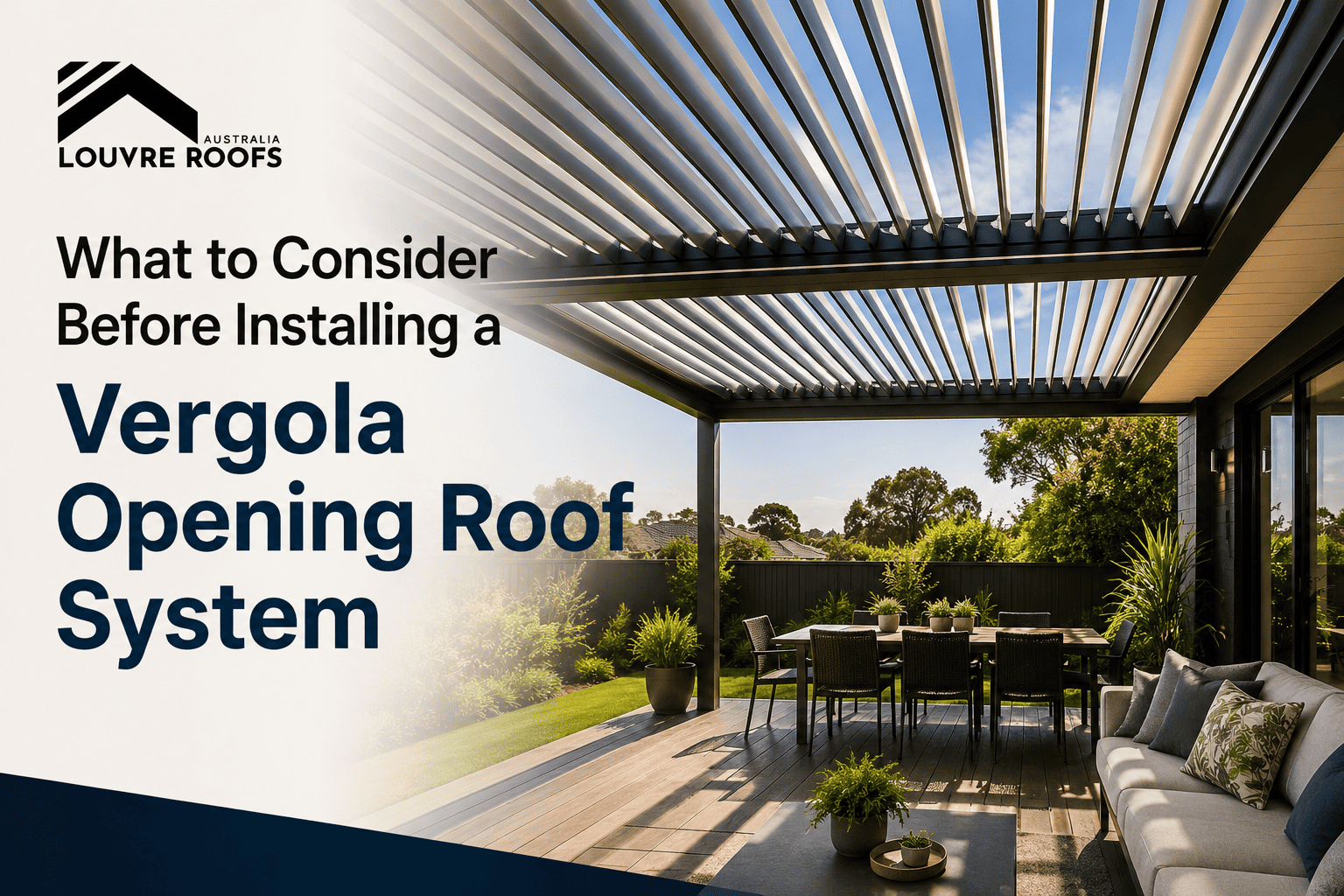
Wanting to turn your patio into a room for all seasons? You’re in luck! Across Australia householders are ditching solid pergolas for opening-closing and tilting roofs at the click of a remote, but before you go signing off on an vergola opening roof system, you need to understand the brutal realities about weatherproofing, materials, wind rating and council approvals that the slick brochures and glossy magazines are hiding from you.
This guide collates what the best installers and the local manufacturers are really saying, so you buy once and you buy correctly!
Understand What You’re Actually Buying
The words get thrown around interchangeably, but they aren’t the same.
Vergola Opening Roof System Basics
Vergola is an Australian brand, not an item; they use adjustable louvres constructed from BlueScope COLORBOND steel, which Vergola claims has a poor thermal conductivity, resulting in the area below staying cool in summer relative to an aluminium alternative. This steel is equipped with four coatings and is manufactured in accordance with AS1397 & AS/NZS 2728. Vergola asserts that their double-skin aerofoil louvres offer 99.9% weather protection while being able to support IBC hurricane-resistant loads.
How An Automatic Louvred Pergola Works
‘Motorised louvred pergolas’ is a more general term for any motorised roof that opens and closes the blades. Smartblade calls them ‘motorised louvres that tilt open and close, adapting to all weather conditions.’ The top-end systems all feature rain sensors that automatically close, integrated gutters and motors under 40 dB; therefore, they are whisper-quiet.
Key Considerations Before You Install
1. Climate And Wind Rating
Structures outdoors are really hammered in Australia and the conditions aren’t kind. Vergola says its roofing meets AS1562 (self-supporting metal roof) and AS1170.2 (wind loads) for tropical cyclone-strength winds. If you live near the coast or in a high-wind area, request an engineering certificate, not marketing jargon. For a completely automatic louvred pergola made of aluminium, specify marine grade AA6063-T6, water resistance of IP65 and greater than 60mph wind resistance for open sites.
2. Material Choice – Steel Vs Aluminium
Here’s the major division:
- Steel (Vergola): Much better insulation. Steel does not carry the same heat as aluminium. Known for Colorbond’s resistance to corrosion. Only drawbacks are the increased weight and the fact that steel can rust if the coating is damaged.
- Aluminium (all other systems): It’s lighter and is inherently resistant to corrosion and usually is powder-coated. The information from Smartblade shows that aluminium has superior resistance to corrosion compared to steel in coastal Sydney. Aluminium is a good conductor of heat and heat will radiate down to you from the roof of the Verandah.
Selection will depend on the distance from salt air and the intensity of afternoon sun the roof receives.
3. Waterproofing Reality Check
Not an opening roof is a tiled house roof. The pergola clearly stated it will not let water through during a normal steady rainfall, as louvres overlap when closed. It can still allow fine spray in during very heavy rainfall. And in a downpour, it can also leak through due to overflowed guttering. They also advised that low-angle, high-pressure spray may push water between the louvres. So if you require your outdoor kitchen to remain completely dry at all times, ensure you have sufficient flashing and drainage as well as the louvres themselves.
4. Size, Span And Engineering
Each Vergola bay reaches a limit of 5 metres in width and 3.6 metres in depth, and one controller can operate up to 15 bays. The structural integrity of larger spans will require additional motors and structural posts. The principle of thinking in terms of energy-efficient windows, Australia-style, suggests that the greater the span, the greater the deflection – always ensure structural engineers sign off.
5. Council Approval And Australian Standards
Your council will probably treat this as a Class 10a structure. It has to conform to National Construction Code requirements. If it’s attached to a new house in NSW then it has to meet BASIX criteria. Don’t just ask your installer for a price; make sure to request Form 15/16 certificates from them.
6. Power, Automation And Smart Features
Benefits of today’s systems:
- Rain sensor closes, then re-opens to 15 degrees for drainage
- Home automation and App control/timings
- LED’s & side screens
Confirm motor warranty – Louvre Roofs Australia’s 8-year guarantee exceeds most of the other brands, which only offer 3 years.
7. Installation And After-Sales
According to Vergola, it has its own planning permission and experienced sub-contractors and an in-house service department. This becomes important if the motor dies in year four of ownership. Find out who will repair it, not just who sold it to you.
Choose Control, Not Compromise
Vergola opening roof systems give you the internal-external adaptability that all Australians desire, but this depends on using the right material for your environment, being happy with the level of waterproofing and having the engineering done right. An automatic louvered pergola is an investment that will last – insist on the wind rating, warranty, and after-sales service in writing.
If you are looking for a no-hassle experience, then Louvre Roofs Australia should be on your list. This is a fully Australian-owned and operated company based in Cranbourne West, VIC, which specialises in custom-designed louvre roofs, offering an 8-year warranty on the motor and a 10 year product guarantee, taking care of the entire process from design to installation.