
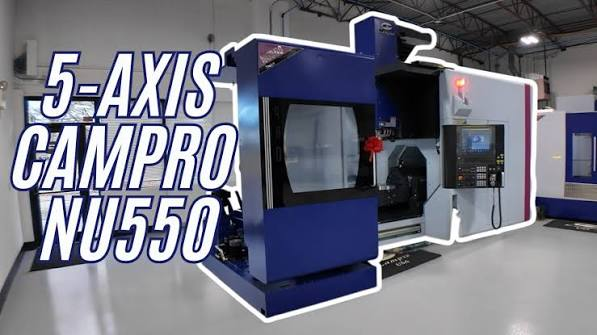
Modern machining environments increasingly demand tighter tolerances, faster cycle times, and the ability to manufacture complex components with fewer setups. For shops producing aerospace, automotive, medical, tooling, or high-precision industrial parts, a 5 axis vertical machining center can provide significant advantages by allowing the cutting tool to approach a workpiece from multiple directions within a single machining cycle.
Choosing the right machine, however, requires more than comparing spindle speed or table size. Rigidity, axis travel, control capability, tool capacity, workholding, chip evacuation, and long-term service requirements all affect real-world performance. Understanding these factors helps manufacturers select equipment that suits both current production demands and future growth.
1. Understand What 5-Axis Machining Actually Changes
Traditional three-axis machining moves the cutting tool along the X, Y, and Z axes. Five-axis machining adds two rotational axes, allowing either the workpiece or cutting tool to tilt and rotate.
This additional movement enables machining on multiple faces without repeatedly removing and repositioning the component. A 5 axis vertical machining center can therefore reduce setups when producing parts with angled holes, sculpted surfaces, deep contours, or complex geometries.
Fewer setups may also reduce opportunities for repositioning errors. This can be especially important when tolerances depend on the relationship between features machined on different sides of a component.
2. Compare Machine Rigidity Before Spindle Speed
Spindle specifications attract attention because faster rotational speeds can support higher cutting rates in suitable materials. However, a fast spindle cannot compensate for a machine structure that lacks rigidity.
Machine construction influences vibration, dimensional accuracy, surface finish, and tool life. Vertical machining systems may use either box-way or linear-guideway configurations. Box ways are generally associated with strong damping and rigidity, while linear guideways can support responsive, high-speed motion.
When evaluating a 5 axis vertical machining center, buyers should therefore consider base construction, column design, structural reinforcement, thermal stability, and the machine’s ability to absorb cutting forces.
3. Look Closely at Axis Travel and Work Envelope
A machine’s working envelope determines the maximum component size it can accommodate.
Axis travel should be evaluated together with rotary-axis clearance, spindle-to-table distance, fixture height, and tool length. A component may technically fit within the advertised table dimensions but still experience interference once it is tilted during five-axis machining.
This is one area where a CNC vertical machining center differs from a simple specification sheet. Real-world accessibility matters as much as nominal travel figures.
Manufacturers should review their largest expected workpieces and simulate likely tool orientations before selecting a machine.
4. Evaluate the Spindle for Your Materials
Different materials create different spindle requirements.
High-speed aluminum machining may benefit from elevated RPM and rapid material removal, while harder steels, titanium, and other difficult alloys may place greater importance on torque and structural rigidity.
Modern vertical machining systems can handle materials ranging from aluminum and brass to steel, titanium, and exotic alloys when appropriately configured.
A 5 axis vertical machining center should therefore be selected according to actual cutting requirements rather than simply choosing the highest spindle-speed specification available.
5. Check Tool Capacity and Automatic Tool Changing
Complex parts often require numerous tools during a single cycle.
Drills, end mills, ball-nose cutters, face mills, probes, and specialty tooling may all be required. An automatic tool changer with sufficient capacity reduces the need for manual intervention and makes longer unattended machining cycles more practical.
Tool-change speed also affects overall cycle time, especially on parts requiring frequent changes.
When comparing a vertical machining center, manufacturers should consider not only the number of tool positions but also maximum tool diameter, weight, length, and compatibility with the chosen spindle taper.
6. Consider Chip and Coolant Management
Chip removal becomes especially important during continuous or high-speed machining.
Accumulated chips can interfere with cutting, increase heat, damage surfaces, and contribute to premature tool wear. Effective chip augers or conveyors help remove debris from the machining area, while coolant systems manage temperature and flush material away from the cutting zone.
A 5 axis vertical machining center used for high-volume cutting should have chip-management capacity suited to the material being processed. Aluminum, for example, can generate large volumes of lightweight chips, while heavy roughing in steel creates different evacuation demands.
7. Review CNC Control and Programming Capability
Five-axis machining places greater demands on both control hardware and programming software.
The CNC must coordinate multiple axes simultaneously while maintaining accurate tool position and orientation. Features such as tool-center-point control, collision avoidance, workpiece probing, tool measurement, and advanced look-ahead can improve productivity and reduce programming risk.
CAM software is equally important. Complex toolpaths need reliable post-processing so that programmed movements correspond accurately with the physical machine configuration.
For this reason, investing in a 5 axis vertical machining center may also require evaluating existing software, programming skills, and operator training.
8. Think About Setup Reduction, Not Just Cutting Speed
One of the most important advantages of five-axis machining is often the reduction in setups rather than raw spindle speed.
A component that would normally require three or four separate fixtures may potentially be completed in one or two operations. This can reduce handling time, fixture complexity, and the cumulative error created when parts are repeatedly repositioned.
It may also improve consistency across production runs because more features are machined from the same reference setup.
These advantages can make five-axis equipment valuable even in applications where cutting speeds themselves are similar to those of conventional vertical machines.
9. Factor Maintenance Into the Buying Decision
Accuracy depends on regular maintenance.
Tool holders, lubrication systems, coolant, spindle condition, alignment, and workholding should all be monitored. Proper maintenance and high-quality tooling are also important for maintaining machining accuracy over time.
Five-axis systems add rotary components that may require additional inspection and calibration compared with simpler three-axis machines.
Manufacturers should therefore investigate preventive-maintenance requirements, replacement-part availability, technical support, and calibration procedures before making a purchase.
10. Match the Machine to Production Volume
A highly capable machine is not automatically the most economical choice for every shop.
Low-volume prototype work may prioritize flexibility and fast setup, while higher-volume production may place greater emphasis on automation, chip handling, pallet systems, tool capacity, and cycle-time consistency.
A 5 axis vertical machining center should be evaluated according to the types of parts being produced, material mix, tolerance requirements, expected annual hours, operator skill level, and potential future jobs.
The objective is to choose a machine whose capabilities will actually be used rather than paying for capacity that remains idle.
Conclusion
Selecting advanced machining equipment requires balancing precision, rigidity, spindle performance, axis travel, tooling, control capability, and operating requirements. A 5 axis vertical machining center can reduce setups, improve access to complex features, and support the production of intricate parts when its specifications are matched carefully to the intended application. For manufacturers comparing CNC machines in the USA, factors such as technical support, parts availability, training, machine configuration, and long-term service should be considered alongside initial purchase price. Ultimately, five-axis capability delivers the greatest value when it solves a specific production challenge. By evaluating part geometry, materials, tolerance requirements, software compatibility, and expected workload before purchasing, manufacturers can make a more informed equipment decision and avoid choosing a machine based on specifications alone.