
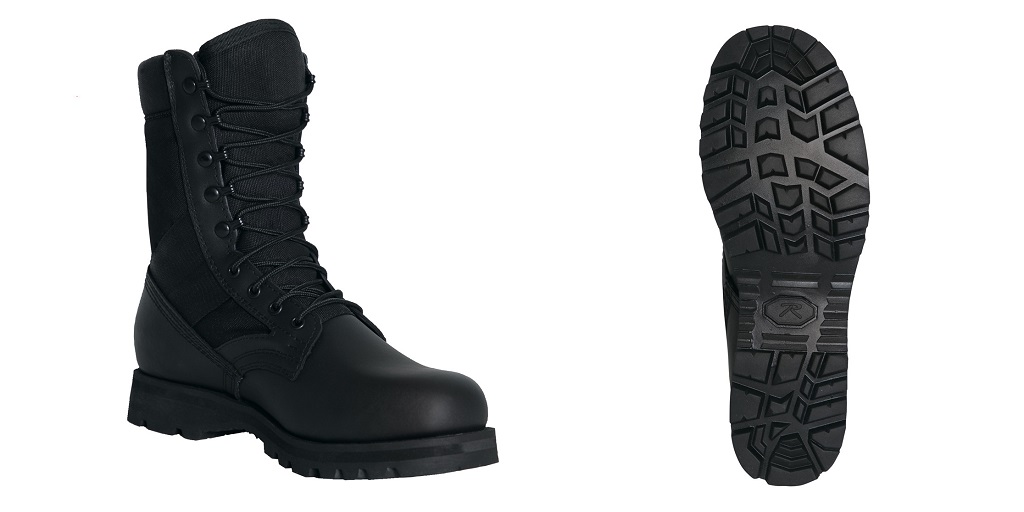
Sole type is one of the key indicators of the suitability for a boot for a given environment, based on the substrate.
Two of the most common types of boots are jungle boots and work boots, and the former pretty much all have lug soles whereas work boots are split.
Here’s what to know.
Jungle Boots and Work Boots
Jungle boots are a special type of boot that are meant to support a wearer in hot, wet forests, hence the name.
They tend to have quick-drying uppers made of vented ballistic nylon or a similar material. That way if the boot is immersed or waterlogged, it will shed excess water but dry out relatively quickly.
As a result, they are not suitable in cold environments.
Also, jungle boots tend to be made with lug soles, which offer better traction on mud and earth (more details to follow).
By contrast, work boots constitute a much broader class of boot that is intended to be used occupationally.
Work boots tend to have high shafts to protect the wearer’s ankles, along with sturdy leather or synthetic uppers that provide solid protection against high and low temperatures as well as chemical and physical threats.
For instance, work boots may be various puncture resistant, oil, gas and slip resistant, and electrical hazard rated.
Work boots also commonly have a steel or composite toe (though not always) which will protect against crush hazards. Additionally, they may or may not be insulated.
Work boots also can be made with wedge soles or lug soles, given the conditions where the work will be performed, and what the occupation entails.
Lug Soles vs. Wedge Soles
Wedge soles consist of wedge-shaped, fairly flat soles that are thicker at the heel and thinner by the toe. They are much more suitable on flat, level, finished surfaces.
As a result, many work boots intended for use on blacktop, cement, pavement, or interior floors tend to have wedge soles. They offer more surface area contact with a flat level surface and therefore better traction given those conditions.
In addition, wedge-soled work boots, since they have more surface area contact with the ground, will wear more slowly. They also tend to be more comfortable on those surfaces than boots with deep lug soles.
Given these considerations, many work boots for first responders, machinists, and others who work in urban or interior environments are made with wedge soles.
In contrast, work boots with lug soles have a deep tread pattern in the sole. This bites into mud and soft earth, and even wood, making lug soles much more suitable on uneven ground and unfinished surfaces, like mud, sand, dirt, gravel, or chips.
Lug soles bite into earth where wedge soles would slip over it. That is why logger boots, hunting boots, and work boots for those who work outdoors tend to have deep lug soles. It is also why jungle boots have lug soles as well.
Some work boots with lug soles may also have a stacked heel, which can also improve traction on soft earth conditions.
The downside is that lug soles actually offer less traction on a flat level surface and will wear more quickly on it as well. Therefore, jungle and work boots with lug soles are best for wearing outside. Leave the wedge sole to work boots that will be used on finished surfaces.
Here for a New Pair of Work or Jungle Boots?
In the market for a new pair of lug-soled boots or a pair of work boots with wedge soles? Check out what’s in stock at Fatigues Army Navy and get in touch with them if you are looking for something specific, they can help you out.
For More Information About Alice Pack and Concealed Carry Jacket Please Visit: Fatigues Army Navy & Surplus Gear Co.