
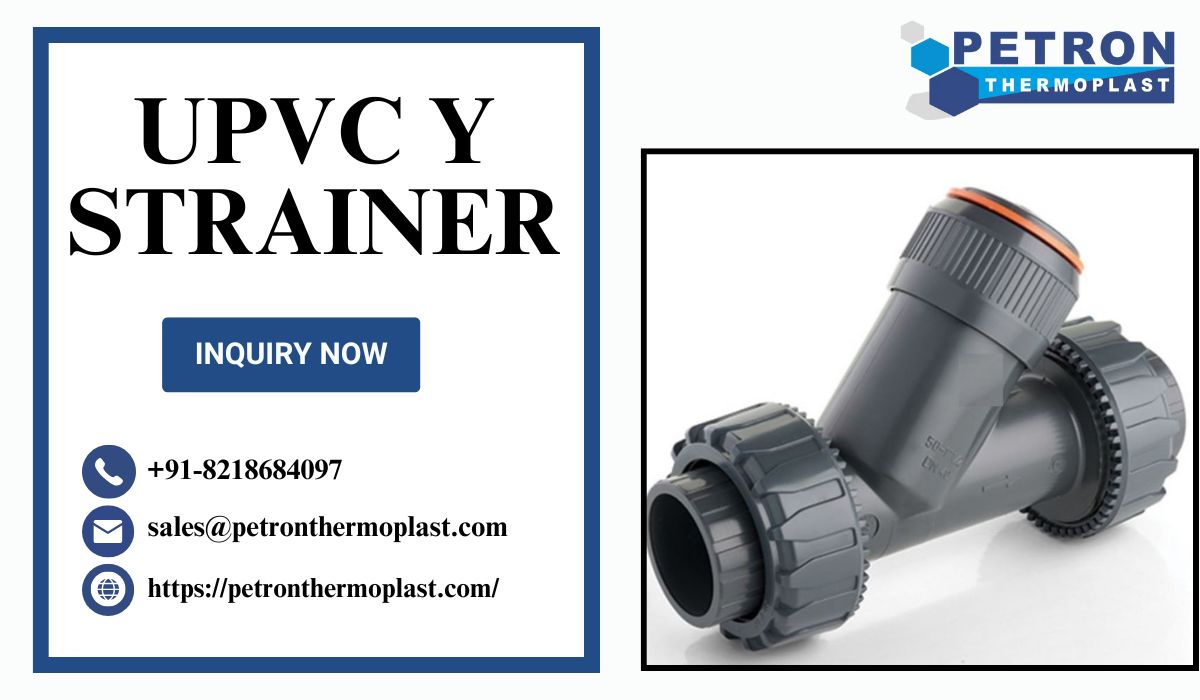
In modern industrial piping systems, ensuring clean, contaminant-free fluid flow is essential for operational efficiency and equipment protection. Industries dealing with water treatment, chemical processing, wastewater management, and irrigation systems are increasingly adopting UPVC Y strainers due to their durability, corrosion resistance, and ease of maintenance. As global industries evolve, so does the demand for products designed to meet international quality benchmarks. UPVC Y strainers stand out as a high-efficiency filtration solution that meets diverse industrial needs while complying with international standards such as ASTM, DIN, ISO, and other global norms.
This comprehensive blog explores the features, advantages, and applications of UPVC Y strainers, and highlights why these strainers are becoming the preferred choice for industries worldwide.
What Are UPVC Y Strainers?
A UPVC Y strainer is a filtration device used in piping systems to remove solid particles from liquids and gases. Its name comes from its “Y-shaped” body, which supports efficient debris collection without restricting flow. The strainer typically houses a perforated or mesh stainless steel screen positioned at an angle to filter out particles while allowing continuous fluid passage.
UPVC (Unplasticized Polyvinyl Chloride) is known for its high chemical resistance, lightweight nature, and long service life, making it an ideal material for manufacturing industrial-grade strainers. Because of these qualities, UPVC Y strainers are a preferred choice in corrosive, high-purity, or heavy-duty applications.
Designed to Meet International Quality Standards
Industrial companies require filtration components that are not only dependable but also compliant with stringent global standards. UPVC Y strainers are engineered to match a wide range of international quality codes, including:
✔ ISO Standards for Quality and Safety
Many UPVC Y strainers adhere to ISO guidelines ensuring product consistency, reliability, and safety during operation.
✔ ASTM Standards for Materials
ASTM standards ensure the UPVC material and metallic screens used in Y strainers provide resistance to pressure, temperature, and corrosion.
✔ DIN Standards for Dimensional Accuracy
Precision dimensional control ensures seamless integration with European-standard piping systems.
✔ RoHS Compliance
Eco-friendly manufacturing practices make UPVC Y strainers safe for industries requiring strict hazardous material restrictions.
The ability to meet these standards makes UPVC Y strainers adaptable for global industrial use, whether in Asia, Europe, the Middle East, or the Americas.
Key Features of International-Standard UPVC Y Strainers
UPVC Y strainers built for global markets incorporate advanced features that ensure long-term reliability and performance:
- High Corrosion Resistance
UPVC provides superior resistance to acids, alkalis, salts, and corrosive chemicals, making the strainers suitable for chemical processing and wastewater applications.
- Lightweight and Easy to Install
Compared to metal strainers, UPVC Y strainers are significantly lighter, allowing quick installation without requiring heavy lifting equipment.
- Precision Filtration
Available in multiple mesh sizes, these strainers efficiently remove particles, protecting pumps, flow meters, valves, and downstream equipment.
- Low Maintenance and Easy Cleaning
The Y-shape design allows easy removal of the filter screen for cleaning, reducing downtime and improving operational efficiency.
- Pressure and Temperature Durability
Though lightweight, UPVC Y strainers can handle moderate to high operating pressures and temperatures commonly found in industrial systems.
- Cost-Effective
UPVC strainers offer long service life at a fraction of the cost of stainless steel or alloy strainers.
- Long-Term Reliability
Their resistance to scaling, rusting, and chemical degradation ensures stable performance over years of continuous operation.
Industrial Applications of UPVC Y Strainers
Thanks to their global-standard build and versatile capabilities, UPVC Y strainers are used across nearly every major industry. Some key applications include:
✔ Water Treatment Plants
Removes dirt, rust, and particles before water enters pipelines, pumps, or treatment units.
✔ Chemical Process Industries
Ideal for handling aggressive chemicals that would corrode metal strainers.
✔ Irrigation and Agriculture
Filters suspended solids to protect drip and sprinkler systems from clogging.
✔ Pharmaceutical Manufacturing
Ensures purity and eliminates particulate contamination in sensitive processes.
✔ Food and Beverage Facilities
Used in cleaning systems, fluid handling, and wastewater management.
✔ Marine and Offshore Applications
Highly resistant to saltwater corrosion, making them suitable for desalination plants and marine systems.
✔ HVAC and Cooling Systems
Protects chillers, cooling towers, and heat exchangers by filtering solid impurities.
✔ Sewage and Effluent Management
Ensures debris removal in wastewater processing units to prevent equipment blockage.
The versatility, safety, and durability of UPVC Y strainers make them indispensable in any environment where fluid contamination must be controlled.
Why UPVC Y Strainers Are Preferred in International Markets?
Industries across the globe choose UPVC Y strainers because of several competitive advantages:
✔ Trusted Worldwide Performance
Their reliability in diverse temperature and chemical conditions makes them a popular choice for global industries.
✔ Compatibility with Worldwide Piping Standards
Available in multiple standard sizes matching international pipeline dimensions, ensuring seamless integration.
✔ Lower Operating Costs
Reduced maintenance, fewer breakdowns, and long service life lower the total cost of ownership.
✔ High Chemical Compatibility
Ideal for corrosive fluids where metal strainers fail or degrade quickly.
✔ Eco-Friendly Manufacturing
UPVC is recyclable, helping industries meet sustainability goals.
How to Select the Right UPVC Y Strainer for Your Application?
When choosing a UPVC Y strainer that complies with international standards, consider the following factors:
- Mesh Size
Choose a mesh size based on the type of particles you need to remove.
- Pressure Rating
Ensure the strainer supports the operating pressure of your piping system.
- Chemical Compatibility
Verify that the UPVC material is suitable for the chemicals in the fluid stream.
- End Connection Type
International designs come with socket, threaded, or flange ends.
- Flow Direction and Installation Location
Proper installation ensures maximum filtration efficiency and minimal pressure drop.
Choosing the right configuration ensures optimal performance, longevity, and compliance with industry standards.
Conclusion
UPVC Y strainers built for international quality standards have become essential components in modern piping systems across industries. Their unmatched chemical resistance, cost-effectiveness, lightweight structure, and ease of maintenance make them a preferred filtration solution for global operations. As industries continue to demand higher efficiency and reliability, UPVC Y strainers stand out as a product that delivers consistent performance under varied environmental and operational conditions.
Manufacturers like Petron Thermoplast are at the forefront of producing world-class UPVC Y strainers that meet the expectations of global industries. With a commitment to quality, precision, and international compliance, they continue to support industries worldwide in building efficient, safe, and reliable piping systems.